
Multiplying
How to use the binomial expansion calculator
- Type the binomial in brackets, then the power. For example
(x + 2)^5,(2x - 3)^4or(x^2 - 2y)^3. Terms can be numbers, letters with powers, fractions like1/2, or reciprocals like1/x. - Read the expansion in the dark panel. Under it you’ll see how many terms there are and what the coefficients add up to.
- Find one term by typing its position in the second box. Type 3 for the third term and the calculator works it out on its own and highlights it in the table.
- Check the triangle. The highlighted row of Pascal’s triangle holds the coefficients before the numbers inside the brackets change them.
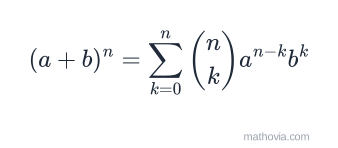
The binomial theorem
Read it as a recipe. There are
Worked example: (x + 2)⁵
This is the calculator’s opening example.
Step 1 — the pieces.
Step 2 — the coefficients. Row 5 of Pascal’s triangle is 1, 5, 10, 10, 5, 1.
Step 3 — build each term. The powers of
Step 4 — simplify.
A quick check: put
When the second term is negative
Write the binomial as
The signs alternate because odd powers of
Finding one term without expanding everything
Exams love “find the 3rd term” or “find the coefficient of
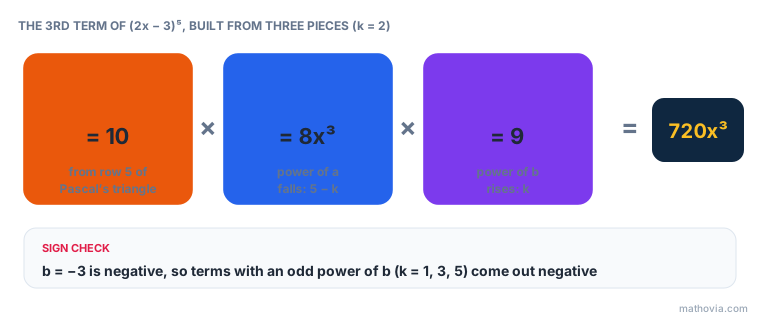
Note the off-by-one: the 3rd term uses (2x - 3)^5 and 3 in the term box to see
The constant term
For (x + 1/x)^6 example to see it sitting in the middle of the expansion.
Expanding with fractions
Fractions follow exactly the same pattern; they just make the arithmetic slower by hand. For
The calculator keeps every coefficient as an exact fraction, so you’ll see (1/2 + x)^3.
Pascal’s triangle and the coefficients
Each row of Pascal’s triangle starts and ends with 1, and every other entry is the sum of the two above it. Row
| n | Pascal row | |
|---|---|---|
| 2 | 1, 2, 1 | |
| 3 | 1, 3, 3, 1 | |
| 4 | 1, 4, 6, 4, 1 | |
| 5 | 1, 5, 10, 10, 5, 1 | |
| 6 | 1, 6, 15, 20, 15, 6, 1 |
Two things to notice. Each row is symmetric, so you only ever need to work out half of it. And each row adds up to
Where binomial expansions are useful
- Quick approximations. Write
as . The first three terms give , which is . The true value is 1.12616, so three terms already get you four significant figures. Compound interest estimates work the same way. - Probability. The coefficients count outcomes:
is the number of ways to get exactly 7 heads in 10 coin flips. The binomial distribution calculator builds on exactly this. - Algebra and calculus. Expanding
is the first step in finding the derivative of from the definition.
Common mistakes
- Forgetting to raise the coefficient.
, not . - Dropping the sign of
. In , use every time. - Off-by-one on the term number. The
th term uses . - Using row
of Pascal’s triangle. The top row is row 0, so uses the row that starts 1, 5. - Expanding
as . The middle terms are the whole point; is , not .
Ready to try some by hand? The binomial theorem practice problems cover full expansions, single terms and constant terms, with answers checked as you type.