
A two-step equation is the first real puzzle in algebra: something has been done to a number twice, and you have to work backwards to find it. Most students can get to the answer with some guessing, but the method behind it, undoing operations in reverse order, is what every later equation depends on. This calculator shows that method for any equation you type, with each step written out and the answer checked at the end.
What counts as a two-step equation
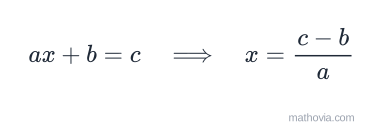
The general form is ax + b = c: the variable is multiplied by one number and then has another added (or subtracted). Each operation needs to be undone, so there are two steps. The same idea shows up in several disguises:
| Form | Example | Undo first | Then | Answer |
|---|---|---|---|---|
| ax + b = c | 3x + 5 = 20 | subtract 5 | divide by 3 | x = 5 |
| x/a + b = c | x/4 − 2 = 6 | add 2 | multiply by 4 | x = 32 |
| −ax + b = c | −2x + 7 = 15 | subtract 7 | divide by −2 | x = −4 |
| (x + b)/a = c | (x + 3)/4 = 5 | multiply by 4 | subtract 3 | x = 17 |
| a(x + b) = c | 2(x + 3) = 14 | divide by 2 | subtract 3 | x = 4 |
| c = ax + b | 5 = 2x − 3 | add 3 | divide by 2 | x = 4 |
Notice the fourth and fifth rows. When brackets or a fraction bar group the addition with the variable, the order flips. The rule isn’t “always subtract first”. It’s “undo the last thing that was done to the variable first”.
How to solve a two-step equation (step by step)
The calculator opens on 3x + 5 = 20. Read it as a story: start with x, multiply by 3, add 5, and you get 20.
Step One: Undo the addition or subtraction
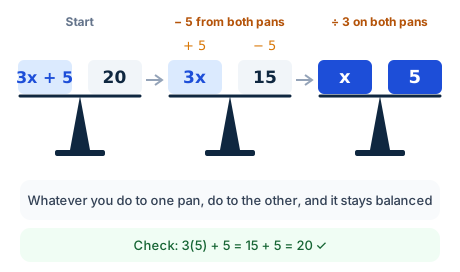
5 was added last, so take it away first, from both sides so the equation stays balanced.
3x + 5 = 20
3x + 5 − 5 = 20 − 5
3x = 15
Step Two: Undo the multiplication or division
x was multiplied by 3, so divide both sides by 3.
3x ÷ 3 = 15 ÷ 3
x = 5
Step Three: Check the answer
Put x = 5 back into the original equation. If both sides match, you’re done.
3(5) + 5 = 15 + 5 = 20 ✓
Under the answer, the calculator draws this as a function machine: x goes through × 3 and then + 5 to make 20, and you walk back through − 5 and ÷ 3 to get from 20 to 5.
Why you undo in reverse order
Think of putting on socks and then shoes. To get back to bare feet you take the shoes off first, then the socks. An equation works the same way. The expression 3x + 5 means “multiply first, add second” (that’s the order of operations), so solving means “subtract first, divide second”.
The linear equations lesson explains why doing the same thing to both sides keeps an equation true, which is what makes every step here legal.
Two-step equations with fractions and decimals
Fractions look harder but follow exactly the same pattern. The only new move is multiplying by a reciprocal instead of dividing by a fraction.
(2/3)x + 1 = 5
(2/3)x = 4          subtract 1
x = 4 × 3/2 = 6     multiply by 3/2, the reciprocal of 2/3
Decimals work the way you’d expect. The calculator keeps decimals in the steps if you type them:
0.5n − 1.2 = 3.8
0.5n = 5            add 1.2
n = 10              divide by 0.5
A two-step equation from real life
A plumber charges a $45 call-out fee plus $30 an hour. Your bill comes to $135. How many hours did the job take?
30h + 45 = 135
30h = 90            subtract the call-out fee
h = 3               divide by the hourly rate
Almost every “flat fee plus a rate” problem, from taxi fares to phone plans to gym memberships, turns into a two-step equation like this one. For more of these, the algebra equation generator makes fresh problems to solve with answers you can check.
Turning words into a two-step equation
Most two-step equations in homework arrive as sentences. The trick is to translate them one phrase at a time, with “is” becoming the equals sign:
| Words | Equation | Answer |
|---|---|---|
| Five more than three times a number is 20. | 3x + 5 = 20 | x = 5 |
| A number divided by 4, minus 2, is 6. | x/4 − 2 = 6 | x = 32 |
| Twice the sum of a number and 3 is 14. | 2(x + 3) = 14 | x = 4 |
| Seven less than a number, divided by 2, is 9. | (x − 7)/2 = 9 | x = 25 |
Watch the difference between “three times a number, plus five” and “three times the sum of a number and five”. The second one, 3(x + 5), groups the addition first, which changes both the equation and the order you undo it in. “Less than” also trips people up: “seven less than a number” is x − 7, not 7 − x.
Once the sentence is an equation, paste it into the calculator to check your algebra.
When there are more than two steps
Some equations need extra steps before they look like ax + b = c. The calculator handles these too and labels them as multi-step:
- Variables on both sides. In 3x + 4 = x − 6, subtract x from both sides to get 2x + 4 = −6, then solve as normal: x = −5.
- Terms to combine. 3x + 5 = 20 + x + x simplifies to 3x + 5 = 2x + 20 first.
- More layers. (2x − 1)/3 + 4 = 9 takes four inverse operations: subtract 4, multiply by 3, add 1, divide by 2, giving x = 8.
If the variable cancels completely, you get either a false statement (no solution) or a true one (every number works).
Common mistakes with two-step equations
- Doing something to only one side. Every operation has to happen on both sides, or the balance breaks.
- Dividing before subtracting in ax + b = c. You can, but then you must divide every term: (3x + 5)/3 = 20/3 is correct but messier.
- Losing a negative sign. In −2x = 8, divide by −2, not 2. The answer is −4. The integer calculator walks through the sign rules if they’re shaky.
- Subtracting first when the addition is inside brackets. In (x + 3)/4 = 5, the 3 is stuck inside the fraction, so multiply by 4 first.
- Skipping the check. Substituting takes ten seconds and catches nearly every arithmetic slip.