Mathovia

Math / Algebra

System of Equations Calculator

Type two or three linear equations and get the exact solution with the working written out. Switch between substitution, elimination, Cramer's rule and Gauss-Jordan to see the same answer reached four different ways. Two-equation systems are graphed too.

Use x and y. Fractions, decimals and brackets are fine: 1/2x, 0.5y, 2(x + y) = 14, y = 3x − 4.

One solution

x = 3,y = 2

(3, 2)

  1. Start with the system2x + 3y = 12x − y = 1
  2. Eliminate x: multiply equation 2 by 2, then subtract the second result from the first2x + 3y = 122x − 2y = 25y = 10
  3. Solve for yy = 2
  4. Substitute y = 2 into equation 12x + 6 = 12x = 3
  5. Check in every original equation2x + 3y = 12: left side = 12 ✓x − y = 1: left side = 1 ✓
xygrid step 1
━ equation 1 ╍ equation 2
Written by
MPhil in Mathematics, Founder of Mathovia
Published

Mathematics verification: Mathematical formulas, calculations, worked examples and solutions are reviewed for accuracy before publication. How we check our work

Most algebra students meet systems of equations as a puzzle with two unknowns and two clues: tickets and money, coins and value, two phone plans and the month they cost the same. Solving one by hand isn’t hard, but it’s fiddly. One dropped minus sign in an elimination step and the whole answer moves. This system of equations calculator does the arithmetic exactly and shows every step, so you can check your own working line by line, or see how a method you haven’t tried yet would handle the same problem.
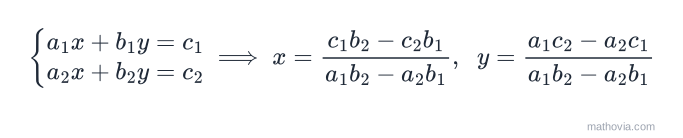
The general system a1 x + b1 y = c1 and a2 x + b2 y = c2 has solution x = (c1 b2 − c2 b1) / (a1 b2 − a2 b1) and y = (a1 c2 − a2 c1) / (a1 b2 − a2 b1)
Every 2 × 2 linear system with one solution follows this formula

How to use the system of equations calculator

  1. Choose 2 or 3 equations. Two equations use and ; three use , and .
  2. Type each equation the way you’d write it: 2x + 3y = 12, y = 2x − 1 or 2(x + y) = 14. They don’t need to be in standard form.
  3. Pick a method from the tabs: substitution, elimination, Cramer’s rule or Gauss-Jordan.
  4. Read the result, then the numbered steps, then the check. With two equations, the graph shows both lines and the point where they cross.

What you can type

You typeThe calculator readsNotes
2x + 3y = 12standard form
y = 2x − 1rearranged for you
1/2x + y = 3fractions stay exact
0.5x − y/4 = 2decimals and division by a number
2(x + y) = 14brackets are expanded
x + 2 = 3yvariables on both sides

Anything that isn’t linear, such as , or dividing by a variable, gets a clear error message instead of a wrong answer.

Worked example: solving a system with steps

The calculator opens on this system:

Here’s what the elimination tab shows, step by step.

Step 1 — make the -coefficients match. Multiply the second equation by :

Step 2 — subtract it from the first equation. The -terms cancel:

Step 3 — back-substitute into the first equation:

Step 4 — check both equations: ✓ and ✓.

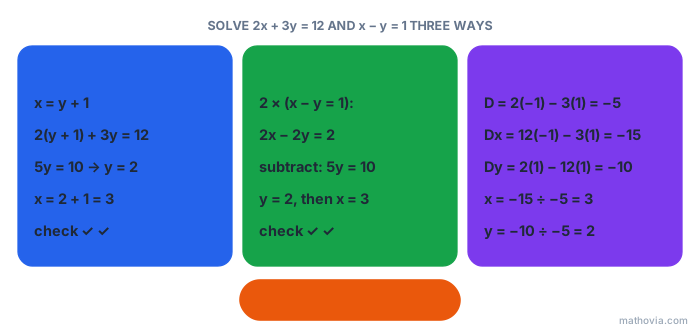
The solution is . Switch to the substitution or Cramer’s rule tab and the working changes completely, but the answer doesn’t:

The system 2x + 3y = 12 and x − y = 1 solved three ways: by substitution, by elimination and by Cramer's rule with determinants D = −5, Dx = −15 and Dy = −10, all giving the same answer (3, 2)
Three methods, three very different-looking pages of working, one answer

Four methods, one answer

MethodHow it worksUse it when
Substitutionsolve one equation for a variable, plug it into the othera variable is already alone, or has coefficient
Eliminationscale the equations so a variable cancels when you add or subtractboth equations are in standard form
Cramer’s ruledivide determinants: , you want a formula, or need just one variable
Gauss-Jordanrow-reduce the augmented matrixthree or more variables, or you’re learning matrices

Cramer’s rule is the formula in the picture at the top of this page. For two equations, the determinant is . Replace the -column with the constants to get , and the -column to get . If , the formula would divide by zero. That’s the algebra’s way of saying the lines are parallel or identical, so there isn’t exactly one solution.

Solving a system of 3 equations with 3 variables

Switch to three equations and the calculator opens on

The elimination tab removes twice. Subtracting the second equation from the first gives , and adding the first and third gives . That’s an ordinary two-variable system, which solves to , , and back-substituting gives . The Gauss-Jordan tab does the same work on the augmented matrix and shows the matrix after every row operation. It’s a good way to see what ”” actually does to the numbers. The three-variable systems lesson explains the strategy in more detail.

When there’s no solution or infinitely many

Not every system has exactly one answer, and the calculator tells you which case you’ve got:

ResultWhat the steps end withOn the graph
one solutiona value for every variablethe lines cross once
no solutiona false statement, like parallel lines
infinitely many solutionsa true statement, like the same line twice

Try the examples y = 2x + 3 and 4x − 2y = 5. The -terms cancel during substitution, leaving , so there’s no solution. With x + 2y = 4 and 2x + 4y = 8 the second equation is just the first one doubled. The calculator reports infinitely many solutions and gives the general solution , . Each value of gives one point on the line.

Common mistakes the calculator helps you catch

  • Sign slips when subtracting equations. Subtracting means adding . Compare your line with the calculator’s at the step where they first differ.
  • Multiplying only part of an equation. Scaling by changes the too.
  • Stopping after one variable. The answer to a two-variable system is an ordered pair. The check step only passes when both values are right.
  • Misreading “no solution”. If your own working ends in , you haven’t made a mistake. That’s the correct conclusion.

If you’d rather learn the methods than check them, start with systems of linear equations, which explains what a solution is and why there can only be one, none, or infinitely many. Then work through the systems of equations word problems, where setting up the equations is the real challenge, and use this calculator to check each answer.

Frequently Asked Questions

How does the system of equations solver show its work?+

It writes out every step the chosen method needs: which equation is solved for which variable, what each equation is multiplied by, which rows are added, and the back-substitution at the end. It then substitutes the answer into every original equation as a check.

Can it solve a system of 3 equations with 3 variables?+

Yes. Switch to 3 equations and enter them in x, y and z. You can solve by elimination (eliminating one variable twice), by Cramer's rule with 3 × 3 determinants, or by Gauss-Jordan elimination on the augmented matrix.

Which method should I choose?+

They all give the same answer. Substitution is quickest when a variable is already alone, like y = 2x − 1. Elimination suits equations in standard form. Cramer's rule is a formula you can apply without thinking about strategy, and Gauss-Jordan is what you'd use for larger systems or on a graphing calculator.

What does it mean when the calculator says no solution?+

The equations contradict each other. For two equations the lines are parallel, so they never cross. The working ends in a false statement such as 0 = 11.

What does infinitely many solutions mean?+

The equations describe the same line (or, with three variables, planes that share a whole line). The working ends in a true statement such as 0 = 0, and the calculator gives a general solution in terms of a parameter t.

Can I enter fractions, decimals and brackets?+

Yes. 1/2x, 0.5y, x − y/2 = 1 and 2(x + y) = 14 all work, and the answer is kept exact, so 1/3 stays 1/3 instead of turning into 0.3333. Equations don't need to be in standard form: y = 3x − 4 is fine.

Can it solve nonlinear systems, like y = x² and y = x + 2?+

No, this calculator handles linear equations only, and it will say so if a term like x² or xy appears. Nonlinear systems are usually solved by substitution, which the nonlinear systems lesson walks through.

Learn and practice this topic

Related calculators