
An arithmetic sequence adds the same amount every time: 3, 7, 11, 15, and so on, up by 4 each step. Finding the 10th term is easy enough to do in your head. The 250th term, or the total of the first 80 terms, is where a formula earns its keep, and that’s what this calculator handles. It finds any term, adds up as many terms as you like, and writes the sequence’s explicit and recursive formulas, working from whatever you happen to know about the sequence.
How to use the arithmetic sequence calculator
- Pick what you know. “First term and difference” takes
and . “From a list of terms” takes the start of the sequence, like 5, 8, 11, 14. “From two terms” takes any two terms and their positions. - Enter n, the term you want. The calculator also adds up the first
terms. - Optionally, enter a value in “Find the position of” to see whether it’s in the sequence and where.
- Read the results:
, , both formulas, a plot of the first 12 terms and every step of the working.
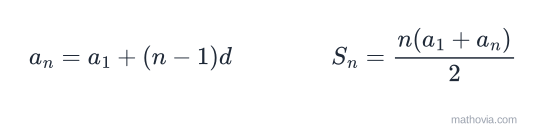
The arithmetic sequence formulas
The first formula says that to reach term
Worked example: a₁ = 3, d = 4
These are the calculator’s default inputs.
Step 1 — the nth term formula.
Step 2 — the 10th term.
Step 3 — the sum of the first 10 terms.
You can check the sum by hand: 3 + 7 + 11 + 15 + 19 + 23 + 27 + 31 + 35 + 39 = 210. The simplified formula
Working from a list of terms
Type the first few terms and the calculator finds 5, 8, 11, 14, the difference is 3 and the formula is
That makes “which term is 62?” a one-line equation:
So 62 is the 20th term. Try 60 instead and you get
Working from two terms
Sometimes you’re given two terms that aren’t next to each other, like
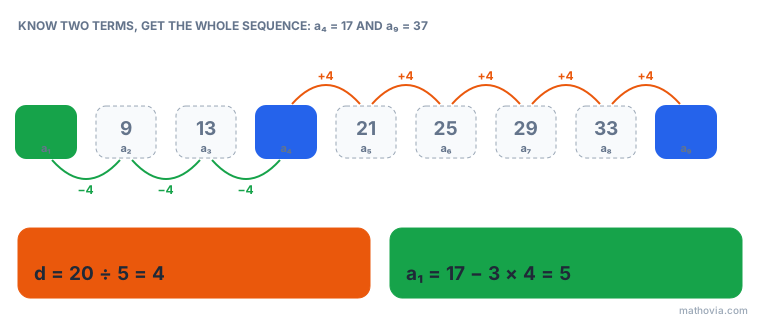
From position 4 to position 9 is five steps, covering
Decreasing sequences and fractions
Nothing changes when the difference is negative or a fraction, but these are the cases where mistakes creep in, so it’s worth seeing them once.
A decreasing sequence. For 50, 46, 42, 38, …, the difference is
The terms pass zero between the 13th (2) and the 14th (−2), and the negative terms at the end eat into the total. That’s why the sum is smaller than you might guess from the first few terms.
Fractions. For 1/2, 5/6, 7/6 to see it.
Arithmetic sequence formulas at a glance
| To find | Formula | Example ( |
|---|---|---|
| any term | ||
| common difference | ||
| sum of | ||
| sum without the last term | ||
| position of a value | 39 is term 10 | |
| recursive form |
Where arithmetic sequences show up
Anything that changes by a fixed amount per step is an arithmetic sequence. A theater with 22 seats in the first row and 3 more in each row after it has
Common mistakes
- Using
instead of . is , not . - Getting the sign of
wrong. For 50, 46, 42, … the difference is . Always subtract a term from the one after it. - Dividing by the wrong gap. From
to is 5 steps, not 9 or 4. - Assuming a pattern is arithmetic. 1, 4, 9, 16 has differences 3, 5, 7, so no single
works. - Mixing up
and . One is a single term; the other is a total.
For the full explanation, see the arithmetic sequences lesson, and when you want to test yourself, the arithmetic sequences practice problems check each answer as you go.