
What pH really is
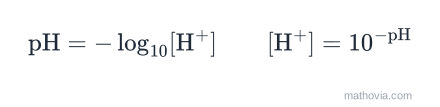
pH is a compressed way of writing the hydrogen ion concentration of a solution. Those concentrations range over more than fourteen orders of magnitude — from about 1 mol/L in a strong acid down to
Because the scale is logarithmic, the differences aren’t linear. A drop of one pH unit is a tenfold rise in acidity; a drop of three units is a thousandfold. This is why neutralizing a strongly acidic waste stream takes so much base, and why small pH shifts in blood or seawater are a big deal.
This calculator runs both ways: a hydrogen ion concentration in, pH and pOH out; or a pH in, and the matching [H⁺] and [OH⁻] out.
The pH formulas
The pH + pOH = 14 relationship holds at 25°C, where water’s ion product
Worked example
The calculator’s default is [H⁺] = 0.001 mol/L.
Running the reverse default, pH = 7:
which is exactly neutral — [H⁺] equals [OH⁻].
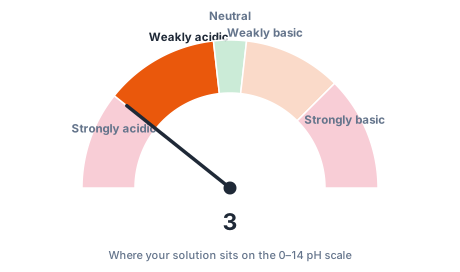
The pH scale in context
| pH | [H⁺] (mol/L) | Example |
|---|---|---|
| 0 | 1 | battery acid |
| 2 | 0.01 | lemon juice, stomach acid |
| 3 | 0.001 | vinegar, cola |
| 5.5 | 3 × 10⁻⁶ | clean rain |
| 7 | 10⁻⁷ | pure water |
| 7.4 | 4 × 10⁻⁸ | human blood |
| 8.3 | 5 × 10⁻⁹ | seawater, baking soda solution |
| 12 | 10⁻¹² | bleach, ammonia |
| 14 | 10⁻¹⁴ | drain cleaner |
Where pH calculations are used
- Titration analysis — converting an endpoint [H⁺] to a reported pH, or predicting a titration curve.
- Buffer design — the Henderson–Hasselbalch equation gives pH from a weak acid’s pKa and its conjugate base ratio.
- Water treatment and aquariums — dosing acid or base to hit a target pH, where the log scale sets how much is needed.
- Biology and medicine — enzyme activity, blood gas analysis, and soil chemistry all track pH.
Common mistakes
- Treating the scale as linear. pH 4 to pH 2 is a hundredfold change, not “twice as acidic.”
- Assuming neutral is always pH 7. It shifts with temperature.
- Using concentration instead of activity for very concentrated solutions, where the two diverge.
For solution concentrations feeding into a pH calculation, see the molarity calculator; for buffer work, the buffer solution calculator.
pH of strong acids and bases
Strong acids and bases dissociate completely, so the concentration you mixed is the ion concentration you use.
- 0.025 M HCl:
, so . - 0.010 M NaOH:
, so and . - 0.005 M Ca(OH)₂: each formula unit releases two hydroxide ions, so
and the pH is again 12.00.
The third case is the one people miss. Count how many H⁺ or OH⁻ ions each formula unit releases before taking the log. Weak acids such as acetic acid only partly dissociate, so they need the acid’s
Going from pH back to concentration
Use the
Significant figures in pH
The digits after the decimal point in a pH match the significant figures in the concentration. 0.0025 M has two significant figures, so its pH is written 2.60, not 2.6 or 2.602. The whole-number part of the pH only sets the power of ten, so it doesn’t count.