
If
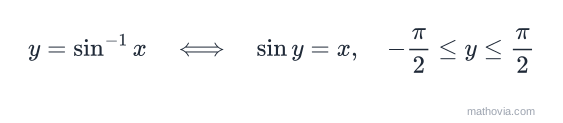
Why the Domain Has to Be Restricted
A function only has an inverse if it’s one-to-one: each output comes from a single input. Sine fails that badly.
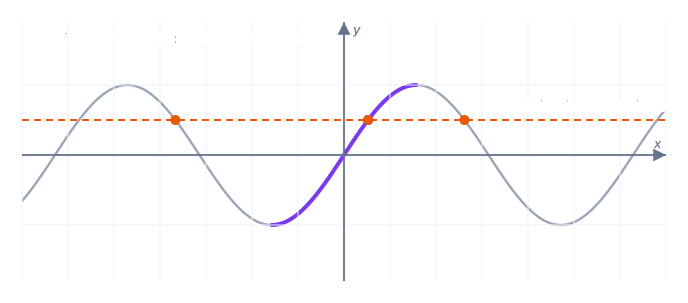
The fix is to keep just one piece of the curve that takes every value once. For sine, the standard choice is
Cosine and tangent get their own intervals, chosen so that the inverse is continuous and covers every value.
Why doesn’t cosine use the same interval as sine? On
The Three Main Inverse Trig Functions
| Function | Also written | Domain | Range (the angles it returns) |
|---|---|---|---|
| arcsin | |||
| arccos | |||
| arctan | all real numbers |
The domain of arcsin and arccos is
Graphs of the Inverse Trig Functions
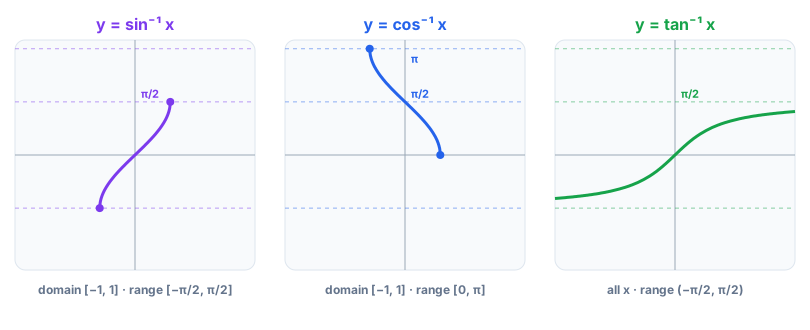
Each graph is the reflection of the restricted trig graph across the line
How to Evaluate Inverse Trig Functions
Ask: which angle in the range has this sine, cosine or tangent? Use the exact values from the trigonometric functions lesson.
Example 1: Exact Values
Both answers lie in
Example 2: Negative Inputs
Negative inputs are where the ranges matter most: arcsin and arctan give negative angles for negative inputs, while arccos gives an angle in the second quadrant.
Compositions
Undoing Each Other, With a Catch
because arcsin can only return angles between
Mixing Functions With a Triangle
To find something like
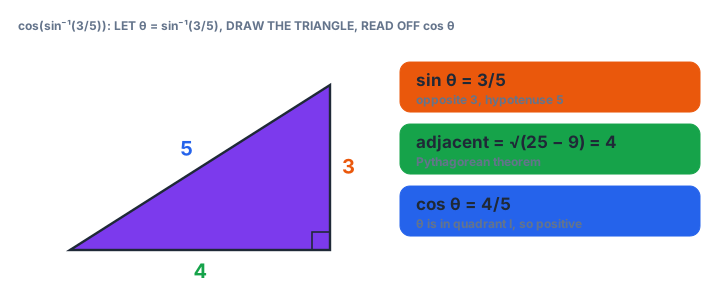
Let
Inverse Trig Functions on a Calculator
The
The Other Three Inverse Functions
Arcsecant, arccosecant and arccotangent exist too, though you’ll meet them far less often. They’re usually defined through the main three, for example
so
Inverse Trig Functions in Calculus
Their derivatives are algebraic, with no trig left in them:
Reading those backwards is what makes them so useful: an integral of
Common Mistakes to Avoid
- Reading
as . That’s . - Giving an answer outside the range.
is , not . - Assuming
always. It’s only true for in . - Taking arcsin of a number outside
. There’s no answer. - Using degree mode. In calculus, inverse trig answers are in radians.
Practice Problems
Work each one before opening the answer.
Problem 1. Evaluate
Show answer
The angle in
Answer:
Problem 2. Evaluate
Show answer
Answer:
Problem 3. Evaluate
Show answer
Answer:
Problem 4. Evaluate
Show answer
The angle in
Answer:
Problem 5. Evaluate
Show answer
Answer:
Problem 6. Find
Show answer
Opposite 3, adjacent 4, so the hypotenuse is 5 and
Answer:
Inverse trig functions give one angle. Solving a trig equation means finding all of them, which is the last lesson of this review chapter.