
Populations, investments, viral posts and bacteria cultures all grow the same way: by a percentage of what’s already there, so the bigger they get, the faster they grow. Radioactive material, a car’s resale value and the caffeine in your bloodstream shrink the same way in reverse. That’s exponential growth and decay, and the questions people ask about it nearly always come down to one formula with four quantities. This exponential growth calculator solves for whichever one you’re missing and shows the working.
How to use the exponential growth calculator
- Choose what to solve for: the final amount, the starting amount, the rate or the time.
- Choose the model.
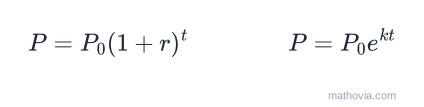
is for a fixed percentage per period, like annual interest or a population growing 3% a year. is for continuous growth. - Enter the other three values. Type the rate as a percentage, 5 for 5%, and use a negative number for decay. The time can be in any unit as long as it matches the rate: years with a yearly rate, hours with an hourly rate.
- Read the results: the answer, the growth factor per period, the doubling time or half-life, a table of values and a graph with your point marked.
The exponential growth formula
Worked example: 5% a year for 10 years
This is the calculator’s first preset: 1,000 growing 5% a year.
Step 1 — the growth factor.
Step 2 — apply it 10 times.
The amount grew by 628.89, not by 500, which is what ten separate 5% steps of the original 1,000 would give. Each year’s 5% is taken of a larger amount than the year before, and that compounding is exactly what makes growth exponential.
Solving for the rate or the time
The same formula answers the reverse questions; you just solve it the other way round.
How fast? A culture grows from 50 to 3,200 bacteria in 6 hours. Divide to get the total factor,
How long? How long does 1,000 take to reach 2,000 at 7% a year? Taking logarithms of
That’s the doubling time, and it doesn’t depend on the starting amount at all. Solving exponential equations covers the logarithm step in detail.
Doubling time and the rule of 72
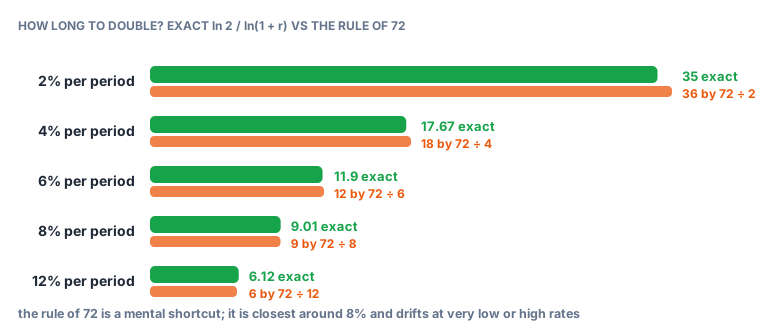
The exact doubling time is
Exponential decay
Decay is growth with a negative rate. A
After 3 years it’s worth
Percent per period vs continuous growth
| Model | Formula | 1,000 at 5% for 10 periods |
|---|---|---|
| once per period | 1,628.89 | |
| continuous | 1,648.72 |
Continuous growth adds its increase every instant rather than once per period, so it ends slightly higher at the same nominal rate. Its effective rate per period is
Reading the graph
The curve in the calculator always passes through the starting amount at
Where exponential growth shows up
- Savings and loans: a balance growing at a fixed annual rate.
- Populations: cities, animals or bacteria growing by a steady percentage, at least until resources run short, which is when logistic growth takes over.
- Depreciation: cars and equipment losing a fixed share of their value each year.
- Medicine: a drug clearing from the body at a fixed rate per hour.
- Sequences: the values at whole-number times form a geometric sequence with ratio
, which the geometric sequence calculator handles term by term.
Common mistakes
- Using the percentage instead of the decimal. 5% is
, so the factor is 1.05, not 6. (In this calculator, type 5 and it converts for you.) - Using
instead of . The factor for 5% growth is 1.05; is nearly zero. - Treating a decrease as
with a positive . A 15% loss is a factor of 0.85. - Mismatched units. A yearly rate needs time in years. Convert a monthly rate before mixing it with years.
- Adding instead of multiplying. Ten years at 5% is not 50% growth; it’s 62.9%.