
In the previous lesson the derivative was defined as a limit. Limits don’t always exist, though, so neither do derivatives. Differentiability is the name for the good case: a function is differentiable at a point when its derivative exists there. That sounds like a technicality, but it’s not. Big results later in calculus, such as the mean value theorem and linear approximation, only work for differentiable functions, so it pays to recognise them quickly.

What Does Differentiable Mean?
A function
exists, and is a finite number. Three words carry that definition:
- At a point: differentiability is checked one point at a time.
is differentiable at 3 but not at 0. - Exists: the limit has to be the same from both sides. If
and give different answers, there’s no derivative. - Finite: a limit of
doesn’t count. That rules out vertical tangent lines.
A differentiable function is one that’s differentiable at every point of its domain. We also say
What Differentiable Looks Like on a Graph
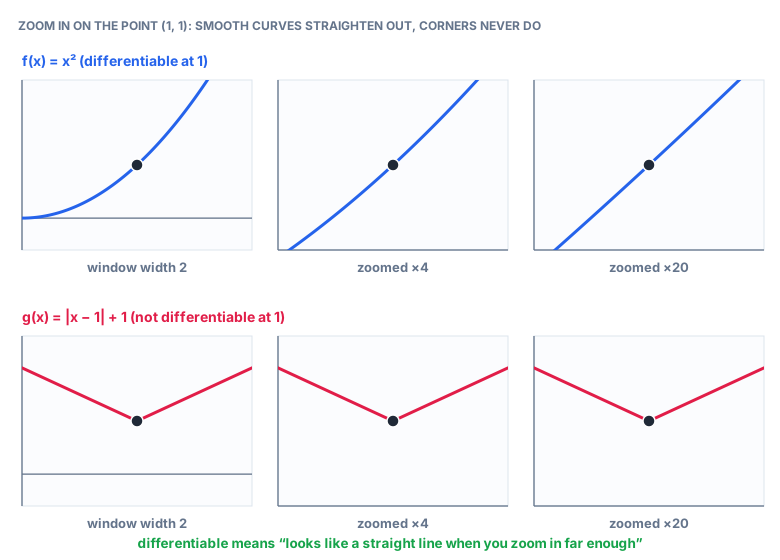
Here’s the most useful way to picture differentiability. Take a graph, put your finger on a point, and zoom in. If the function is differentiable there, the curve looks straighter and straighter until it’s indistinguishable from a line, its tangent line. Mathematicians call this local linearity.
At a corner, zooming in never helps. The
So the informal test for what makes a graph differentiable is: smooth and unbroken. You should be able to draw it through the point in one stroke without lifting your pen, without turning a sharp corner, and without the curve going vertical.
Differentiability Implies Continuity
This is the key theorem of the lesson:
If
is differentiable at , then is continuous at .
The proof is short. For
As
The theorem is most useful backwards: if a function isn’t continuous at a point, it can’t be differentiable there. Every jump, hole and vertical asymptote from types of discontinuity is automatically a point with no derivative, and you don’t need to calculate anything.
Continuous vs Differentiable
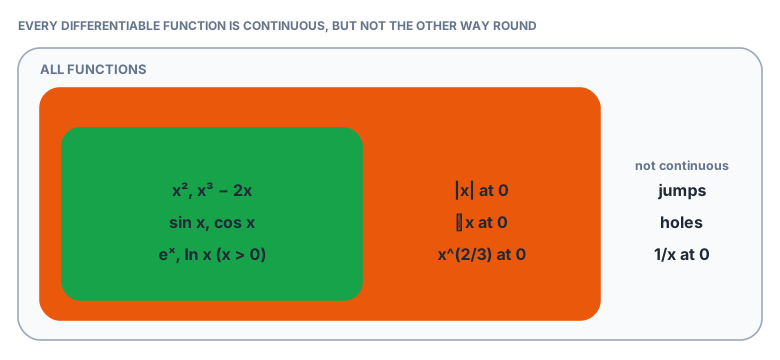
The converse of the theorem is false. Being continuous does not make a function differentiable.
| Continuous at a? | Differentiable at a? | |
|---|---|---|
| yes | yes | |
| yes | no (corner) | |
| yes | no (vertical tangent) | |
| a jump at a | no | no |
One way to keep it straight: continuity asks the heights to match up; differentiability asks the heights and the slopes to match up. Differentiability is the stricter test.
Four Ways a Function Fails to Be Differentiable
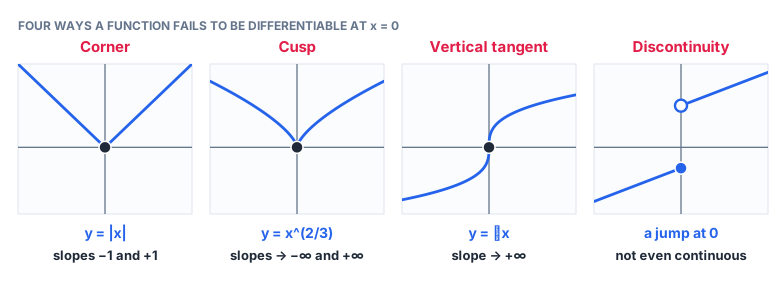
Differentiable and non-differentiable points are easy to tell apart once you know the four failure types.
- Corner. The one-sided slopes are two different finite numbers, as with
at 0 (slopes and ). - Cusp. The slopes from the two sides run off to
and , so the graph comes to a sharp point, as with at 0. - Vertical tangent. The graph is smooth but stands straight up for an instant, so the slope is infinite, as with
at 0. - Discontinuity. A jump, a hole or an asymptote. By the theorem above, there’s no derivative.
Away from those four situations, the functions you meet in Calculus 1 are differentiable.
How to Determine If a Function Is Differentiable
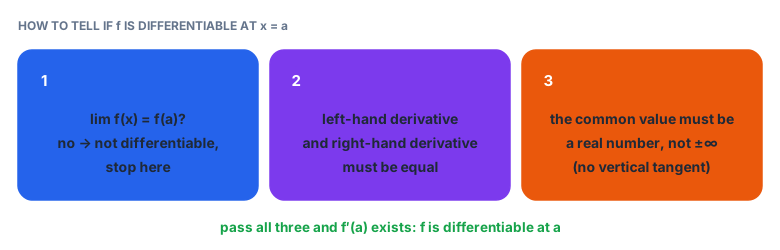
To determine whether
- Check continuity. If
isn’t continuous at , you’re done: it’s not differentiable. - Find the slope from each side. These are the one-sided derivatives: $$ f’-(a) = \lim{h \to 0^-} \frac{f(a + h) - f(a)}{h}, \qquad f’+(a) = \lim{h \to 0^+} \frac{f(a + h) - f(a)}{h} $$ They’re ordinary one-sided limits of the difference quotient.
- Compare. If both are the same finite number,
is differentiable at and is that number. If they differ, or either is infinite, it isn’t.
For a piecewise function, there’s a shortcut for step 2: if each piece is a polynomial (or another function you can already differentiate), the one-sided derivatives at the break point are just the derivatives of the two pieces evaluated there. That shortcut assumes step 1 passed, so always check continuity first.
Example 1: A Corner
Is
It’s continuous, since
Example 2: A Vertical Tangent
Is
Example 3: A Cusp
Is
The quotient is
Example 4: A Piecewise Function That Is Differentiable
Is this function differentiable at
Continuity:
Slopes: from the left,
So yes,
Example 5: Making a Piecewise Function Differentiable
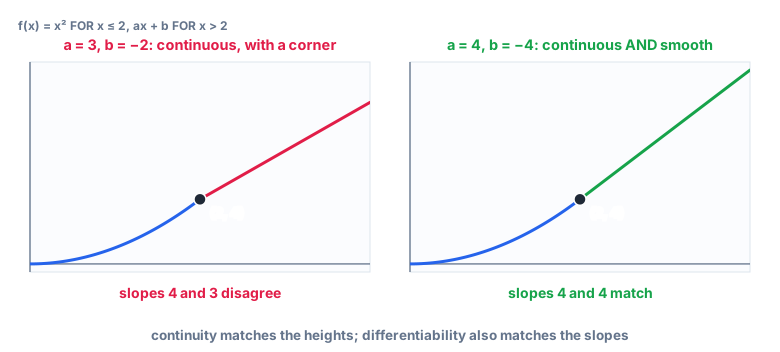
This is the classic exam question. Find
is differentiable everywhere.
Each piece is differentiable on its own, so only
- Heights match (continuity):
, so . - Slopes match: the left slope is
at , and the right slope is . So .
Then
Example 6: A Surprise, f(x) = x|x|
Is
It contains an absolute value, so you might expect a corner. Check the definition:
The limit exists and is finite, so yes, and
Where Common Functions Are Differentiable
| Function | Differentiable on | Problem points |
|---|---|---|
| polynomials, | all real numbers | none |
| not defined at 0 | ||
| domain ends at 0 | ||
| vertical tangent at 0 | ||
| vertical asymptotes | ||
| corner at 0 | ||
| vertical tangent at 0 |
Sums, products and compositions of differentiable functions are differentiable too, which is why you rarely need the limit definition for everyday functions. The places to look closely are the joins of piecewise functions, anything inside an absolute value that hits zero, and roots or fractional powers at zero.
Common Mistakes
- Assuming continuous means differentiable. It doesn’t:
is the counterexample to keep in your pocket. - Matching only the slopes for a piecewise function. If the heights don’t match, the function isn’t even continuous. Check continuity first.
- Calling a vertical tangent differentiable. The tangent line exists, but its slope is infinite, so
doesn’t. - Judging from the formula alone. An absolute value doesn’t guarantee a corner (see
). When in doubt, take the one-sided limits.
Practice Problems
Try each one before opening the answer. The practice set has 12 more with instant checking.
Problem 1. Is
Show answer
The one-sided derivatives are
Answer: no
Problem 2. Is
Show answer
Continuous: both pieces give 1 at
Answer: no (continuous, with a corner)
Problem 3. Find
Show answer
Both pieces give 1 at
Answer:
Problem 4. Where is
Show answer
Each absolute value has a corner where its inside is zero.
Answer:
Problem 5. True or false: if
Show answer
Answer: false
Now that you know when a derivative exists, the next step is finding derivatives quickly. The power rule turns the limit calculations of the last two lessons into one line.