
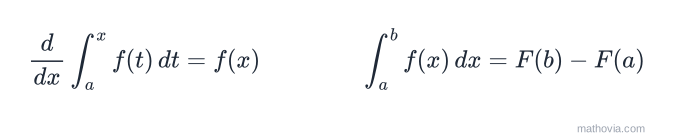
The fundamental theorem of calculus (FTC) says that differentiation and integration are inverse processes. It comes in two parts:
Part 1. If
Part 2. If
Part 2 is the one you’ll use most. It turns the limit of Riemann sums from the definite integral lesson into a two-step calculation: find an antiderivative, then subtract its values at the endpoints.
The Accumulation Function
Part 1 is about a function defined by an integral. Fix a starting point
Example. For
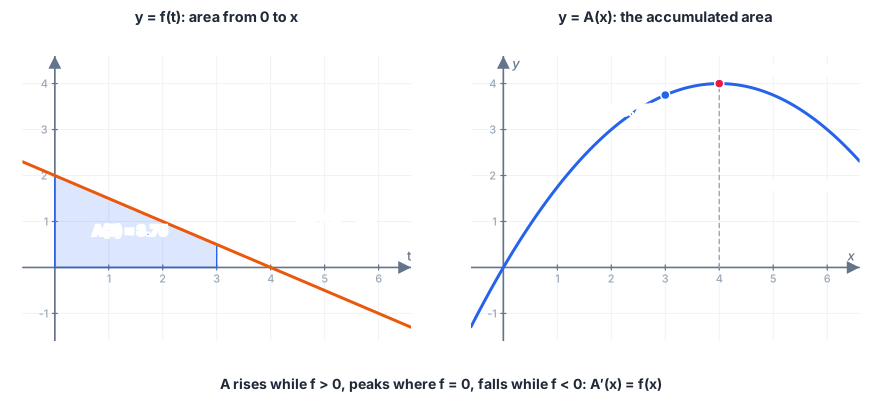
Look at how the two graphs match up. While
FTC Part 1 (the First Fundamental Theorem)
Fundamental theorem of calculus, Part 1. If
is continuous on , then is differentiable on , and .
In words: the rate at which area accumulates is the height of the curve. Integrating
Why it works. Increase
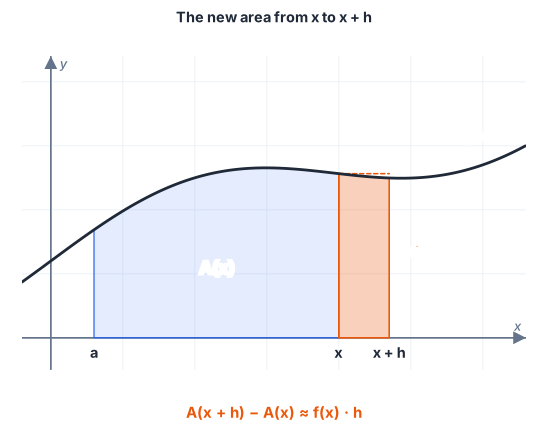
Divide by
A full proof uses the mean value theorem for integrals to pin the strip’s height between the minimum and maximum of
Derivative of an Integral
Part 1 lets you differentiate an integral without evaluating it. That matters when the integrand has no simple antiderivative.
Example 1. Find
The lower limit is a constant and the upper limit is
The lower limit doesn’t matter: changing it only changes the integral by a constant.
When the upper limit is a function of
Example 2. Find
Here
When
Example 3. Find
When both limits depend on
Example 4. Find
Neither of the last two integrals can be evaluated with elementary functions, but their derivatives take one line.
FTC Part 2 (the Second Fundamental Theorem)
Fundamental theorem of calculus, Part 2. If
is continuous on and is any antiderivative of , then .
Part 2 is also called the evaluation theorem. The difference
Why it works. By Part 1,
and
Naming. Most textbooks call the evaluation formula the second fundamental theorem of calculus, as here. Some courses number the two parts the other way round, so check which statement your teacher means.
How to Evaluate a Definite Integral
- Find an antiderivative
of the integrand, using the antiderivative rules. Leave off . - Evaluate
at the upper limit and at the lower limit . - Subtract:
, upper minus lower. - Check that
is continuous on . If it isn’t, the theorem doesn’t apply.
Example 5. Evaluate
Example 6. Evaluate
One arch of the sine curve has area exactly 2.
Example 7. Evaluate
Rewrite as powers:
Example 8. Evaluate
Example 9 (checking an earlier answer). In the Riemann sums lesson, sums for
The limit that took a table of sums is now one subtraction.
The Net Change Theorem
Part 2 has a useful restatement. If
This is the net change theorem: the integral of a rate of change is the net change. It turns rate information into amounts:
| Rate | Integral |
|---|---|
| velocity | displacement, the net change in position |
| flow rate into a tank | net change in the amount of liquid |
| population growth rate | net change in population |
| marginal cost | change in cost from |
To find the amount at the end, add the net change to the starting amount:
Example 10. Water flows into a tank at
The amount rises by 100 L, so the tank holds
Displacement vs distance. The integral of velocity counts motion in the negative direction as negative, so it gives displacement. For the total distance traveled, integrate speed,
Example 11. A particle moves along a line with velocity
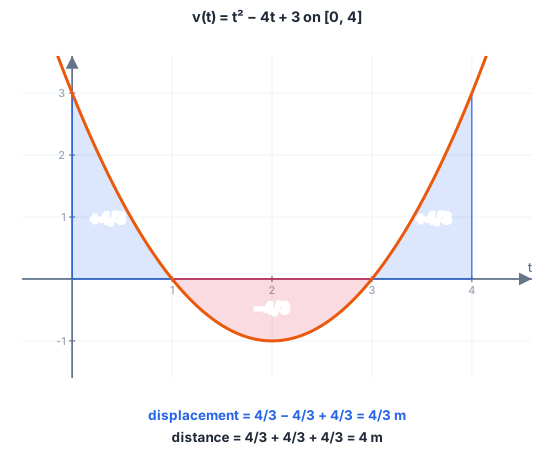
An antiderivative is
For distance,
so the total distance is
Common Mistakes
- Subtracting in the wrong order. It’s
: upper limit minus lower limit. - Dropping parentheses at the lower limit.
. Without the parentheses, the signs of the lower-limit terms go wrong. - Forgetting the chain rule factor.
, not . - Forgetting the sign when
is the lower limit. Reverse the limits first. - Ignoring discontinuities.
is not . The integrand is positive, so a negative answer is impossible. isn’t continuous at 0, so Part 2 doesn’t apply. - Confusing displacement with distance. Integrating
gives displacement; integrate for distance.
For proofs of both parts and more examples, see Sections 5.3 and 5.4 of the free textbook OpenStax Calculus Volume 1.
Practice Problems
Try each one before opening the answer. The practice set has 12 more with instant checking.
Problem 1. Evaluate
Show answer
Answer: 4
Problem 2. Evaluate
Show answer
Answer: 1
Problem 3. Evaluate
Show answer
Answer:
Problem 4. Find
Show answer
By Part 1, replace
Answer:
Problem 5. Find
Show answer
The upper limit is
Answer:
Problem 6. A car’s velocity is
Show answer
Answer: 36 m
With the fundamental theorem, a definite integral is only as hard as finding an antiderivative. Next, u-substitution, the chain rule in reverse, extends the antiderivative rules to composite functions like