Mathovia

Calculus / Calculus 1 · Algebra & Trigonometry Review

Trigonometric Functions

Sine, cosine and tangent start life as ratios of sides in a right triangle, but calculus uses them as functions of any angle, defined by points on the unit circle. This review covers both views, the exact values you'll use constantly, and the shapes of the graphs.

Practice Problems
Written by
MPhil in Mathematics, Founder of Mathovia
Published

Mathematics verification: Mathematical formulas, calculations, worked examples and solutions are reviewed for accuracy before publication. How we check our work

Calculus is full of things that repeat: waves, orbits, alternating current, the swing of a pendulum. The functions that describe them are the trigonometric functions, and calculus leans on them constantly, from the first limits to the integrals of Calculus 2. This review rebuilds them from scratch: first as ratios in a right triangle, then as coordinates on the unit circle, which is the version calculus actually uses. Angles here are in radians; if that’s rusty, start with radians and degrees.

Sine theta equals opposite over hypotenuse, cosine theta equals adjacent over hypotenuse, tangent theta equals opposite over adjacent
The three main trig ratios

Trig Functions in a Right Triangle

Pick one of the acute angles of a right triangle and call it . Seen from , the three sides have names: the hypotenuse opposite the right angle, the opposite side across from , and the adjacent side next to it.
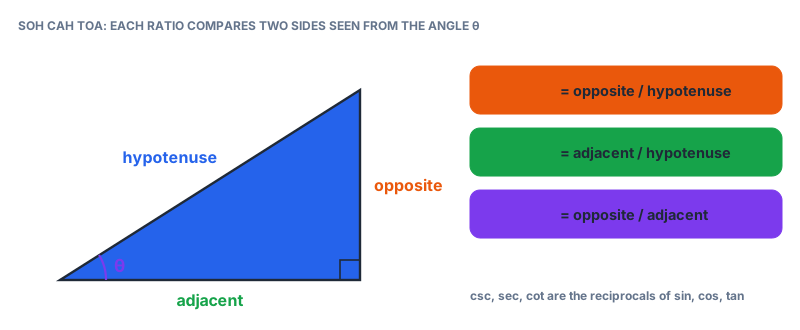
A right triangle with angle theta at the bottom left, labelled hypotenuse, opposite and adjacent, next to the definitions sin theta = opposite over hypotenuse, cos theta = adjacent over hypotenuse and tan theta = opposite over adjacent
SOH CAH TOA

The six trigonometric functions are the six possible ratios of those sides:

FunctionRatioReciprocal of
opposite / hypotenuse—
adjacent / hypotenuse—
opposite / adjacent—
hypotenuse / opposite
hypotenuse / adjacent
adjacent / opposite

Example 1: A 3-4-5 Triangle

A right triangle has legs 3 and 4 and hypotenuse 5. For the angle opposite the side of length 3:

and the reciprocals are , , . The size of the triangle doesn’t matter: a 6-8-10 triangle gives the same ratios, which is why these depend only on the angle.

Trig Functions on the Unit Circle

A right triangle only allows angles between 0 and . Calculus needs for any angle, including negative ones and ones bigger than a full turn. The unit circle, a circle of radius 1 centred at the origin, provides that.
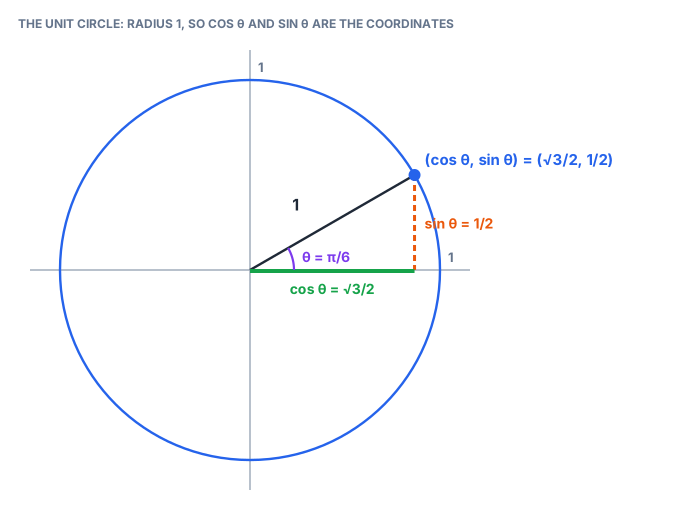
The unit circle with a radius drawn at angle theta = pi over 6; the point where it meets the circle is (cos theta, sin theta) = (root 3 over 2, 1/2), with the horizontal leg labelled cos theta and the vertical leg labelled sin theta
On the unit circle, the point at angle θ is (cos θ, sin θ)

Turn an angle counterclockwise from the positive -axis. Where it meets the circle, the coordinates are defined to be

For angles between 0 and this agrees exactly with SOH CAH TOA, because the hypotenuse is the radius, 1. But it keeps working all the way around the circle, which is what lets sine and cosine become functions on the whole real line. It also explains the most important identity in the subject: the point is on a circle of radius 1, so

Exact Values at the Special Angles

These come up so often in calculus that they’re worth knowing cold:

0
01
10
01undefined

A pattern helps: the sine row is , and the cosine row is the same list backwards.

Signs in Each Quadrant

Outside the first quadrant, the coordinates can be negative, so the trig functions can be too.
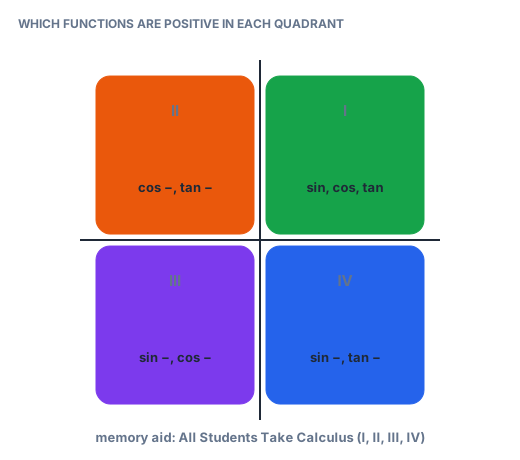
The four quadrants: in quadrant I all functions are positive; in quadrant II only sine; in quadrant III only tangent; in quadrant IV only cosine
All Students Take Calculus

To evaluate a trig function at any angle, find the reference angle (the acute angle to the -axis), take the value from the table, and attach the sign for the quadrant.

Example 2: Angles Outside the First Quadrant

: the angle is in quadrant II with reference angle . Sine is positive there, so .

: quadrant III, reference angle , cosine negative, so .

: quadrant II, reference angle , tangent negative, so .

Graphs of the Trig Functions

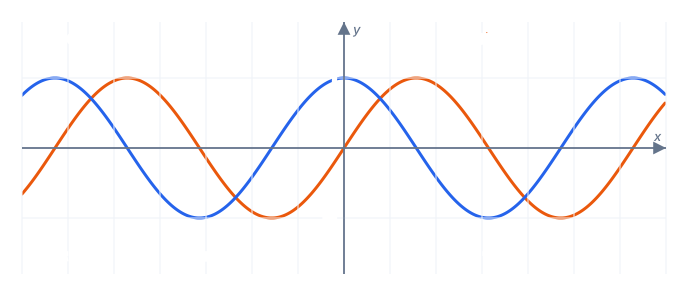
The graphs of y = sin x and y = cos x from −2π to 2π: both waves oscillate between −1 and 1, with sine passing through the origin and cosine starting at 1, the cosine wave being the sine wave shifted left by π/2
Sine and cosine are the same wave, shifted by π/2
FunctionDomainRangePeriodZeros
all reals
all reals
all reals

Tangent looks different: it has vertical asymptotes wherever , and between them it rises from to . Sine and cosine aren’t one-to-one, which matters for their inverses, the next lesson in this chapter.

Amplitude and Period

Most trig functions in calculus problems are stretched or squeezed versions of these, written as

The amplitude is how far the wave rises above and falls below its centre line, and the period is how long one full cycle takes. For , the wave swings between and 3 and repeats every . These are the same function transformations used for any graph: stretches vertically and compresses horizontally.

Why Trig Functions Matter in Calculus

Their derivatives are each other: and . That makes them the natural functions for anything that oscillates, and the reason they show up in every chapter of calculus, from limits like to integrals in physics and engineering.

Common Mistakes to Avoid

  • Mixing up opposite and adjacent. They depend on which angle you’re looking from.
  • Forgetting the sign. is , not .
  • Calculator in degree mode. means one radian here.
  • Reading as . The reciprocal is ; is the inverse function.
  • Writing for . means .

Practice Problems

Work each one before opening the answer.

Problem 1. A right triangle has opposite side 5, adjacent side 12 and hypotenuse 13. Find , and .

Show answer

Answer: , ,

Problem 2. Find .

Show answer

Answer:

Problem 3. Find .

Show answer

Quadrant II, reference angle , cosine negative.

Answer:

Problem 4. Find .

Show answer

Quadrant III, reference angle , tangent positive.

Answer:

Problem 5. Find .

Show answer

.

Answer:

Problem 6. If and is in quadrant II, find .

Show answer

, and cosine is negative in quadrant II.

Answer:

Trig functions take an angle and give a number. The next lesson turns that around: given the number, which angle produced it?

Frequently Asked Questions

What are the six trigonometric functions?+

Sine, cosine and tangent, and their reciprocals cosecant, secant and cotangent. In a right triangle, , , , and , , are 1 divided by each of those.

What does SOH CAH TOA mean?+

It's a memory aid for the right-triangle definitions: Sine is Opposite over Hypotenuse, Cosine is Adjacent over Hypotenuse, and Tangent is Opposite over Adjacent.

How is the unit circle used to define the trig functions?+

Draw a circle of radius 1 centred at the origin and turn an angle from the positive -axis. The point where it meets the circle is , and . This works for every angle, not just those between 0 and 90 degrees.

Which trig functions are positive in each quadrant?+

All are positive in quadrant I, only sine (and cosecant) in quadrant II, only tangent (and cotangent) in quadrant III, and only cosine (and secant) in quadrant IV. The phrase All Students Take Calculus helps you remember it.

What are the period and range of sine and cosine?+

Both repeat every and take values between and . Tangent repeats every , takes every real value, and is undefined where , at .

Related lessons

Calculators for this topic