
The definite integral of
It’s a single number: the net signed area between the graph of
What Is a Definite Integral?
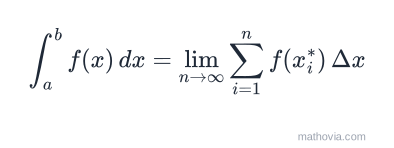
A Riemann sum estimates the area under a curve with
When the limit exists,
Definite Integral Notation
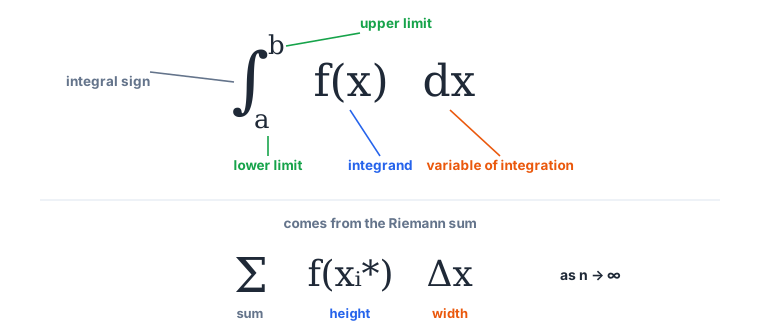
is the integral sign, a stretched S for “sum.” and are the lower and upper limits of integration. The interval is the interval of integration. is the integrand, the function whose area you’re measuring. names the variable of integration and stands for the width in the limit.
The variable is a placeholder.
Definite vs Indefinite Integrals
The two share a symbol but answer different questions:
| Definite integral | Indefinite integral | |
|---|---|---|
| Notation | ||
| Limits of integration | yes, | none |
| The answer is | a number | a family of functions, |
| It means | net signed area from | all antiderivatives of |
| Example |
The fundamental theorem of calculus, in the next lesson, shows why they share a symbol: you can compute the definite integral from any antiderivative.
The Definite Integral as Net Signed Area
When
Example 1. Find
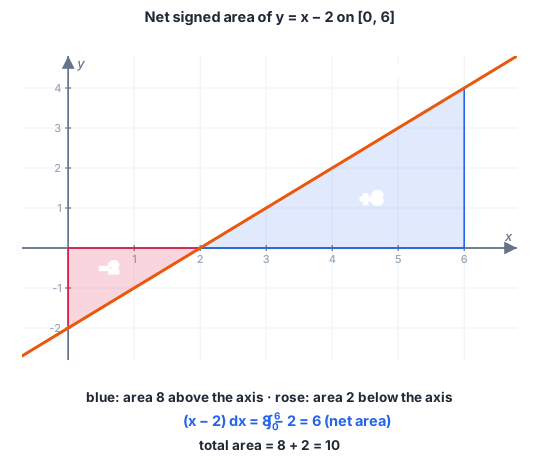
The line crosses the axis at
Net area vs total area. The total area between the graph and the axis counts every region as positive: here
If a problem asks for “the area of the region,” it means total area. If it asks for “the value of the integral,” it means net area.
How to Find a Definite Integral
There are three ways, and you’ll use all of them:
- Geometry. If the region is made of triangles, rectangles, trapezoids or parts of circles, add their areas, subtracting any below the axis.
- The limit definition. Write a Riemann sum with
rectangles and take the limit as . This always works in principle but is slow. - The fundamental theorem of calculus. Find an antiderivative
and compute . This is the method you’ll use most often, and it’s the subject of the next lesson.
Example 2 (a trapezoid). Find
The region under
Example 3 (a semicircle). Find
The graph of
None of the antiderivative rules so far can handle
Example 4 (the limit definition). Find
With
The sum of the first
As
Example 5 (a preview of the fundamental theorem). An antiderivative of
That’s the same answer as Example 4, with no sums and no limits. The next lesson shows why this always works.
Properties of Definite Integrals
These properties follow from the definition, because sums behave the same way. They let you break an integral into simpler pieces, and they answer many AP-style questions without any integration.
| Property | Formula |
|---|---|
| Zero-width interval | |
| Reversing the limits | |
| Constant function | |
| Constant multiple | |
| Sum and difference | |
| Additivity over intervals |
The comparison properties tell you about the size of an integral without computing it:
| Comparison property | Formula |
|---|---|
| Positive integrand | if |
| Larger integrand | if |
| Bounds | if |
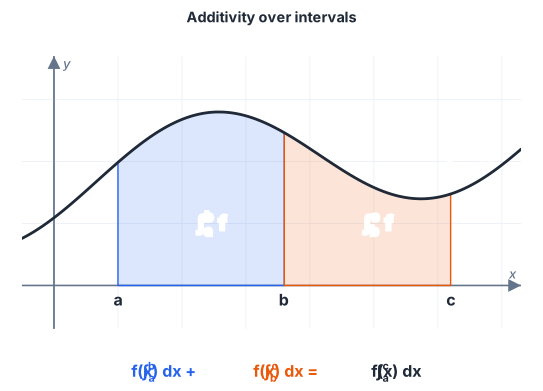
Additivity holds even when
Example 6. Suppose
(a)
(b)
(c)
(d)
Example 7 (estimating with bounds). Show that
On
The true value is about 0.747. This integral has no elementary antiderivative, so bounds and numerical sums are the practical tools for it.
Which Functions Are Integrable?
- Every continuous function on
is integrable there. - A function that is bounded with only finitely many jump discontinuities is also integrable. Each jump just separates two pieces of area.
- A function with a vertical asymptote inside the interval is not integrable in this sense.
has no value as a definite integral, because the area near 0 is unbounded. Integrals like this are called improper integrals and are handled in Calculus 2.
Common Mistakes
- Adding
to a definite integral. The answer is a number. The constants cancel in . - Confusing net area with total area. The integral subtracts area below the axis. For total area, split at the zeros and add absolute values.
- Forgetting the sign when reversing limits.
. - Splitting a product.
is not . Only sums and constant multiples split. - Integrating across an asymptote. Check that
is defined and bounded on the whole interval first.
For more examples of net area and the properties, see Section 5.2 of the free textbook OpenStax Calculus Volume 1.
Practice Problems
Try each one before opening the answer. The practice set has 12 more with instant checking.
Problem 1. Find
Show answer
The region is a rectangle of height 3 and width
Answer: 9
Problem 2. Find
Show answer
A trapezoid with parallel sides
Answer: 8
Problem 3. Find
Show answer
The line is below the axis on all of
Answer:
Problem 4. Find
Show answer
The graph is the quarter of the circle
Answer:
Problem 5. If
Show answer
By additivity,
Answer: 7
Problem 6. If
Show answer
First
Answer:
The definite integral turns area into a number. Next, the fundamental theorem of calculus shows how to compute it from an antiderivative, without any Riemann sums at all.