
The product rule handles functions multiplied together. Its partner, the quotient rule, handles one function divided by another:
What Is the Quotient Rule?
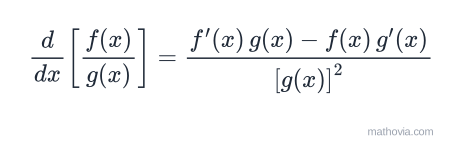
If
In words: the derivative of the top times the bottom, minus the top times the derivative of the bottom, all over the bottom squared. You’ll also see it written with
Unlike the product rule, the two terms are subtracted, so their order matters. Swap them and every answer comes out with the wrong sign.
The Low D-High Mnemonic
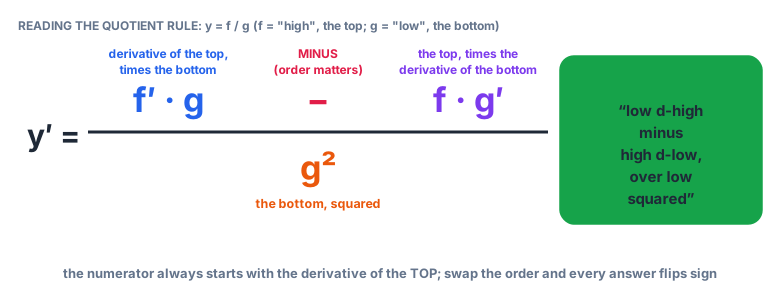
Generations of calculus students have remembered it with a rhyme. Call the numerator “high” and the denominator “low”, and read “d” as “the derivative of”:
Low d-high minus high d-low, over low squared.
“Low d-high” is the bottom times the derivative of the top,
Why the Minus Sign? Where the Rule Comes From
The quotient rule falls straight out of the product rule. Call the quotient
Now solve for
The minus sign has a plain meaning too. A fraction gets smaller when its denominator gets bigger, so the rate at which the bottom grows works against the derivative. That’s the
The Division Rule for Derivatives
You may see this rule called the division rule for derivatives, especially outside the US. It’s the same rule with a different name: the derivative of one function divided by another is
so everything on this page applies whichever name your course uses.
How to Use the Quotient Rule, Step by Step
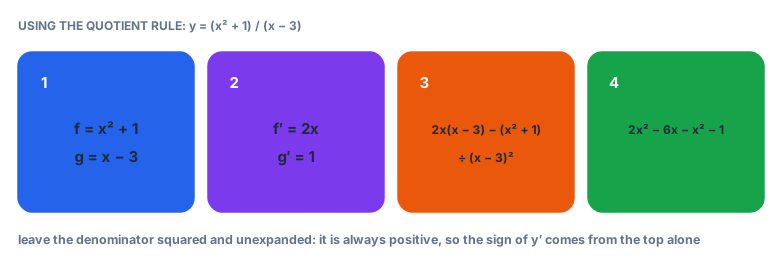
- Name the top
and the bottom . - Differentiate each to get
and . - Assemble
, with brackets around every factor that has more than one term. - Simplify the numerator by expanding and collecting terms. Leave the denominator as a square: it’s never negative, so the sign of the derivative comes from the top alone, which is exactly what you need for finding where a function rises or falls.
Example 1: A Polynomial Over a Polynomial
Differentiate
With
Watch the second term: the minus sign applies to the whole of
Example 2: Checking Against the Power Rule
Differentiate
The top is the constant 1, so
That matches the power rule on
Example 3: Finding Turning Points
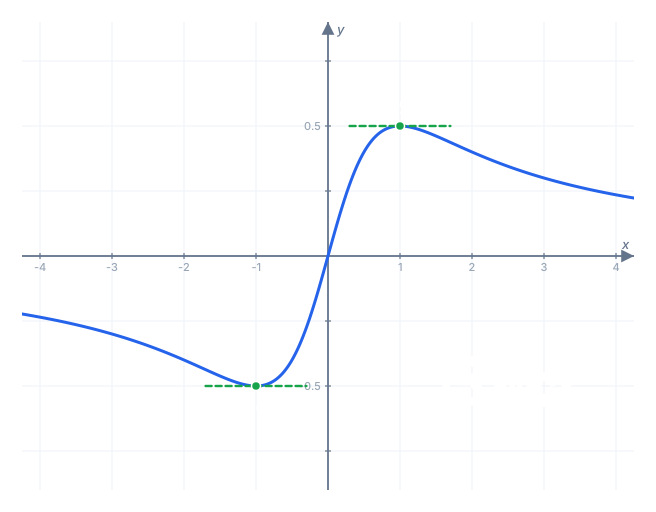
Differentiate
A fraction is zero only when its numerator is zero, so solve
Example 4: The Derivative of tan x
Find
Write
The Pythagorean identity
Example 5: e to the x Over x
Differentiate
Factoring out
Example 6: A Linear Over a Linear
Differentiate
The
Example 7: Using a Table of Values
Suppose
Careful with
When You Don’t Need the Quotient Rule
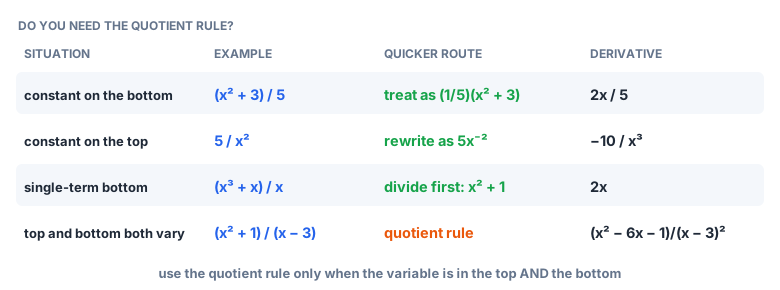
The quotient rule always works, but it isn’t always the fastest:
- A constant denominator.
is just , with derivative . - A constant numerator.
, so the power rule gives in one step. - A single-term denominator.
(for ), with derivative .
Save the quotient rule for fractions with the variable in both the top and the bottom.
Common Mistakes With the Quotient Rule
- Swapping the order.
gives the negative of the right answer. Always start with the derivative of the top. If in doubt, test on . - Forgetting to square the denominator. It’s
, not . - Dropping brackets in the second term. The minus sign applies to all of
. - Differentiating top and bottom separately.
is L’Hôpital’s rule for limits, not the derivative of a quotient. - Expanding the denominator. It almost never helps, and it hides the fact that the denominator is never negative.
Practice Problems
Try each one before opening the answer. The practice set has 12 more with instant checking.
Problem 1. Differentiate
Show answer
Answer:
Problem 2. Differentiate
Show answer
Answer:
Problem 3. Differentiate
Show answer
Answer:
Problem 4. If
Show answer
Answer:
Problem 5. Find the tangent line to
Show answer
The point is
Answer:
With the power, product and quotient rules you can differentiate any combination of powers built with sums, products and quotients. The last basic rule, the chain rule, handles functions nested inside other functions, like