
The limit laws say you can usually find a limit by substituting. This lesson is about the times you can’t, when substitution gives
How to Evaluate a Limit: the Strategy
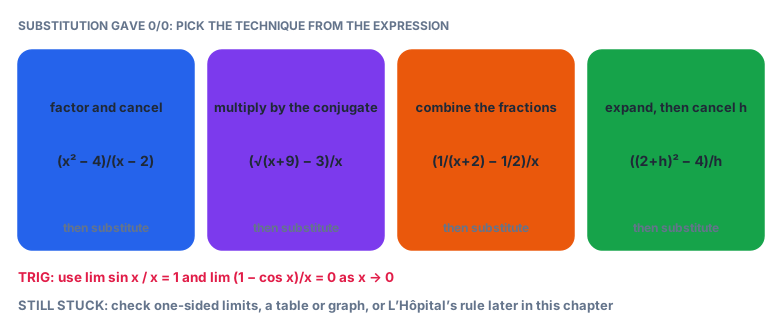
- Substitute first. If you get a number, you’re finished.
- If you get a nonzero number over 0, the function grows without bound and the limit does not exist (check one-sided limits to describe how).
- If you get
, rewrite the expression using the technique that fits, cancel, and substitute again.
Why is cancelling allowed? A limit never uses the value at
Technique 1: Factor and Cancel
Find
Substituting gives
The same works for a difference of cubes. With
If the factoring is rusty, the factoring polynomials lesson covers every pattern you’ll need.
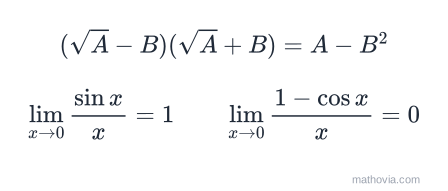
Technique 2: Rationalize With the Conjugate
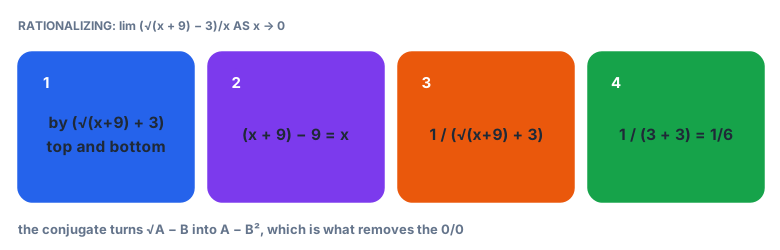
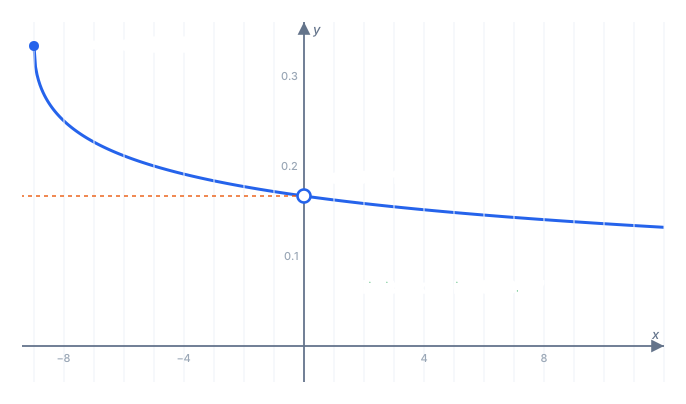
Find
Substitution gives
Now substitute:
Technique 3: Combine the Fractions
Find
When small fractions sit inside a big one, put them over a common denominator first:
Dividing by
Technique 4: Expand and Cancel
Find
Expand the bracket:
Special Trig Limits
Trig expressions often don’t factor, so two known limits do the work (with
To use them, make the expression match. For
because
Tangent works the same way once you write it with sine and cosine. Since
The conjugate idea even works for trig. To find
The first of these special limits is proved with the squeeze theorem in the next lesson.
A Limit That Needs Two Techniques
Some limits need more than one move. Find
Substitution gives
Now the polynomial on top factors as
Checking Your Answer
Algebra is easy to slip on, so a quick numerical check is worth the ten seconds it takes. Plug in a value very close to
When Nothing Cancels
If substitution gives
Common Mistakes to Avoid
- Stopping at 0/0. It’s never the answer; it’s the cue to simplify.
- Cancelling terms instead of factors. In
you can’t cancel the ‘s or the 2’s; factor first. - Expanding the conjugate on the bottom. Leave
factored so the cancels. - Using degrees in trig limits.
is only true in radians.
Practice Problems
Work each one before opening the answer.
Problem 1. Find
Show answer
Factor:
Answer: 6
Problem 2. Find
Show answer
Answer: 2
Problem 3. Find
Show answer
Multiply by
Answer:
Problem 4. Find
Show answer
Expand:
Answer: 6
Problem 5. Find
Show answer
Rewrite as
Answer: 5
Next, the squeeze theorem: how to pin down a limit by trapping a function between two others, and the proof that