Mathovia

Calculus / Calculus 1 · Derivatives

Limit Definition of the Derivative

The derivative measures how fast a function is changing at a single point. The limit definition is where that idea comes from: take the slope between two nearby points on a graph, then let the gap between them shrink to zero. Every derivative rule you'll learn later comes from this one limit.

Practice Problems
Written by
MPhil in Mathematics, Founder of Mathovia
Published

Mathematics verification: Mathematical formulas, calculations, worked examples and solutions are reviewed for accuracy before publication. How we check our work

Your car’s speedometer reads 50 at a single instant, yet speed is distance divided by time, and at a single instant no time passes and no distance is covered. So what is the speedometer actually measuring? That puzzle is what the derivative answers. The answer is a limit: work out the average speed over shorter and shorter time intervals and see what number those averages settle on. Written for any function, that idea is the limit definition of the derivative.
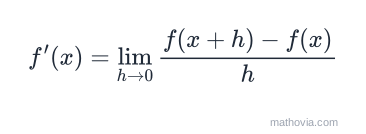
The limit definition of the derivative: f prime of x equals the limit as h approaches 0 of f of x plus h, minus f of x, all over h
The limit definition of the derivative

What Is the Limit Definition of a Derivative?

The derivative of a function is

wherever this limit exists. Read it from the inside out:

  • is how much the output changes when the input moves from to .
  • Dividing by turns that change into a rate: output change per unit of input. This fraction is the difference quotient you met in algebra.
  • The limit shrinks the step until it’s “instantaneous”.

So the derivative is a limit of difference quotients. Some books call this the formal definition of a derivative, or say they’re finding the derivative “by the limit process”. It’s all the same formula. When exists at a point, is called differentiable there.

From Average Rate of Change to Instantaneous Rate
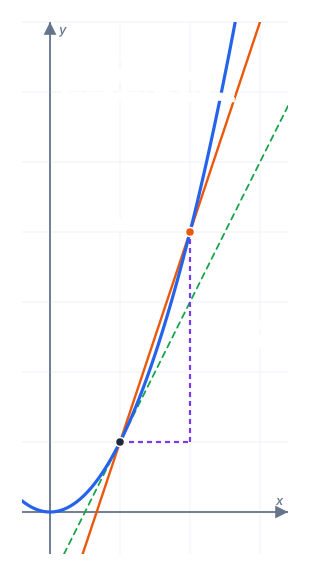
Graph of f of x equals x squared with points P at (1, 1) and Q at (2, 4). The secant line through P and Q has slope 3, with a run of h equals 1 and a rise of f of a plus h minus f of a equals 3. A dashed tangent line at P has slope 2
The difference quotient is the slope of the secant line PQ

Pick a point on a graph, and a second point a horizontal distance further along, at . The line through them is a secant line, and its slope is rise over run:

That’s an average rate of change over the interval from to . For with and , the secant runs from to and has slope . The tangent line at , the line that just grazes the curve there, is less steep. The derivative is how we get its slope.

Watching the Secant Become the Tangent
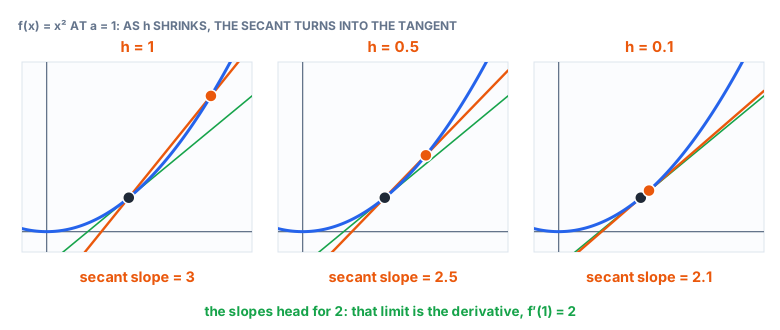
Three panels of f of x equals x squared at a equals 1. With h equals 1 the secant slope is 3, with h equals 0.5 it is 2.5, and with h equals 0.1 it is 2.1. Each time the secant line moves closer to the dashed tangent line of slope 2
As h shrinks, Q slides toward P and the secant swings onto the tangent

Now slide toward by making smaller. For at , the secant slope works out to , so:

hSecant slope
13
0.52.5
0.12.1
0.012.01
0.0012.001
−0.011.99
−0.11.9

From both sides the slopes close in on 2, so . Notice we never actually let land on . With there’s only one point, and one point doesn’t determine a line. The limit is the only honest way to ask “what slope are these secants heading for?”, which is why the derivative is defined as a limit.

What the Derivative Represents

The number has two everyday meanings, and it helps to keep both in mind:

  1. The slope of the tangent line to at . For at the tangent has slope 2, so its equation is , or .
  2. The instantaneous rate of change of at : how fast the output is changing per unit of input at that exact moment.

The second meaning is the speedometer. Drop a stone from a cliff and it falls about feet in seconds. Its velocity at is

so after 2 seconds the stone is falling at 64 feet per second. The units come straight from the fraction: feet on top, seconds on the bottom.

The Derivative at a Point vs the Derivative Function

The same limit can produce two kinds of answer, and mixing them up is a common source of confusion.

  • At a point: plug in a number first, and you get a number. is the slope at only.
  • As a function: keep as a letter, and you get a new function that gives the slope at every . For it turns out to be , and then , , all come for free.

When a problem says “find the derivative of ”, it wants the function. When it says “find ” or “the slope at ”, it wants a number. Example 1 below finds a derivative at a point; Example 3 finds a derivative function.

How to Use the Limit Definition, Step by Step
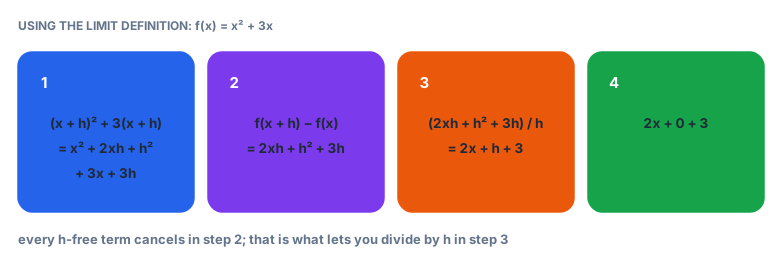
Four steps for f of x equals x squared plus 3x. Step 1, write f of x plus h: x squared plus 2xh plus h squared plus 3x plus 3h. Step 2, subtract f of x: 2xh plus h squared plus 3h. Step 3, divide by h: 2x plus h plus 3. Step 4, let h approach 0: f prime of x equals 2x plus 3
The same four steps work for almost every limit-definition problem

Using the definition of the derivative almost always follows the same four steps:

  1. Write . Replace every in the formula with , brackets included, and expand.
  2. Subtract . Every term without an should cancel. If something survives without an , go back and check your algebra.
  3. Divide by . Factor out of the numerator and cancel it with the denominator. For fractions, combine them first; for square roots, multiply by the conjugate.
  4. Let . Now direct substitution works, because the problem is gone.

Step 3 is where the real work happens. It’s the same move you practised in evaluating limits: the original limit is , and algebra removes the factor that causes it.

Example 1: The Derivative at a Point

Use the limit definition to find for .

Here and , so

The tangent to at has slope 6.

Example 2: A Straight Line

Find for .

The answer is just the slope of the line, which is exactly what you’d hope. A line’s steepness never changes, so every secant and every tangent has slope 5. This makes a good sanity check for the definition.

Example 3: A Polynomial

Find for .

This is the function in the four-step card. Expanding, . Subtracting leaves , so

Check one value: at the slope is 3, and near the origin does rise about 3 units for every 1 unit across.

Example 4: A Fraction, f(x) = 1/x

Find for .

With fractions, combine the top into a single fraction before dividing by :

Now let : . The minus sign makes sense, because is decreasing on both sides of 0.

Example 5: A Square Root, f(x) = √x

Find for .

The quotient won’t factor, so multiply top and bottom by the conjugate :

Letting gives . At that’s ; keep that number in mind for the next section.

Example 6: A Cubic, and a Pattern

Find for .

Using :

Put the results side by side: gave , gave , and gave . The exponent comes down in front and drops by one. That’s the power rule, coming up in this chapter, and it’s proved with exactly this kind of limit.

The Alternate Definition of the Derivative
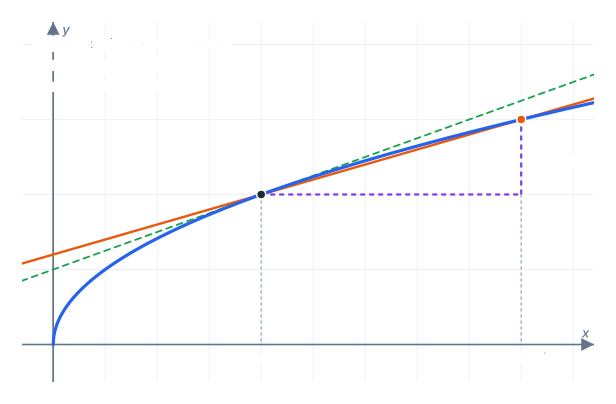
Graph of f of x equals the square root of x with a fixed point at (4, 2) and a moving point at (9, 3). The horizontal gap is labelled x minus a and the vertical gap f of x minus f of a. The secant slope is 1/5 and the dashed tangent at 4 has slope 1/4
The alternate form keeps a fixed and moves x toward it

There’s a second way to write the derivative at a point , often called the alternate definition or alternative definition of the derivative:

It’s the same idea with different labels. Instead of a gap , you have a second point sliding toward ; the two forms match when you set . The alternate form shines when you want the derivative at one specific number and the top factors nicely.

Example. Find for using the alternate definition.

The trick is seeing as a difference of squares, . The answer agrees with Example 5, as it must.

Derivative Notation

You’ll see the derivative written several ways. They all mean the same thing:

NotationRead asTypical use
“f prime of x”function notation (Lagrange)
“y prime”when the function is
“dee y dee x”rates, related rates, the chain rule (Leibniz)
“the derivative of f(x)”an instruction to differentiate

Leibniz’s is a reminder of where derivatives come from: a tiny change in divided by a tiny change in , which is after the limit is taken.

When the Derivative Doesn’t Exist

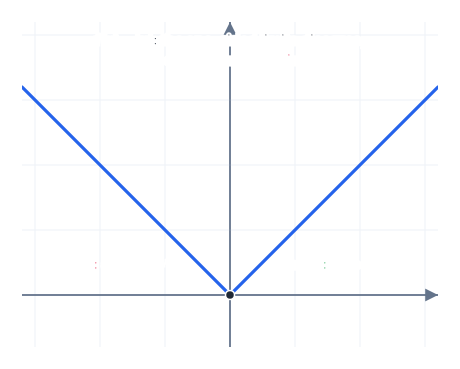
Graph of f of x equals the absolute value of x with a sharp corner at the origin. Secants from the left have slope negative 1 and from the right slope positive 1, so the one-sided limits disagree and f prime of 0 does not exist
A corner: the slopes from the two sides never agree

The definition only works if the limit exists, and sometimes it doesn’t. For at 0, the difference quotient is , which equals when and when . The one-sided limits disagree, so does not exist, even though is perfectly continuous there.

That’s the general picture. A function must be continuous to have a derivative, but being continuous isn’t enough: corners, cusps and vertical tangent lines all break the limit. Exactly when a function is differentiable is the subject of the next lesson.

Common Mistakes With the Limit Definition

  • Writing instead of . For , , not . Replace every , and keep the brackets.
  • Forgetting to distribute the minus sign when subtracting . Put in brackets and subtract the whole thing.
  • Plugging in too early. If you substitute before cancelling the in the denominator, you’ll get . Simplify first, then take the limit.
  • Leaving the limit symbol off halfway through, or keeping it after is gone. Write on every line until the final substitution; teachers do take marks off for this.
  • Mixing up and . One is a number, the other is a function. Read the question to see which it wants.

Practice Problems

Try each one with the limit definition before opening the answer. There are more in the practice set.

Problem 1. Use the definition of the derivative to find for .

Show answer

, so the limit is 4.

Answer:

Problem 2. Find for .

Show answer

.

Answer:

Problem 3. Find for .

Show answer

. Dividing by gives , which tends to .

Answer:

Problem 4. Find for .

Show answer

. Dividing by gives .

Answer:

Problem 5. Use the alternate definition to find for .

Show answer

.

Answer: 10

The limit definition is the foundation, but nobody wants to expand every time. Next, we’ll look at exactly when this limit exists, and then build the rules that let you skip straight to the answer.

Frequently Asked Questions

What is the limit definition of a derivative?+

The derivative of is , provided the limit exists. The fraction is the slope of the secant line between and ; letting turns that average slope into the slope of the tangent line, the instantaneous rate of change.

What is the alternate definition of the derivative?+

At a point , the alternate (or alternative) definition is . It's the same limit written with a moving point instead of a gap , since . It's often quicker when you want the derivative at one specific number.

What does the derivative represent?+

Geometrically, is the slope of the tangent line to the graph at . Physically, it's the instantaneous rate of change: if is position, is velocity. Its units are the output units per input unit, such as feet per second.

Is the derivative the same as the difference quotient?+

No. The difference quotient is an average rate of change over a gap of size . The derivative is the limit of that quotient as approaches 0. The quotient is the ingredient; the limit is the derivative.

Why can't you just set h = 0?+

Putting straight into gives , which is meaningless. You first simplify the fraction until the in the denominator cancels, and only then let go to 0. That's exactly why a limit is needed.

Why learn the limit definition if there are derivative rules?+

The rules (power, product, quotient, chain) are all proved from the limit definition, so it's what makes them trustworthy. Exams also ask for it directly with wording like "use the definition of the derivative", and it's the only tool that works at points where the rules break down, such as the corner of .

Related lessons