Mathovia

Calculus / Calculus 1 · Derivatives

Implicit Differentiation

Implicit differentiation finds dy/dx straight from an equation like x² + y² = 25, without solving for y first. Differentiate both sides, multiply every y-term's derivative by dy/dx, and solve for dy/dx.

Practice Problems
Written by
MPhil in Mathematics, Founder of Mathovia
Published

Mathematics verification: Mathematical formulas, calculations, worked examples and solutions are reviewed for accuracy before publication. How we check our work

So far every function you’ve differentiated came in the form something in . But plenty of curves don’t arrive that way. The circle has and tangled together, and it isn’t even a function: most vertical lines cross it twice. It still has a tangent line at every point, though, and implicit differentiation is how you find its slope without untangling the equation first.
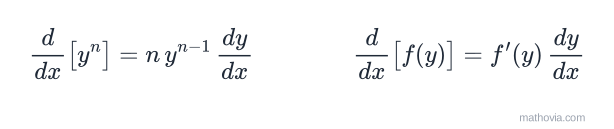
The key rule of implicit differentiation: the derivative of y to the n with respect to x is n y to the n minus 1 times dy by dx, and in general the derivative of f of y is f prime of y times dy by dx
When you differentiate a y-term with respect to x, a factor of dy/dx comes along

Explicit vs Implicit Functions

An equation is in explicit form when is alone on one side: , , . It’s in implicit form when and are mixed together: , , .

Sometimes you can turn implicit into explicit. Solving gives , and that’s easy to differentiate. But solving the circle gives two separate functions, and , and an equation like can’t be solved for at all. Implicit differentiation skips the solving step entirely.

The One Rule That Makes It Work

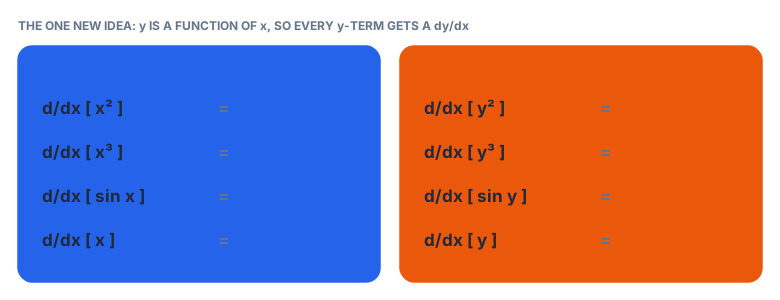
Two columns. Differentiating x-terms with respect to x: x squared gives 2x, x cubed gives 3x squared, sin x gives cos x, x gives 1. Differentiating y-terms: y squared gives 2y times dy by dx, y cubed gives 3y squared times dy by dx, sin y gives cos y times dy by dx, and y gives dy by dx
Same rules on both sides; the y-terms just pick up a dy/dx

The whole method rests on one idea: treat as a function of , even though you haven’t written down which function.

When you differentiate with respect to , you get . When you differentiate with respect to , you’re really differentiating , a composition. The chain rule says: differentiate the outside (the square) to get , then multiply by the derivative of the inside, which is :

Every rule you know still works on -terms. You just attach a at the end. Even plain on its own has derivative , not 1. Writing for saves a lot of ink, and the rest of this lesson uses both.

How to Do Implicit Differentiation: 4 Steps

  1. Differentiate both sides of the equation with respect to , term by term.
  2. Attach to the derivative of every term that contains . Terms like need the product rule first.
  3. Collect every term with on one side, and move everything else to the other side.
  4. Factor out and divide to get on its own.

The answer will usually contain both and . That’s normal: on a curve like a circle, the slope depends on which point you’re at, and alone can’t tell you which point that is.

Example 1: The Slope of a Circle

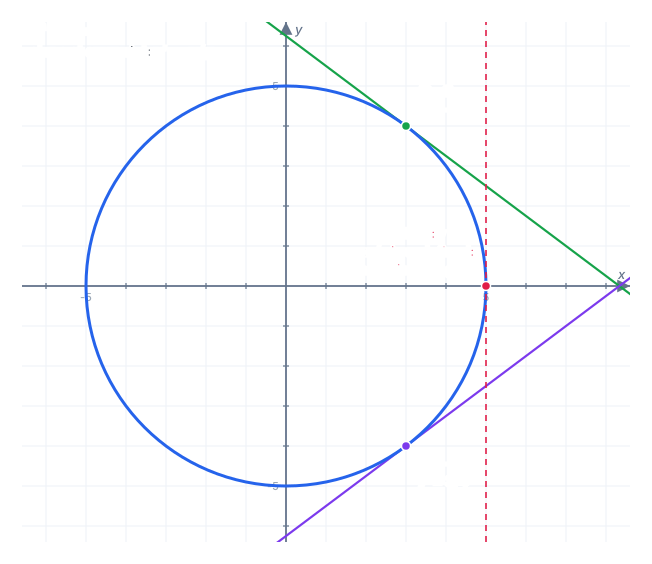
The circle x squared plus y squared equals 25 with tangent lines at 3, 4, where the slope is minus 3 over 4, and at 3, minus 4, where the slope is 3 over 4. At 5, 0 the formula minus x over y is undefined because y is 0, and the tangent line is vertical
One formula, y′ = −x/y, gives the slope at every point of the circle

Find for , and the slope of the tangent line at .

Differentiate both sides. The right side is a constant, so its derivative is 0:

Solve for :

At the slope is . At , directly below, it’s . Same , different slope, which is exactly why the formula needs . And at , makes the formula undefined: that’s where the tangent line is vertical.

You can check the answer the explicit way. On the top half, , and the chain rule gives . Same answer, but implicit differentiation handled both halves at once.

The tangent line at , in point-slope form, is , or .

Example 2: A Curve That Fails the Vertical Line Test
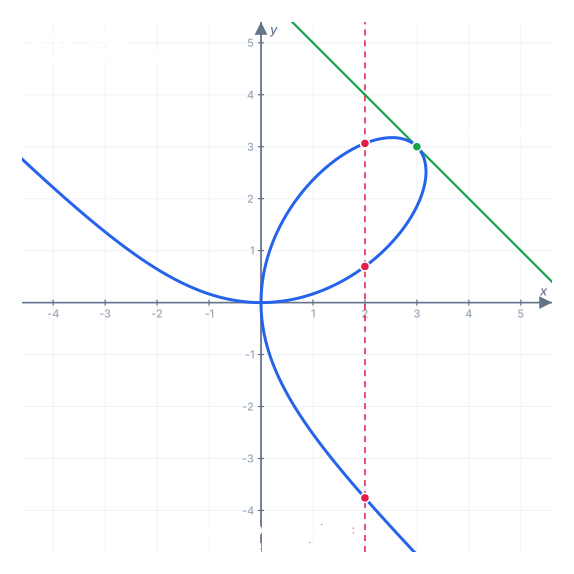
The folium of Descartes, x cubed plus y cubed equals 6xy, a curve with a loop in the first quadrant. The vertical line x equals 2 crosses it three times, so it is not the graph of a function. Its tangent line at 3, 3 has slope minus 1
The vertical line x = 2 hits this curve three times, but every point still has a slope

Find for , and the slope at .

This curve is called the folium of Descartes. Solving it for would mean solving a cubic, so implicit differentiation is the only sensible route. The right side is a product:

Collect the terms on the left and everything else on the right:

Factor out and divide (and cancel the common factor of 3):

At , first check the point is on the curve: . Then .

Example 3: Products of x and y

Find for , and its value at .

Each term on the left is a product, so each needs the product rule:

Collect and factor:

At : .

Example 4: The Implicit Derivative of x/y

Find for .

The term needs the quotient rule, with as the derivative of the bottom:

Multiply through by to clear the fraction, then collect:

At the point , which is on the curve since , the slope is .

Example 5: An Equation You Can’t Solve for y

Find for .

There’s no way to write as a formula in here. Implicit differentiation doesn’t care:

At the origin, which is on the curve, .

This is the same trick that proved the derivatives of inverse trig functions: starting from , differentiating both sides gave .

Example 6: An Implicit Second Derivative

Find for the circle .

From Example 1, . Differentiate that with the quotient rule, remembering that still carries a :

Now substitute :

The last step uses the original equation, . That’s a common finishing move for second derivatives. At , : negative, which fits the top of the circle bending downward.

Example 7: Horizontal and Vertical Tangent Lines
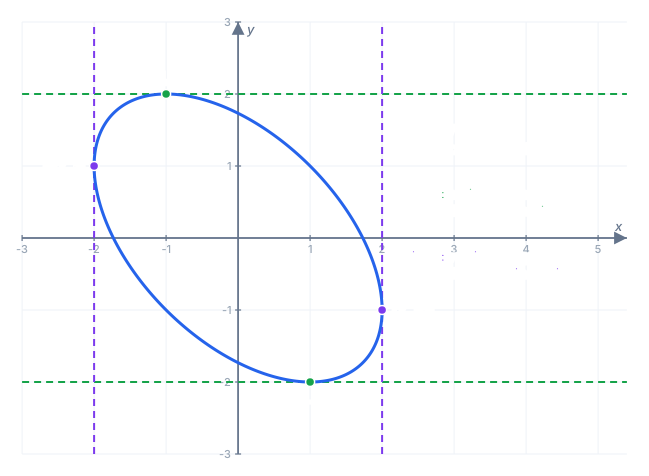
The tilted ellipse x squared plus xy plus y squared equals 3. Horizontal tangent lines touch it at minus 1, 2 and 1, minus 2, where the numerator of y prime is zero. Vertical tangent lines touch it at minus 2, 1 and 2, minus 1, where the denominator is zero
Horizontal tangents where the top of y′ is zero, vertical tangents where the bottom is

Find the points on where the tangent line is horizontal or vertical.

Differentiate, using the product rule on :

Horizontal tangents happen where , so the numerator is zero: . Substitute into the original equation: , so . The points are and .

Vertical tangents happen where the denominator is zero (and the numerator isn’t): . Then , so , giving and .

Bonus: Proving the Power Rule for Fractional Powers

The power rule lesson promised a proof for powers like . Here it is. Let , where and are whole numbers. Raise both sides to the power :

Differentiate implicitly: . Solve for and substitute :

That’s exactly the power rule, with .

When to Use Implicit Differentiation

  • The equation can’t be solved for , like .
  • Solving would split the curve into pieces, like the two halves of a circle.
  • Solving is possible but messy, like .
  • Inverse functions, where you know in terms of (as with ).

It’s also the engine behind related rates, coming up in the next chapter, where several quantities all change with time.

Common Mistakes

  • Forgetting on a -term. is , not .
  • Writing . It’s . Only .
  • Skipping the product rule on . , not or .
  • Forgetting to differentiate the constant side. In , the 25 becomes 0, not 25.
  • Dividing too early. Collect every term first, then factor. Dividing by part of an expression loses terms.

Practice Problems

Work each one out before opening the answer. The practice set has 12 more with instant checking.

Problem 1. Find for .

Show answer

.

Answer:

Problem 2. Find for .

Show answer

, so .

Answer:

Problem 3. Find the slope of at .

Show answer

Product rule: , so .

Answer:

Problem 4. Find the slope of at .

Show answer

From Example 7, .

Answer:

Problem 5. Find for .

Show answer

.

Answer:

Next comes logarithmic differentiation, which combines this lesson’s “differentiate both sides” idea with the log rules to handle products, quotients and powers like that no other rule can touch.

Frequently Asked Questions

What is implicit differentiation?+

Implicit differentiation is a way to find when and are mixed together in an equation, such as , instead of being written on its own. You differentiate both sides with respect to , treating as a function of , and then solve the result for .

How do you do implicit differentiation?+

1. Differentiate both sides of the equation with respect to . 2. Every time you differentiate a term containing , multiply by (the chain rule). 3. Move all the terms to one side and everything else to the other. 4. Factor out and divide.

Why do you multiply by dy/dx when differentiating y?+

Because stands for a function of . Differentiating is like differentiating : the chain rule gives , which is . Differentiating gives just , because the derivative of with respect to is 1.

When should you use implicit differentiation?+

Use it when the equation is hard or impossible to solve for , like , or when solving would give several pieces, like the two halves of a circle. If is already written as a function of , ordinary differentiation is simpler.

What is the difference between explicit and implicit differentiation?+

Explicit differentiation works on an equation already solved for , such as . Implicit differentiation works on an equation where and are mixed, such as . Both give the same derivative when both are possible; the implicit answer usually contains as well as .

What is the derivative of xy in implicit differentiation?+

Use the product rule: . Forgetting the product rule on terms is one of the most common mistakes.

How do you find the second derivative with implicit differentiation?+

Differentiate your formula for again, using the quotient rule if it's a fraction. Wherever appears in the result, substitute the formula you already found, then simplify using the original equation if you can.

Related lessons