Mathovia

Calculus / Calculus 1 · Limits

L'Hôpital's Rule

L'Hôpital's rule turns a stubborn 0/0 or ∞/∞ limit into a simpler one: differentiate the top and the bottom separately, then take the limit again. It's the most powerful shortcut in the limits chapter, as long as you only use it when the form really is indeterminate.

Practice Problems
Written by
MPhil in Mathematics, Founder of Mathovia
Published

Mathematics verification: Mathematical formulas, calculations, worked examples and solutions are reviewed for accuracy before publication. How we check our work

Some limits resist every technique in this chapter. doesn’t factor, has no conjugate and isn’t a squeeze. L’Hôpital’s rule handles it, and most other and limits, by replacing the functions with their derivatives. It uses derivatives, which the next chapter develops fully, so a short table of the ones you need is included below.

L'Hôpital's rule: the limit of f of x over g of x equals the limit of f prime of x over g prime of x, when the limit has the form 0 over 0 or infinity over infinity
L'Hôpital's rule

What L’Hôpital’s Rule Says

Suppose gives or when you substitute. If and are differentiable near , and there (except possibly at ), then

as long as the right-hand limit exists (or is ). The same holds for one-sided limits and for . The key word is separately: differentiate the top on its own and the bottom on its own. This is not the quotient rule.

The Derivatives You’ll Need

FunctionDerivative
(constant)
, e.g.

Derivatives of sums are sums of derivatives, and constants multiply through. That’s enough for every example on this page.

Why It Works
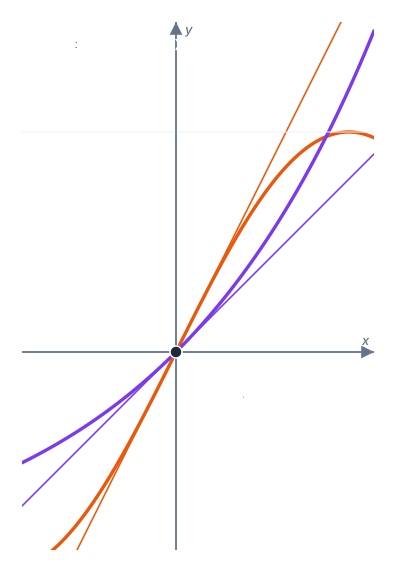
Graphs of sin 2x and e to the x minus 1 near the origin, each hugging its tangent line: y = 2x for sin 2x and y = x for e to the x minus 1. Near 0 the ratio of the functions approaches the ratio of the slopes, 2
Near the point, each function looks like its tangent line

If , then close to each function is almost its tangent line: and . The factors cancel in the ratio, leaving . In the picture, starts out like and like , so their ratio heads for 2.

When to Use L’Hôpital’s Rule

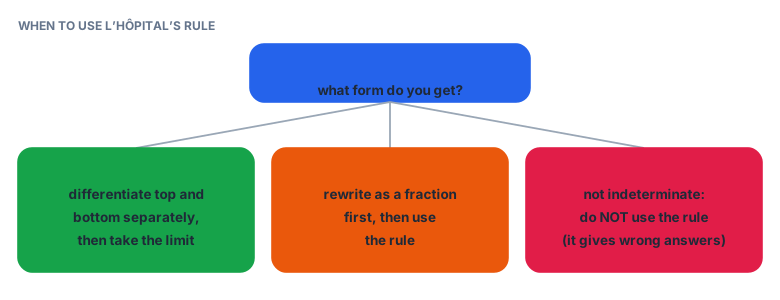
Decision card: substitute first. If you get 0 over 0 or infinity over infinity, differentiate top and bottom separately and take the limit. If you get 0 times infinity, infinity minus infinity or a similar form, rewrite as a fraction first. If you get a number or k over 0, do not use the rule
Check the form before every application

Always substitute first. The rule applies only to and . Using it anywhere else gives wrong answers: by substitution, but “differentiating” would give .

How to Use L’Hôpital’s Rule, Step by Step

  1. Substitute the value approaches. If you get a number, stop: that’s the limit.
  2. Identify the form. If it’s or , continue. If it’s , or an exponent form, rewrite it as a fraction first (see below).
  3. Differentiate the numerator and the denominator separately.
  4. Take the limit of the new fraction. If it’s still indeterminate, go back to step 3.
  5. Sanity-check the answer with a value close to , as you would for any limit.

Example 1: A 0/0 Limit

Find .

Substitution gives . Differentiate top and bottom: . (The squeeze theorem proved this limit without derivatives; that proof is needed to find the derivative of in the first place, so the two results don’t go in a circle.)

Example 2: Checking Against Factoring

Find .

, so . Evaluating limits gets the same answer by factoring. For simple algebra, factoring is often just as quick; the rule shines when algebra can’t help.

Example 3: An ∞/∞ Limit

Find .

. One application gives , still . A second gives , matching the degree rule from limits at infinity.

Example 4: Applying the Rule Twice

Find .

, so take derivatives: . Still , so again: . Re-check the form before each step; stop as soon as substitution gives a number.

Example 5: Comparing Growth Rates

: , then , then . Similarly . These prove the growth ranking from the previous lessons: logarithms grow slower than any power of , and powers grow slower than .

Other Indeterminate Forms

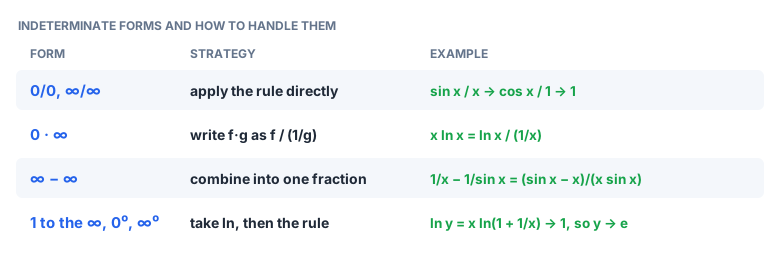
Indeterminate forms: 0/0 and infinity/infinity, apply the rule directly; 0 times infinity, write f g as f over 1/g; infinity minus infinity, combine into one fraction; 1 to the infinity, 0 to the 0 and infinity to the 0, take the natural log then use the rule
Turn every indeterminate form into a fraction first

. : rewrite as , which is . The rule gives .

. : combine into , which is . Two applications of the rule give 0.

. : let be the expression and take logs, , a form whose limit is 1. So . This is the limit that defines , and it’s the same idea behind continuous compound interest.

When the Rule Doesn’t Help

Occasionally the rule goes in circles. For , each application swaps the fraction for its reciprocal and never ends. Dividing top and bottom by instead gives the answer, 1, straight away. And if doesn’t exist, the rule says nothing about the original limit; try another method.

A Short History

The rule carries the name of Guillaume de l’Hôpital, a French nobleman who published it in 1696 in Analyse des infiniment petits, the first textbook on differential calculus. The mathematics, though, came from his tutor Johann Bernoulli, whom l’Hôpital paid for his discoveries. You’ll see the name spelled “L’Hôpital”, “L’Hospital” and “Lhopital”; they’re all the same rule.

Common Mistakes to Avoid

  • Using the quotient rule instead of differentiating top and bottom separately.
  • Applying the rule without checking the form. It’s only for and .
  • Forgetting to re-check after each application; you may already have a number.
  • Skipping the rewrite for , and exponent forms.

Practice Problems

Work each one before opening the answer.

Problem 1. Find .

Show answer

: .

Answer: 3

Problem 2. Find .

Show answer

: .

Answer: 1

Problem 3. Find .

Show answer

: , still : .

Answer:

Problem 4. Find .

Show answer

Three applications: , , .

Answer: 0

Problem 5. Can L’Hôpital’s rule be used for ?

Show answer

No: substitution gives , which isn’t indeterminate.

Answer: no; the limit is 1

That completes the limits chapter. With limits in place, Calculus 1 moves on to derivatives: the limit of the average rate of change, and the rules that make finding it quick.

Frequently Asked Questions

What is L'Hôpital's rule?+

If has the form or , and and are differentiable near with , then , provided the right-hand limit exists or is . It also works for one-sided limits and limits at infinity.

When should you use L'Hôpital's rule?+

Only when direct substitution gives or . Other indeterminate forms (, , , , ) must first be rewritten as a fraction. If substitution gives a number or a nonzero number over 0, the rule doesn't apply.

Is L'Hôpital's rule the same as the quotient rule?+

No. In L'Hôpital's rule you differentiate the numerator and the denominator separately, giving . The quotient rule is for finding the derivative of , which is a different calculation.

Can you use L'Hôpital's rule more than once?+

Yes. If is still or , apply the rule again. For it takes two applications to reach . Check the form before every application.

Who discovered L'Hôpital's rule?+

It's named after the French mathematician Guillaume de l'Hôpital, who published it in 1696 in the first calculus textbook. The result itself was found by his teacher, Johann Bernoulli.

Related lessons