Mathovia

Calculus / Calculus 1 · Integrals

Antiderivatives and Indefinite Integrals

An antiderivative of f is a function F whose derivative is f. Since x³ has derivative 3x², x³ is an antiderivative of 3x², and so is x³ + C for any constant C. Finding antiderivatives means running the derivative rules backwards.

Practice Problems
Written by
MPhil in Mathematics, Founder of Mathovia
Published

Mathematics verification: Mathematical formulas, calculations, worked examples and solutions are reviewed for accuracy before publication. How we check our work

Chapter 5 · Lesson 1 of 1Calculus 1 · Integrals
  1. 1.Antiderivatives and Indefinite Integrals
See all calculus chapters →

An antiderivative of a function is a function whose derivative is :

For example, is an antiderivative of , because the derivative of is . Finding antiderivatives is differentiation run backwards, and it’s the first step into integral calculus. Velocity is the antiderivative of acceleration, position is the antiderivative of velocity, and later in this chapter the fundamental theorem of calculus will turn antiderivatives into a way to compute areas.

The integral of x to the n d x equals x to the n plus 1 over n plus 1, plus C, for n not equal to negative 1. The integral of 1 over x d x equals the natural log of the absolute value of x, plus C
The power rule for integrals and its one exception

What Is an Antiderivative?

You already know how to go from a function to its derivative. An antiderivative goes the other way: given the derivative, find a function that has it.

Function An antiderivative Check:

The last column is the most important habit in this topic. You can always check an antiderivative by differentiating it. If you get back the original function, your answer is right.

Why There’s Always a + C

isn’t the only antiderivative of . So are , and , because the derivative of a constant is 0. Graphically, these are the same parabola shifted up or down. At any given , they all have the same slope.

The mean value theorem shows there are no others. If on an interval, then there, and a function with zero derivative on an interval is constant. So:

Every antiderivative of on an interval has the form , where is any one antiderivative and is a constant.

is called the general antiderivative, and is the constant of integration. A single function such as is a particular (or specific) antiderivative. Picking out a particular one needs extra information, as you’ll see in the section on initial-value problems below.

Indefinite Integral Notation

The general antiderivative has its own notation, the indefinite integral:
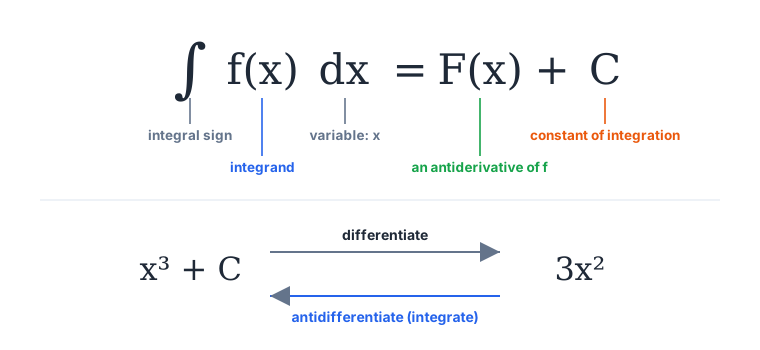
The indefinite integral notation, integral of f of x d x equals F of x plus C, with labels: integral sign, integrand f of x, variable x from d x, an antiderivative F of x, and the constant of integration C. Below, an arrow shows that differentiating x cubed plus C gives 3 x squared, and an arrow back shows that antidifferentiating 3 x squared gives x cubed plus C
The parts of the notation, and differentiation and integration as reverse operations
  • is the integral sign.
  • is the integrand, the function you’re antidifferentiating.
  • says the variable is . In , the variable is .

So is read “the integral of with respect to is plus .” Finding it is called antidifferentiation or integration. The word “indefinite” separates it from the definite integral, which has limits and gives a number instead of a function.

The Power Rule for Integrals

The power rule for derivatives lowers the exponent by one and multiplies by the old exponent. To undo it, raise the exponent by one and divide by the new exponent:

Check: the derivative of is .

The rule works for any exponent except , including negative and fractional ones:

IntegralRewriteApply the ruleAnswer

Dividing by a fraction is multiplying by its reciprocal, so .

The Exception: the Integral of 1/x

For , the power rule would give , which is undefined. The antiderivative of comes from the derivative of the natural log instead:

The absolute value matters. only exists for , but is defined for negative too, and the derivative of is on both sides of 0. (Strictly, since the domain has a gap at 0, the constant could be different on each side. Textbooks write a single by convention.)

Basic Integration Rules

Two rules let you split up an integral, just like the sum and constant multiple rules for derivatives:

Each basic antiderivative below is a derivative formula read backwards. If you know the derivatives of trig functions, exponential and log functions and inverse trig functions, you already know this table.

Because
(a constant)
, power rule

There is no product rule or quotient rule for integrals. is not . Rewrite products and quotients as sums first, as in Examples 2 and 4.

How to Find an Antiderivative

  1. Rewrite the integrand as a sum of basic terms: roots as fractional powers, as , fractions split term by term, products multiplied out.
  2. Pull out constants and integrate term by term.
  3. Apply a rule from the table to each term.
  4. Add once at the end.
  5. Check by differentiating your answer.

Example 1: A Polynomial

Find .

Integrate term by term with the power rule:

Check: . ✓

Example 2: Split the Fraction First

Find .

Divide each term of the numerator by :

Then

Example 3: Roots and 1/x

Find .

Write . The term needs the log rule, not the power rule:

Example 4: Multiply Out a Product

Find .

Expand first, since there’s no product rule for integrals:

A tempting shortcut is , but its derivative is by the chain rule, twice too big. The correct version, , expands to . That’s the same family as the answer above: two correct antiderivatives can look different and still differ only by a constant. Handling inside functions like directly is the job of u-substitution, a later lesson.

Example 5: Trig and Exponential Terms

Find .

Each term is in the table:

Watch the signs with sine and cosine. The antiderivative of is , because the derivative of is .

Finding a Particular Antiderivative (Initial-Value Problems)

Often you know one value of the function as well as its derivative. That’s an initial-value problem: find given and a point on its graph. The point fixes .
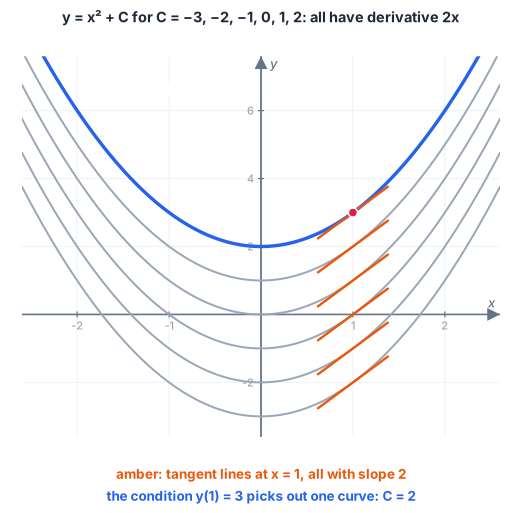
Six parabolas y equals x squared plus C, for C from minus 3 to 2, stacked vertically. Short amber tangent lines at x equals 1 are parallel on every curve, each with slope 2. The curve y equals x squared plus 2 is highlighted in blue and passes through the point (1, 3)
The general antiderivative is a family of curves; one point picks out one of them

Example 6. Find if and .

The general antiderivative is . Use the point: , so .

Example 7. Find the particular antiderivative that satisfies and .

. Then , so , and

Check: ✓ and ✓.

Application: From Acceleration to Position

Velocity is the derivative of position, and acceleration is the derivative of velocity (see higher-order derivatives). So antidifferentiating goes the other way: acceleration → velocity → position, with one constant at each step.

Example 8. A ball is thrown upward from 2 m above the ground at 15 m/s. Gravity gives it a constant acceleration of m/s². Find its height .

Velocity: . At , , so :

Position: . At , , so :

The ball is highest when , at s. Its maximum height is m. (This ignores air resistance.)

Common Mistakes

  • Forgetting . Without it you’ve given one antiderivative, not the general one, and most courses mark it wrong.
  • Using the power rule on . It gives division by zero. The answer is .
  • Integrating products factor by factor. . Multiply out first.
  • Getting the sign of wrong. It’s .
  • Forgetting to rewrite. is and is . The power rule only applies once the term is a power of .
  • Skipping the check. Differentiating your answer takes seconds and catches almost every error above.

For more exercises, including initial-value problems with trig functions, see Section 4.10 of the free textbook OpenStax Calculus Volume 1.

Practice Problems

Try each one before opening the answer. The practice set has 12 more with instant checking.

Problem 1. Find .

Show answer

Integrate term by term: .

Answer:

Problem 2. Find .

Show answer

.

Answer:

Problem 3. Find .

Show answer

.

Answer:

Problem 4. Find .

Show answer

and .

Answer:

Problem 5. Find .

Show answer

Split the fraction: .

Answer:

Problem 6. Find if and .

Show answer

, and , so .

Answer:

Antiderivatives undo derivatives. Next, Riemann sums start the other half of the story: adding up thin rectangles to find the area under a curve. The fundamental theorem of calculus will then show that the two ideas are the same.

Frequently Asked Questions

What is an antiderivative?+

An antiderivative of a function is a function with . For example, is an antiderivative of , because the derivative of is . Every function with one antiderivative has infinitely many, because adding a constant doesn't change the derivative: works too.

How do you find the antiderivative of a function?+

Rewrite the function as a sum of basic terms (turn roots into powers and split fractions), then antidifferentiate each term with a rule from the table: raise the power by one and divide by the new power for , use for , and read the trig and exponential derivatives backwards. Add , and check by differentiating.

Why do you add + C to an antiderivative?+

The derivative of a constant is 0, so , and all have derivative . On an interval, every antiderivative of has the form . Writing gives the whole family at once; leaving it out gives only one member of it.

What is the difference between an antiderivative and an indefinite integral?+

An antiderivative is one function with . The indefinite integral stands for all of them at once, . In practice, 'find the antiderivative' and 'evaluate the indefinite integral' ask for the same answer, written with .

What is the antiderivative of 1/x?+

. The power rule can't be used, because would divide by zero. The absolute value makes the answer work for negative too: the derivative of is for every .

Does every function have an antiderivative?+

Every function that is continuous on an interval has an antiderivative there; that's a consequence of the fundamental theorem of calculus. But not every antiderivative can be written with a formula. has an antiderivative, yet it can't be expressed using powers, roots, exponentials, logs and trig functions.

Related lessons
