
If you were 1 metre tall at age three and 1.6 metres at age fifteen, there was a moment when you were exactly 1.3 metres tall. You can’t grow from one height to another without passing through every height in between. The intermediate value theorem (IVT) is the precise version of that idea for functions, and it’s the first of several big theorems that depend on continuity.
![Intermediate value theorem: if f is continuous on [a, b] and N is between f(a) and f(b), then f(c) = N for some c in (a, b)](/images/formulas/intermediate-value-theorem-formula.svg)
What Is the Intermediate Value Theorem?
Suppose
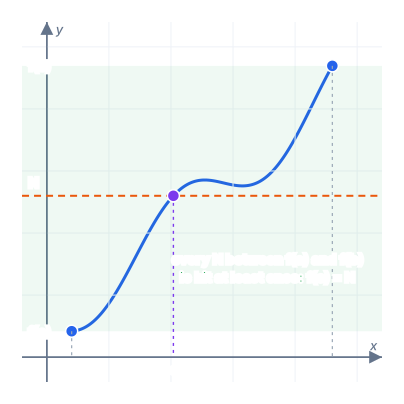
On a graph: draw any horizontal line between the heights of the two endpoints. Because the curve is unbroken and runs from one side of the line to the other, it has to cross the line at least once. The theorem guarantees that a crossing exists; it doesn’t say where it is, and there may be more than one.
Why Continuity Is Essential
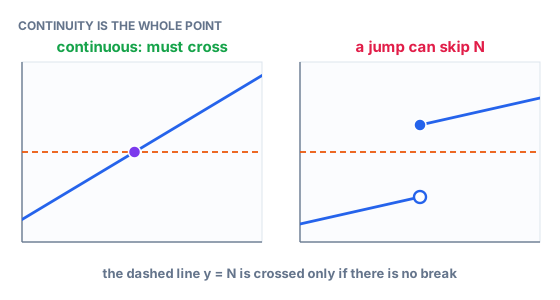
Take away continuity and the theorem fails.
Example 1: Showing an Equation Has a Root
Show that
Let
Since 0 lies between
Example 2: An Equation You Can’t Solve by Algebra
Show that
No algebra will isolate
Example 3: Hitting a Value Other Than Zero
Show that
Approximating a Root: the Bisection Method
The IVT doesn’t locate the root, but you can use it over and over to trap the root in smaller and smaller intervals. Halve the interval, check the sign at the midpoint, and keep the half where the sign still changes.
![Bisection for x³ + x − 1: the interval [0, 1] shrinks to [0.5, 1], [0.5, 0.75], [0.625, 0.75] and [0.625, 0.6875], each with a sign change, closing in on the root near 0.6823](/images/lessons/graphing/ivt-bisect.svg)
For
The Idea Behind the Proof
Why is the theorem true? The full proof rests on a property of the real numbers called completeness, which says the number line has no gaps. Suppose
What the Theorem Does Not Say
- It doesn’t say where
is, only that it exists. - It doesn’t say how many values of
there are; there could be several. - The converse is false. A function can hit every value between
and and still be discontinuous. - No sign change doesn’t mean no root.
on is positive at both ends but has two roots in between. The IVT simply can’t detect them.
Common Mistakes to Avoid
- Skipping the continuity check. Always state why
is continuous on . - Using an interval that contains a discontinuity, like
for . - Claiming you found the root. The IVT proves existence; finding the value is a separate step.
- Forgetting to move everything to one side before looking for a sign change.
Practice Problems
Work each one before opening the answer.
Problem 1. Does
Show answer
Answer: yes, by the IVT
Problem 2. Can the IVT show that
Show answer
Answer: no
Problem 3. Show that
Show answer
Answer: a solution exists in
Problem 4. Why doesn’t the IVT apply to
Show answer
Answer:
Problem 5. Use one bisection step to say which half of
Show answer
Answer:
Next, the epsilon-delta definition of a limit: the precise language that turns “gets close to” into mathematics.