Mathovia

Calculus / Calculus 1 · Applications of Derivatives

Extreme Value Theorem

The extreme value theorem says a continuous function on a closed interval always has a highest and a lowest value. The closed interval method finds them: check the critical points and the endpoints, and compare.

Practice Problems
Written by
MPhil in Mathematics, Founder of Mathovia
Published

Mathematics verification: Mathematical formulas, calculations, worked examples and solutions are reviewed for accuracy before publication. How we check our work

Chapter 4 · Lesson 4 of 5Calculus 1 · Applications of Derivatives
  1. 1.Related Rates
  2. 2.Linear Approximation
  3. 3.Critical Points
  4. 4.Extreme Value Theorem
  5. 5.Rolle's Theorem
See all calculus chapters →

A company wants its highest possible profit. An engineer wants the lowest possible cost. Before trying to find the best value, it helps to know that one exists. The extreme value theorem guarantees it: a continuous function on a closed interval always reaches a highest and a lowest value. Then a short method using critical points finds them. This is the core of every optimization problem later in the chapter.

If f is continuous on the closed interval a to b, then f has an absolute maximum and an absolute minimum on a to b
Continuous on a closed interval guarantees a highest and a lowest value

Absolute vs Local Extrema

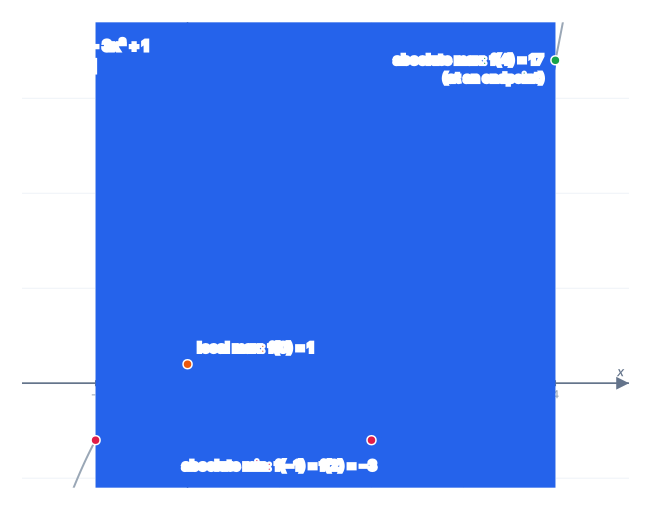
Graph of f of x equals x cubed minus 3 x squared plus 1 on the interval from minus 1 to 4. The absolute maximum is f of 4 equals 17, at the right endpoint. There is a local maximum f of 0 equals 1 that is not the absolute maximum. The absolute minimum value minus 3 is reached twice, at x equals minus 1 and x equals 2
The local max at x = 0 is not the highest point; the endpoint x = 4 is

On an interval, the absolute maximum of is the largest value takes anywhere on that interval, and the absolute minimum is the smallest. Together they’re the absolute extrema (also called global extrema).

A local maximum only has to beat the points near it. The difference matters. In the graph, is a local maximum with , a little peak. But the function climbs much higher by the right end of the interval, reaching . The absolute maximum is at an endpoint, where there’s no peak at all.

Local maximumAbsolute maximum
Compared withnearby pointsevery point on the interval
How manycan be severalone value (possibly reached at several )
At an endpoint?not usually countedyes, often

The Extreme Value Theorem

If is continuous on a closed interval , then has an absolute maximum value and an absolute minimum value on .

The theorem promises that the extremes exist. It doesn’t say where they are or what they are; the closed interval method below finds that. Like the intermediate value theorem, it’s an existence theorem, and like that theorem it depends on continuity.

Why Both Conditions Matter
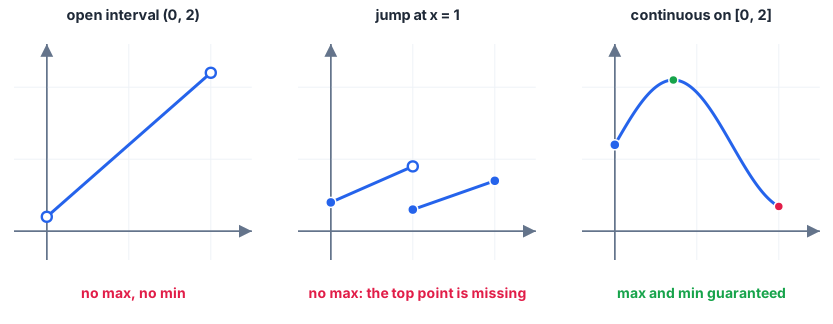
Three graphs. A line on the open interval from 0 to 2 with open dots at both ends has no maximum and no minimum. A function with a jump at x equals 1, where the top of the left piece is an open dot, has no maximum. A continuous curve on the closed interval from 0 to 2 has a highest and a lowest point
Drop either condition and the guarantee is gone
  • The interval must be closed. on the open interval gets closer and closer to 2 but never reaches it, because isn’t included. There’s no largest value: whatever value you pick, there’s a bigger one. The same goes for the minimum.
  • The function must be continuous. With a jump, the top of a piece can be an open dot, a value the function approaches but never takes. Then there’s no maximum.
  • The interval must be bounded. On , has no maximum at all.

Failing a condition doesn’t mean there can’t be extremes, only that they aren’t guaranteed. on the open interval still has maximum 1 and minimum .

Where Can the Extremes Be?

On , an absolute maximum or minimum happens either

  • at an endpoint, or , or
  • at an interior point, where it is also a local extreme, and so, by Fermat’s theorem from the critical points lesson, at a critical point.

That short list of candidates is the whole idea behind the method.

How to Find the Absolute Maximum and Minimum

The closed interval method, for continuous on :

  1. Find the critical points of that lie inside . Ignore any outside the interval.
  2. Evaluate at each of those critical points.
  3. Evaluate at the endpoints, and .
  4. Compare. The largest value is the absolute maximum; the smallest is the absolute minimum.

A table of candidates keeps the work organised, as in the examples.

Example 1: A Cubic With a Tie

Find the absolute maximum and minimum of on .

Step 1 — critical points:

Both are inside .

Steps 2 and 3 — evaluate the candidates:

Type
endpoint
critical point
critical point
endpoint

Step 4 — compare. The absolute maximum is 17, at . The absolute minimum is , reached at both and . The critical point is a local maximum but neither absolute extreme.

Example 2: A Critical Point Outside the Interval

Find the absolute extrema of on .

gives , which is not in , so it’s not a candidate. Only the endpoints are left: and .

The absolute minimum is at , and the absolute maximum is at . Including would give the wrong minimum: the function never takes that value on .

Example 3: A Cusp

Find the absolute extrema of on .

is never 0 and is undefined at , which is inside the interval. Candidates:

Absolute maximum 4 at ; absolute minimum 0 at , the cusp. If you only solved , you’d miss the minimum entirely.

Example 4: A Trig Function

Find the absolute extrema of on .

when , so in this interval.

Absolute maximum at ; absolute minimum at .

Example 5: Exponential and Log Functions

Find the absolute extrema of on .

at . Then , and . The maximum is at and the minimum is 0 at .

Find the absolute extrema of on .

at . Then , and . The maximum is at the right endpoint and the minimum is at .

Why the Theorem Is True

A full proof needs a property of the real numbers called completeness (there are no “gaps” in the number line), which is covered in analysis courses rather than Calculus 1. The idea has two steps. First, the values of are bounded: if they weren’t, you could find points in with growing without limit, those points would pile up at some in the interval (this is where “closed and bounded” is used), and continuity at would force to stay close to , a contradiction. Second, the values then have a least upper bound . Pick points where gets closer and closer to ; they pile up at some in , and continuity gives , so the maximum is actually reached. The same argument gives the minimum.

Common Mistakes

  • Forgetting the endpoints. The absolute extremes are often there, as in Examples 1, 2 and 5.
  • Using critical points outside the interval. In Example 2, isn’t in , so isn’t a candidate.
  • Missing critical points where is undefined, like the cusp in Example 3.
  • Answering with the -value instead of the value. “The absolute maximum is 17, at .” The maximum is the -value; is where it happens.
  • Applying the method on an open interval or to a discontinuous function, where the theorem’s guarantee doesn’t hold.

Practice Problems

Try each one before opening the answer. The practice set has 12 more with instant checking.

Problem 1. Find the absolute maximum and minimum of on .

Show answer

Step 1 — critical points: at .

Step 2 — candidates:

Answer: absolute maximum at ; absolute minimum at

Problem 2. Find the absolute extrema of on .

Show answer

Step 1 — critical points: at , both in the interval.

Step 2 — candidates:

Answer: absolute maximum at ; absolute minimum at

Problem 3. Find the absolute extrema of on .

Show answer

Step 1 — critical points:

Step 2 — candidates:

Answer: absolute maximum at ; absolute minimum at

Problem 4. Find the absolute extrema of on .

Show answer

Step 1 — critical points: at ; only is in .

Step 2 — candidates:

Answer: absolute maximum at and ; absolute minimum at

Problem 5. Find the absolute extrema of on .

Show answer

Step 1 — critical points: when , so . ( is undefined at the endpoint , which is checked anyway.)

Step 2 — candidates:

Answer: absolute maximum at ; absolute minimum at

Problem 6. Does the extreme value theorem guarantee that has an absolute maximum on ?

Show answer

No. The interval is closed, but is not continuous on it: is undefined. In fact grows without bound as , so there is no maximum.

Answer: no, because is not continuous at

The extreme value theorem finds the extremes on a closed interval by checking a short list of candidates. Next, Rolle’s theorem and the mean value theorem use it to connect a function’s average rate of change to its derivative.

Frequently Asked Questions

What is the extreme value theorem?+

The extreme value theorem says that if is continuous on a closed interval , then has an absolute maximum and an absolute minimum on that interval. In other words, there are numbers and in with and for every in .

What are the conditions of the extreme value theorem?+

Two conditions: the interval must be closed and bounded, , and the function must be continuous on all of it. If either fails, the function may have no maximum or no minimum, like on the open interval .

How do you find the absolute maximum and minimum of a function?+

On a closed interval : find the critical points of inside , evaluate at those critical points and at both endpoints and , then pick the largest value (the absolute maximum) and the smallest (the absolute minimum).

What is the difference between an absolute maximum and a local maximum?+

A local maximum is higher than the points near it. An absolute maximum is the highest value of the function on the whole interval. Every absolute maximum inside the interval is also a local maximum, but a local maximum can be lower than the absolute maximum, which may be at an endpoint.

Can the absolute maximum be at an endpoint?+

Yes, and it often is. That's why the closed interval method always checks and . For on , the absolute maximum is , at the right endpoint.

Can a function have its absolute maximum at more than one point?+

Yes. The maximum value is unique, but it can be reached at several -values. For on , the absolute minimum value is reached at both and .

Related lessons