
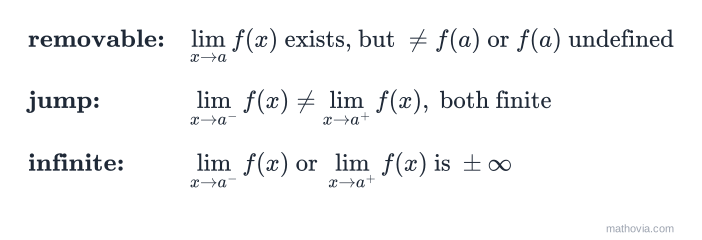
The continuity lesson gave a three-part test:
Removable Discontinuity
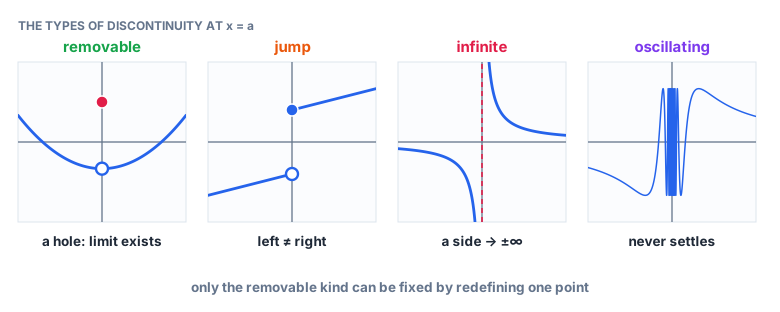
A removable discontinuity happens when
Example.
In rational functions, removable discontinuities come from factors that cancel between the top and bottom. The rational functions lesson calls them holes.
Jump Discontinuity
A jump discontinuity happens when both one-sided limits are finite numbers but they’re different. The graph jumps from one height to another, and the size of the jump is the difference between the two limits.
Example.
Jumps are typical of piecewise functions and step functions such as the floor function, which jumps by 1 at every integer. They also model real prices: a parking fee that rises by a fixed amount at the start of each hour jumps at every hour mark.
Infinite Discontinuity
An infinite discontinuity happens when at least one one-sided limit is
Example.
Oscillating Discontinuity
Occasionally a function neither settles nor blows up.
How to Find and Classify Points of Discontinuity
- List the candidates. Zeros of every denominator, edges of the domain (from roots and logs), and the points where a piecewise function changes formula. Everywhere else, familiar functions are continuous.
- Compute the one-sided limits at each candidate, and
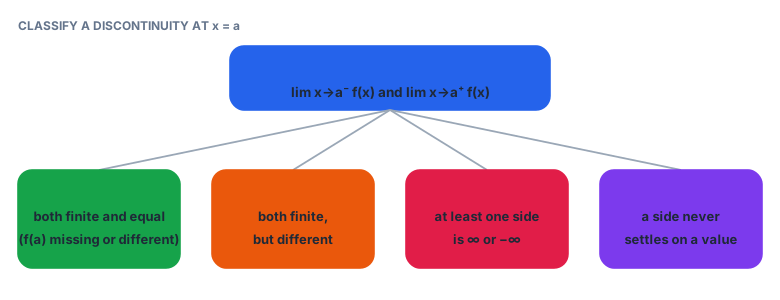
if it exists. - Classify with the flowchart: equal finite limits mean removable (unless they match
, in which case it’s continuous after all), different finite limits mean a jump, and an infinite side means an infinite discontinuity.
Worked Example: Two Types in One Function
Find and classify the discontinuities of
Factor:
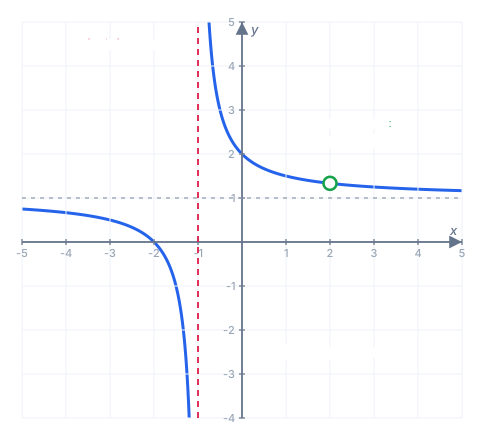
- At
: the factor cancels, leaving . The limit exists but doesn’t, so this is a removable discontinuity, a hole at . - At
: the simplified form gives , so the one-sided limits are infinite. This is an infinite discontinuity, with the vertical asymptote .
This is the standard pattern for rational functions: factors that cancel leave holes, and factors that stay in the denominator leave asymptotes.
Removable vs Non-Removable
The practical difference is whether the limit exists. If it does, the discontinuity is removable and a single redefinition fixes it. If it doesn’t, because the sides disagree (a jump), blow up (infinite) or never settle (oscillating), the discontinuity is non-removable. When a question asks for “the value that makes
Common Mistakes to Avoid
- Calling every zero of the denominator an asymptote. Cancel first; a cancelled factor gives a hole.
- Judging a jump from one side. You need both one-sided limits to see the jump.
- Thinking a dot fixes a jump. A filled dot at
doesn’t help if the two sides approach different heights. - Forgetting the switch points of a piecewise function. They’re the most common place for a jump.
Practice Problems
Work each one before opening the answer.
Problem 1. Classify the discontinuity of
Show answer
It simplifies to
Answer: removable
Problem 2. Classify the discontinuity of
Show answer
Answer: infinite
Problem 3. For
Show answer
Left limit 2, right limit 4: finite but different.
Answer: jump (of size 2)
Problem 4. What value of
Show answer
Answer:
Problem 5. Find and classify every discontinuity of
Show answer
Answer: removable at
Next, the intermediate value theorem: why a continuous function can’t skip any values, and how to use that to prove an equation has a solution.