Mathovia

Calculus / Calculus 1 · Derivatives

Higher-Order Derivatives

A higher-order derivative is what you get by differentiating again. The second derivative measures how fast the slope is changing, which is why it tells you how a graph bends and why it's acceleration in physics.

Practice Problems
Written by
MPhil in Mathematics, Founder of Mathovia
Published

Mathematics verification: Mathematical formulas, calculations, worked examples and solutions are reviewed for accuracy before publication. How we check our work

The derivative of a function is another function, so you can differentiate it again. The result is the second derivative, and you can keep going to the third, fourth and beyond. These higher-order derivatives aren’t just repetition. The second derivative measures how the slope itself is changing, which tells you how a graph bends and gives you acceleration in physics. Later it powers the second derivative test, concavity and Taylor series.
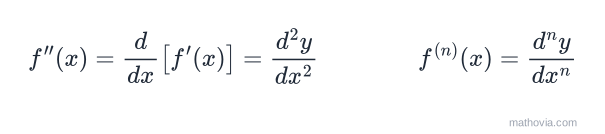
The second derivative f double prime of x is the derivative of f prime of x, written d squared y over d x squared. The nth derivative f superscript n of x is written d to the n y over d x to the n
The second derivative is the derivative of the derivative

What Is the Second Derivative?

The second derivative of is the derivative of . You find it in two passes: differentiate once with the rules you already know, then differentiate the answer.

Take . The power rule gives

and differentiating again gives

Keep going and you get the third derivative , then the fourth derivative . Every derivative after that is 0 as well.

Notation for Higher-Order Derivatives

OrderPrime notationLeibniz notationAlso written
First
Second
Third
Fourth
nth

Two details trip people up:

  • Brackets after three primes. Writing is hard to read, so from the fourth derivative on you put the order in brackets: . The brackets matter, because means to the fourth power.
  • Where the 2 goes in . It’s applied twice, . The “d” on top is used twice, and on the bottom it’s twice, written . It is not , and it is not .

What the Second Derivative Tells You
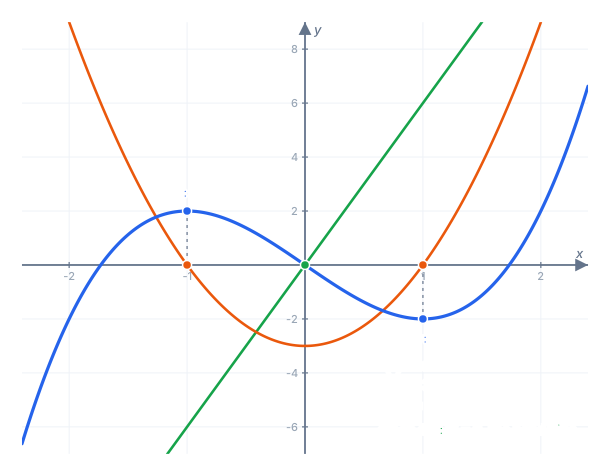
Graphs of f of x equals x cubed minus 3x in blue, its derivative 3x squared minus 3 in orange, and its second derivative 6x in green. The orange curve crosses zero at x equals minus 1 and 1, exactly below the peak and valley of the blue curve. The green line crosses zero at x equals 0, where the blue curve switches from bending down to bending up
f′ is zero at the peak and valley; f″ is zero where the bend flips

The first derivative is the slope. The second derivative is the rate of change of the slope: whether the slope is increasing or decreasing as you move right.

  • : the slope is increasing. The graph bends upward like a cup. This is called concave up.
  • : the slope is decreasing. The graph bends downward like a cap. This is concave down.
  • changes sign: the bend flips. That point is an inflection point.

Look at in the graph. For , is negative and the blue curve is shaped like a cap, with its peak at . For , is positive and the curve is a cup, with its valley at . At the bend switches.

The first derivative finds where the curve turns around ( at ). The second derivative tells you which way it bends there: , so is a peak; , so is a valley. That’s the idea behind the second derivative test, which you’ll use for optimization later in the course.

Position, Velocity and Acceleration

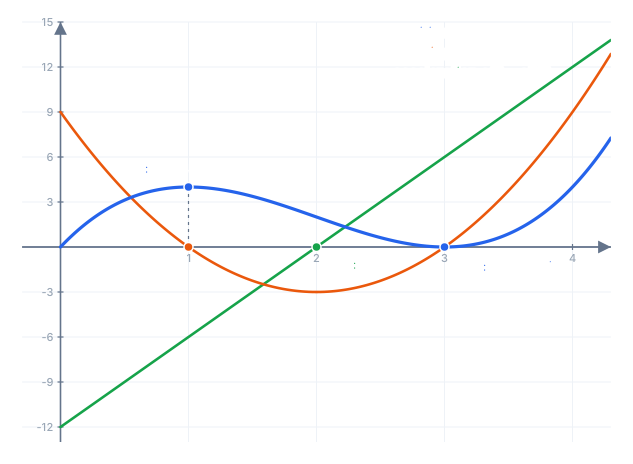
Position s of t equals t cubed minus 6 t squared plus 9t in blue, velocity in orange and acceleration in green, for t from 0 to about 4. The velocity is zero at t equals 1 and t equals 3, where the position curve turns around. The acceleration is zero at t equals 2
Velocity is the first derivative of position; acceleration is the second

If is the position of an object at time , then

Velocity is how fast the position changes. Acceleration is how fast the velocity changes. So yes, the second derivative of position is acceleration.

A particle moves along a line with meters after seconds.

Step 1 — velocity, the first derivative:

Step 2 — acceleration, the second derivative:

Step 3 — read the motion off the signs. The particle stops () at and . At the acceleration is m/s², so it’s being pushed backward, and it reverses. At it’s moving forward at 9 m/s but m/s², so it’s slowing down.

A useful rule: an object speeds up when and have the same sign and slows down when they have opposite signs. Here, between and , both are negative, so it’s moving backward and speeding up.

Example 1: A Polynomial All the Way Down

Find every derivative of .

DerivativeResult

Each pass lowers the degree by one, so a polynomial of degree has a constant th derivative, and every derivative after that is zero. The constant is times the leading coefficient: here .

Example 2: The Derivatives of sin x Repeat
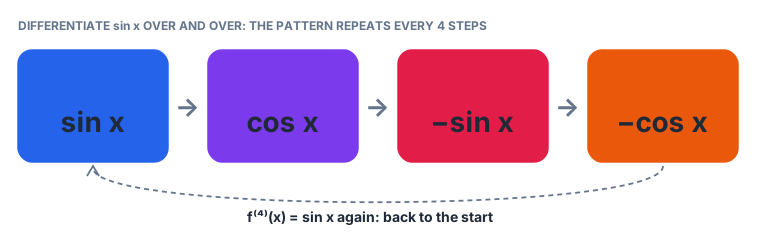
Four cards in a row: f of x equals sine x, f prime equals cosine x, f double prime equals minus sine x, f triple prime equals minus cosine x. An arrow loops from the last card back to the first: the fourth derivative is sine x again
Every fourth derivative of sin x brings you back to sin x

Using the derivatives of the trig functions:

The cycle has length 4. To find a high derivative, divide the order by 4 and look at the remainder. For the 99th derivative: , so it matches the third derivative, .

Notice that . Sine is a function whose second derivative is its own negative, and that’s why it describes springs and waves.

Example 3: The nth Derivative of e^(2x)

Find a formula for the th derivative of .

The chain rule brings out a factor of 2 every time:

The pattern is clear:

Example 4: Using the Product Rule Twice

Find for .

Step 1 — first derivative, by the product rule:

Step 2 — differentiate , again a product:

Simplifying before step 2 kept the second pass short. The pattern continues: .

Example 5: A Pattern With Factorials

Find the first four derivatives of , and the th.

Rewrite as so the power rule applies:

DerivativeResult

The signs alternate and the numbers are factorials, . So

Example 6: An Implicit Second Derivative

For the hyperbola , implicit differentiation gives , so . Find .

Step 1 — differentiate with the quotient rule, remembering depends on :

Step 2 — substitute :

Step 3 — use the original equation, , so :

Above the x-axis , so : those parts of the hyperbola bend down. Below the axis they bend up. The implicit differentiation lesson does the same calculation for a circle.

Common Mistakes

  • Squaring the first derivative. is not . For , , but .
  • Mixing up and . Brackets mean the fourth derivative; no brackets means the fourth power.
  • Forgetting the chain-rule factor on every pass. Each derivative of brings out another 2, so the third derivative is , not .
  • Treating as a constant in an implicit second derivative. It depends on , so substitute its formula in before simplifying.

Practice Problems

Try each one before opening the answer. The practice set has 12 more with instant checking.

Problem 1. Find for .

Show answer

Step 1 — first derivative:

Step 2 — differentiate again:

Answer:

Problem 2. Find for .

Show answer

Step 1 — write it as a power and differentiate:

Step 2 — differentiate again:

Answer:

Problem 3. Find the third derivative of .

Show answer

Each pass multiplies by :

Answer:

Problem 4. Find for .

Show answer

Step 1 — product rule:

Step 2 — product rule on the first term again:

Answer:

Problem 5. A particle has position . Find its acceleration at each time its velocity is zero.

Show answer

Step 1 — velocity:

So at and .

Step 2 — acceleration:

Step 3 — evaluate:

Answer: and

Problem 6. Find the 50th derivative of .

Show answer

The derivatives of cycle every 4: . Since , the 50th derivative matches the second.

Answer:

You can now differentiate a function as many times as you like. Next, the first derivative goes to work on geometry: finding the equation of the tangent line to any curve.

Frequently Asked Questions

What is the second derivative?+

The second derivative is the derivative of the derivative. If is the slope of , then is the rate at which that slope changes. For , and .

How do you find the second derivative?+

Find the first derivative with the usual rules, simplify it, then differentiate that result again. There is no separate formula: the second derivative of is just the first derivative of .

What does the second derivative tell you?+

It tells you how the graph bends. Where the slope is increasing and the graph is concave up, like a cup. Where the slope is decreasing and the graph is concave down, like a cap.

Is the second derivative acceleration?+

Yes, when the function is a position. If is position, then is velocity and is acceleration, the rate at which the velocity changes.

How do you write the second derivative?+

Common notations are , and . In the Leibniz form the 2 goes on top next to the and on the bottom after the , because it is applied twice to .

What is the nth derivative?+

The nth derivative, written or , is what you get after differentiating times. For example, every derivative of is , and the nth derivative of is .

Can the second derivative be zero when the first derivative isn't?+

Yes. For , but . The graph is still sloping down at ; it is just switching from bending down to bending up.

Related lessons