Mathovia

Calculus / Calculus 1 · Derivatives

Derivatives of Exponential and Logarithmic Functions

The derivative of eˣ is eˣ itself, and the derivative of ln x is 1/x. Every other exponential and logarithm rule comes from those two. Here are all four rules, where they come from, and how to use them with the chain, product and quotient rules.

Practice Problems
Written by
MPhil in Mathematics, Founder of Mathovia
Published

Mathematics verification: Mathematical formulas, calculations, worked examples and solutions are reviewed for accuracy before publication. How we check our work

Money growing at a fixed rate, a cooling cup of coffee, a population of bacteria, the loudness of a sound in decibels: exponentials and logarithms are everywhere, and calculus is how you measure how fast they change. Two facts carry the whole topic. The derivative of is , and the derivative of is . Once those make sense, the rules for other bases are one small step away.
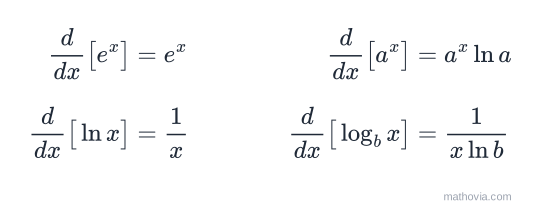
The four rules: the derivative of e to the x is e to the x, of a to the x is a to the x times ln a, of ln x is 1 over x, and of log base b of x is 1 over x ln b
The derivatives of exponential and logarithmic functions

The Four Rules

FunctionDerivativeWith an inside function

The first two rows are exponentials, with the variable up in the exponent. That makes them a different animal from powers like , and the power rule doesn’t apply to them. The last two rows are their inverses, the logarithms. If the log notation feels rusty, the common and natural logarithms review covers what and mean.

The Derivative of e^x

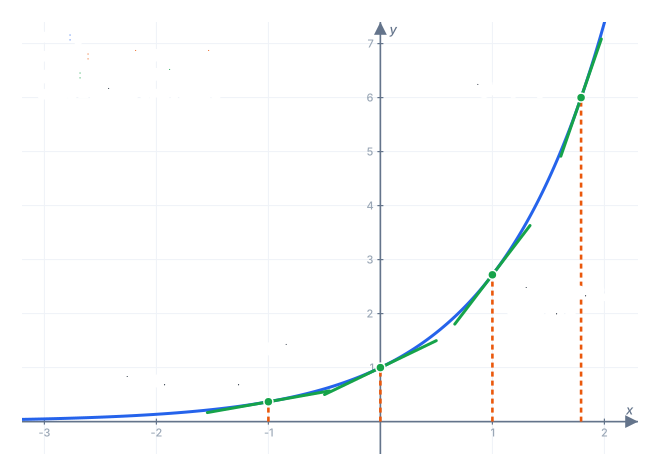
Graph of y equals e to the x with tangent lines at four points. At x equals minus 1 the height and the slope are both 0.37, at x equals 0 both are 1, at x equals 1 both are e, about 2.72, and where the height is 6 the slope is also 6
On y = eˣ, the slope at every point is the same as the height

Here’s the headline:

The function is its own derivative. Look at what that means on the graph. Where the curve is at height 1, its tangent line has slope 1. Where it’s at height 6, the slope is 6. The higher it climbs, the faster it climbs, and the two numbers always match.

To see why, start from the limit definition of the derivative and use the exponent rule :

The factor comes out of the limit because it doesn’t depend on . What’s left, , is the slope of at . Try a few small values of : at it’s about 1.052, at it’s 1.005, at it’s 1.0005. The limit is exactly 1, so the derivative is .

That limit being 1 isn’t luck. It’s the reason the number is special in the first place.

Why e? The Derivative of a^x

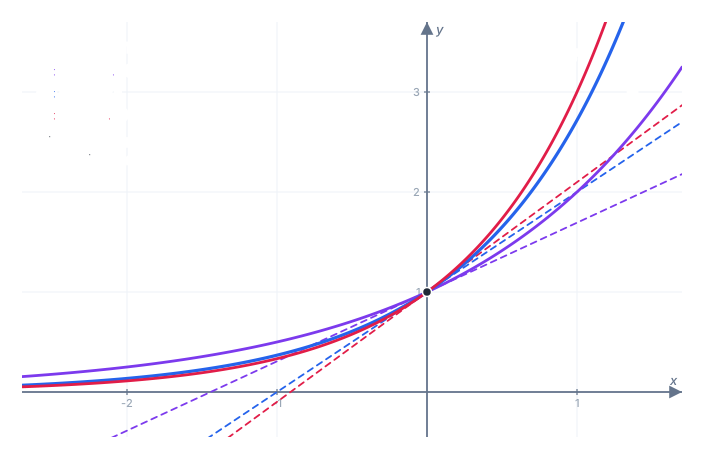
The graphs of 2 to the x, e to the x and 3 to the x all pass through the point 0, 1. Their tangent lines there have slopes ln 2, about 0.69, exactly 1, and ln 3, about 1.10. e is the base whose slope at x equals 0 is exactly 1
Of all the exponential curves through (0, 1), y = eˣ is the one with slope exactly 1 there

Run the same limit argument on any base and you get

The derivative is always the function itself times a constant, the slope of the curve at . For that constant is about 0.693, so grows a bit slower than its own height. For it’s about 1.099, a bit faster. Somewhere between 2 and 3 there’s a base where the constant is exactly 1, and that base is . In other words, is chosen so that the rule comes out clean, the same way radians were chosen to make the derivatives of trig functions clean.

Those mystery constants, 0.693 and 1.099, are and . Here’s the proof. Any base can be rewritten with , because :

Now the chain rule finishes it. The outside is , the inside is , and the inside’s derivative is just the constant :

So and . Put in and , so you’re back to .

The Derivative of ln x

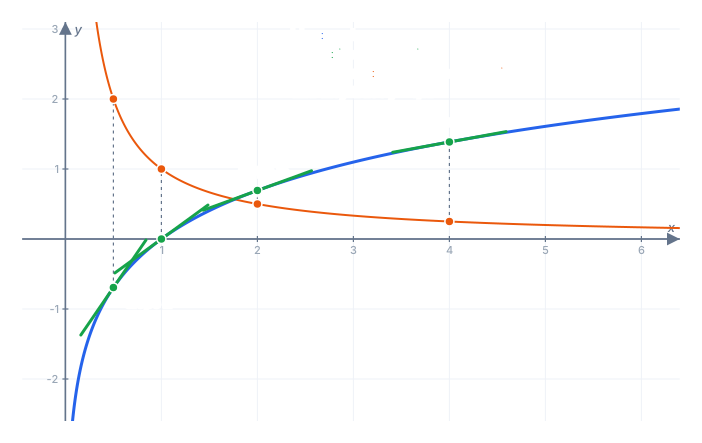
Graph of y equals ln x with tangent lines at x equals one half, 1, 2 and 4. Their slopes are 2, 1, one half and one quarter. Plotting each slope as a height gives orange dots that lie on the curve y equals 1 over x
The slopes of ln x are 2, 1, ½, ¼ at x = ½, 1, 2, 4: exactly the values of 1/x

The natural log has the simplest derivative you could hope for:

The graph backs it up. Near the log curve shoots up steeply; at its slope is 1; further right it keeps rising, but more and more gently, with slope at and at . Plot those slopes as heights and they land on the curve .

The proof uses the fact that and undo each other. If , then

Differentiate both sides with respect to . The right side gives 1. On the left, is a function of , so the chain rule gives :

The last step swaps back for . (This trick of differentiating both sides of an equation has a name, implicit differentiation, and it gets its own lesson later in the course.)

The mirror-image picture

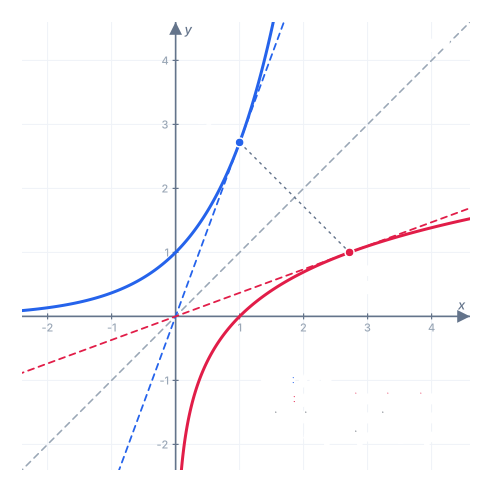
The graphs of e to the x and ln x are reflections of each other across the line y equals x. The point 1, e on the exponential curve has slope e, and its mirror point e, 1 on the log curve has slope 1 over e. Both tangent lines pass through the origin
Reflecting across y = x swaps rise and run, so slope e becomes slope 1/e

There’s a second way to see the same result. The graph of is the graph of reflected across the line , because they’re inverse functions. Reflecting swaps the roles of and , so every rise becomes a run and every slope flips to its reciprocal. The point on the exponential has slope , so its mirror point on the log curve has slope . And is exactly at .

What about negative x?

only exists for , but is defined for every , and its derivative is also . On the left side, , and the chain rule gives . This version matters later, when you run the rule backwards to integrate .

The Derivative of log x in Any Base

For a log with some other base , the change of base formula turns it into a natural log divided by a constant:

is just a number, so it rides along while you differentiate:

For the common log that’s . Notice that shows up in both base- rules: it multiplies in the derivative of and divides in the derivative of . With base it equals 1 and quietly disappears, which is why calculus prefers and whenever it can.

One warning about notation. In algebra and on most calculators, means base 10. In many calculus and university textbooks, means the natural log, and then its derivative is plain . If a problem writes with no base, check which convention your course uses.

Exponential and Log Derivatives With the Chain Rule

Most problems put something more complicated than in the exponent or inside the log. The chain rule handles it the usual way: differentiate the outside, leave the inside alone, and multiply by the inside’s derivative.

So an exponential keeps its exact form and picks up the derivative of its exponent:

And the derivative of a log is “the derivative of the inside over the inside”:

Two short ones catch a lot of students out. The derivative of is , exactly the same as the derivative of . That makes sense once you use the logarithm rules: , and the graph of is just shifted up by the constant , which doesn’t change any slopes. And the derivative of on its own is 0, because is a number, not a function.

Example 1: e to the 2x

Differentiate .

The exponent is , with :

The exponential itself doesn’t change. It gets multiplied by the derivative of what’s upstairs.

Example 2: The Derivative of ln 2x

Differentiate .

With and :

The 2s cancel. The same thing happens for , , or with any positive constant : the derivative is always .

Example 3: x e^x

Differentiate .

This is a product, so use the product rule with and :

Factoring out is the standard final form. Since is never zero, it also tells you straight away that the slope is zero only at .

Example 4: ln of a Polynomial

Differentiate .

Derivative of the inside over the inside:

No need to expand or simplify further; this is the answer.

Example 5: Other Bases

Differentiate .

Each term uses its base- rule:

The most common slip here is writing for the first term. That’s the power rule, and it only works when the variable is in the base, not the exponent.

Example 6: Use the Log Rules First

Differentiate .

You could use the chain rule on the whole thing, but the quotient that comes out is ugly. Break the log apart first, using and :

Now each piece is easy:

Whenever a log has products, quotients or powers inside it, simplify before you differentiate. Pushing that idea further gives a technique called logarithmic differentiation, which turns messy products into sums.

Example 7: A Tangent Line to ln x

Find the tangent line to at .

The point is , since . The slope is at , which is . In point-slope form:

The tangent line passes straight through the origin. That’s the dashed rose line in the mirror-image figure above, and its reflection is the tangent to at , the line .

Common Mistakes

  • Using the power rule on . is , not . The power rule needs the variable in the base.
  • Forgetting the chain rule factor. , not .
  • Writing for the derivative of . The inside’s derivative, 2, cancels it back to .
  • Differentiating a constant log. , and are numbers, so their derivatives are 0.
  • Dropping . The derivative of is , and the derivative of is . Only base lets you skip it.
  • Mixing up and . The first is , with derivative . The second needs the chain rule: .

Practice Problems

Work each one out before opening the answer. The practice set has 12 more with instant checking.

Problem 1. Differentiate .

Show answer

Each term on its own: .

Answer:

Problem 2. Differentiate .

Show answer

Chain rule: .

Answer:

Problem 3. Differentiate .

Show answer

Product rule: .

Answer:

Problem 4. Differentiate .

Show answer

Derivative of the inside over the inside.

Answer:

Problem 5. Find the slope of at .

Show answer

, so the slope is .

Answer:

With exponentials and logs added, you can now differentiate almost every function you met in algebra. One family is left: the inverse trig functions, whose derivatives turn out to be fractions and square roots with no trig in them at all.

Frequently Asked Questions

What is the derivative of ln x?+

The derivative of is , for . More generally, for every . It comes from writing as and differentiating both sides.

What is the derivative of e^x?+

The derivative of is . It is the only function (apart from multiples of it) that is its own derivative, which means the slope of its graph at every point equals the height of the graph there.

What is the derivative of e^2x?+

The derivative of is . By the chain rule, the exponential stays the same and gets multiplied by the derivative of the exponent, which is 2.

What is the derivative of ln 2x?+

The derivative of is , not . The chain rule gives . You can also see it from the log rules: , and the constant has derivative 0.

What is the derivative of ln 2?+

The derivative of is 0. is a constant number, not a function of , so its derivative is zero like any other constant.

What is the derivative of log x?+

For a logarithm with base , . So the derivative of the common log is . In many calculus books means the natural log, and then its derivative is simply .

What is the derivative of a^x?+

for any base . For example, the derivative of is . When , and the rule becomes .

Related lessons