Mathovia

Calculus / Calculus 1 · Limits

Limit Laws

The limit laws are the rules that let you work out a limit piece by piece instead of with a table or a graph. Split a complicated expression into simple parts, take the limit of each part, and put the answers back together. For most functions they lead straight to one shortcut: just substitute.

Practice Problems
Written by
MPhil in Mathematics, Founder of Mathovia
Published

Mathematics verification: Mathematical formulas, calculations, worked examples and solutions are reviewed for accuracy before publication. How we check our work

So far, limits have come from tables and graphs. That works, but it’s slow, and a table only ever suggests an answer. The limit laws (also called the rules of limits or the properties of limits) turn finding a limit into algebra. They say that limits behave the way you’d hope: the limit of a sum is the sum of the limits, the limit of a product is the product of the limits, and so on. Put together, they explain why you can usually just substitute, and they show exactly when you can’t.
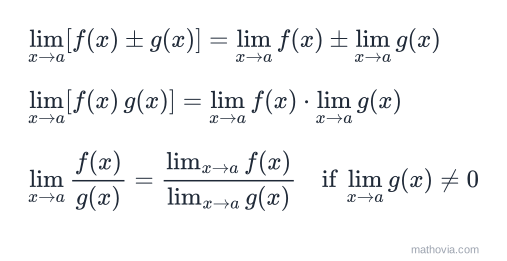
The sum and difference law, the product law and the quotient law for limits; the quotient law needs the limit of g to be nonzero
The three laws you'll use most

The Limit Laws

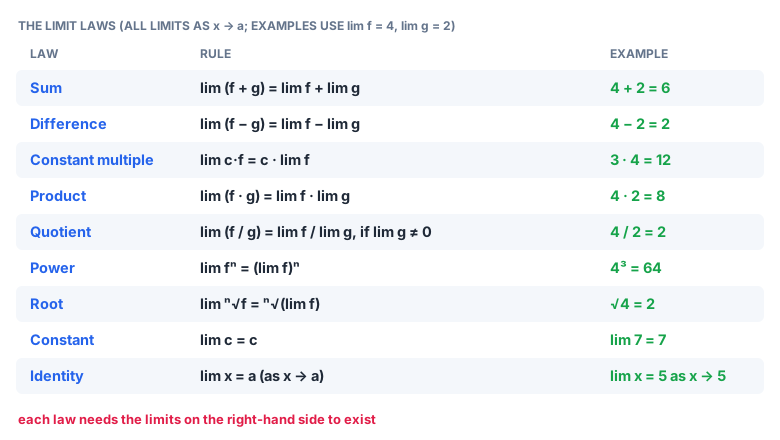
Suppose is a constant and the limits and both exist. Then:

Table of the limit laws with examples using lim f = 4 and lim g = 2: sum 6, difference 2, constant multiple 3 times 4 = 12, product 8, quotient 2 if lim g is not 0, power 4 cubed = 64, root square root of 4 = 2, constant lim 7 = 7, identity lim x = a
Every rule of limits on one card
  1. Sum law:
  2. Difference law:
  3. Constant multiple law:
  4. Product law:
  5. Quotient law: , as long as
  6. Power law: for a positive integer
  7. Root law: , assuming the root is defined (for even , the limit must be positive)

Two basic limits complete the toolkit: (a constant stays put) and (the input heads for , so does too).

What the Sum Law Looks Like

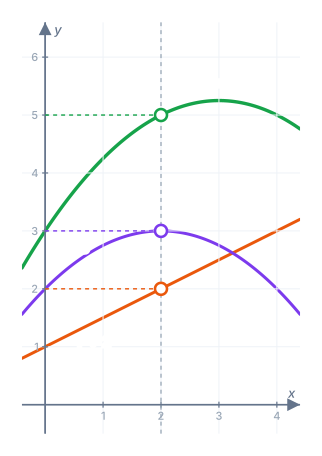
Graphs of f approaching 2, g approaching 3 and f plus g approaching 5 as x approaches 2, each marked with an open circle at x = 2
If f heads for 2 and g heads for 3, f + g heads for 5

The laws match intuition. If is getting close to 2 and is getting close to 3, their sum can’t help getting close to 5. The other laws work the same way for differences, products and quotients.

Example 1: A Polynomial, Step by Step

Find .

by the sum, difference and constant multiple laws. By the power law and the two basic limits, that’s

Notice the final line is just . That’s no accident.

Direct Substitution

Example 1 shows a general fact. Every polynomial is built from constants and using sums, products and powers, so the limit laws always give back the value at :

The same holds for a rational function whenever , and for roots, trig, exponential and log functions at points inside their domains. This is the direct substitution property, and it’s how most limits are found in practice. Functions that obey it are called continuous, which gets its own lesson later in this chapter.

Example 2: Using Given Limits

Suppose and . Find each limit as .

Questions like this appear on almost every test, because they check that you know the laws without any algebra getting in the way.

Example 3: The Quotient and Root Laws

Find and .

The denominator’s limit is , so the quotient law applies: .

For the root, the inside approaches , which is positive, so .

Example 4: Trig and Exponential Functions

Find .

Cosine and are defined everywhere and have no breaks, so substitution works for each, and the sum law adds them: . Remember to use radians for trig limits; the radians and degrees lesson explains why.

When the Laws Don’t Apply Directly

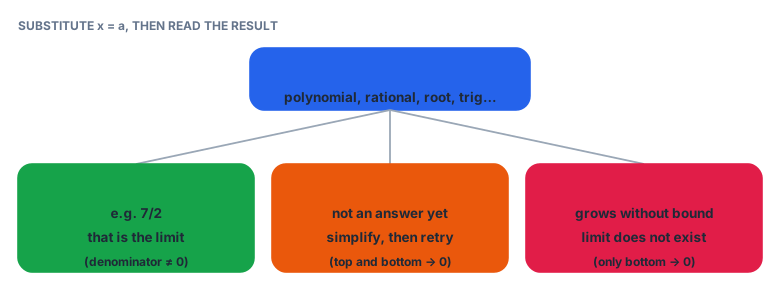
Decision card: substitute x = a. A number means that is the limit. 0 over 0 means simplify and retry. A nonzero number over 0 means the function grows without bound and the limit does not exist
What the result of substituting tells you

The quotient law has a condition, and it matters. Try : the denominator’s limit is 0, so the law says nothing. Substituting gives , which is called an indeterminate form. It doesn’t mean the limit is 0, and it doesn’t mean the limit fails; it means you have more work to do. Factoring gives for , so the limit is 6. The next lesson, on evaluating limits, collects all the algebraic techniques for this situation.

If only the denominator approaches 0, say , the fraction grows without bound and the limit does not exist, as with the one-sided limits of .

The laws also need each separate limit to exist. and both blow up at 0, so you can’t split with the sum law. Simplify first: the expression is 0 for every , so its limit is 0.

The Laws Work for One-Sided Limits Too

Every law above still holds if you replace with or . That’s useful at the edge of a domain, where only one side makes sense. For example,

using the sum law with the right-hand limit of , which is 0. The same laws also carry over to limits as , which you’ll meet in the lesson on limits at infinity. Whatever kind of limit you’re taking, the rules of limits let you split it into pieces, as long as each piece has a limit of its own.

Common Mistakes to Avoid

  • Using the quotient law when the bottom goes to 0. Check the denominator’s limit before dividing.
  • Reading 0/0 as an answer. It’s a signal to simplify, not a result.
  • Splitting limits that don’t exist. Each piece must have a limit for the laws to work.
  • Forgetting the domain in the root law. can’t be found by substitution, because isn’t real.

Practice Problems

Work each one before opening the answer.

Problem 1. Find .

Show answer

Direct substitution: .

Answer: 5

Problem 2. If and , find .

Show answer

Power and difference laws: .

Answer: 4

Problem 3. Find .

Show answer

The denominator approaches , so divide the limits: .

Answer: 1

Problem 4. Find .

Show answer

The inside approaches 16, so the root law gives .

Answer: 4

Problem 5. Can the quotient law be used for ? Find the limit.

Show answer

No: the denominator approaches 0 and substitution gives . Factor: , which approaches 2.

Answer: 2

Next, evaluating limits: factoring, rationalizing, combining fractions and the other algebraic techniques for limits that start out as 0/0.

Frequently Asked Questions

What are the limit laws?+

They are rules for combining limits. If and both exist as , then the limit of a sum, difference, constant multiple, product, power or root is that same combination of the separate limits. The limit of a quotient is the quotient of the limits, as long as the denominator's limit isn't 0.

What is the quotient rule for limits?+

, provided . If the denominator's limit is 0, the rule doesn't apply and you need another method, such as factoring and cancelling.

What is direct substitution for limits?+

For polynomials, rational functions (where the denominator isn't 0), roots, and the trig, exponential and log functions inside their domains, the limit as is just the value at . The limit laws prove this, so you can substitute directly.

Can you use the limit laws if one limit doesn't exist?+

No. Each law assumes the separate limits exist. For example, and have no limit at 0, so the sum law can't be used, even though their sum is 0 everywhere and has limit 0.

What does it mean if substitution gives 0/0?+

It means the quotient law can't be applied yet, not that the limit is 0 or doesn't exist. Simplify first, for example by factoring and cancelling, rationalizing or combining fractions, then substitute again.

Related lessons