
Some functions behave differently on each side of a point. A piecewise function can switch formulas, a square root can stop at the edge of its domain, and a fraction can blow up in opposite directions. In each case it helps to ask about one side at a time. That’s what one-sided limits do, and they’re how you decide whether an ordinary two-sided limit exists at all.

What Is a One-Sided Limit?
The left-hand limit
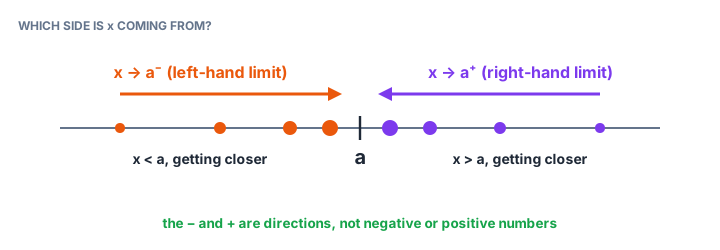
The small minus and plus are directions only.
That rule is what you were using in finding limits from a graph when you traced the curve from each side.
How to Find One-Sided Limits
- Decide which values of
count: just below for , just above for . - Use only the rule that applies there. For a piecewise function, that means one piece.
- Substitute, simplify or check signs, exactly as for any limit.
- Compare the two sides if the question asks about the two-sided limit.
Example 1: A Piecewise Function With a Jump
Find the one-sided limits at
From the left,
From the right,
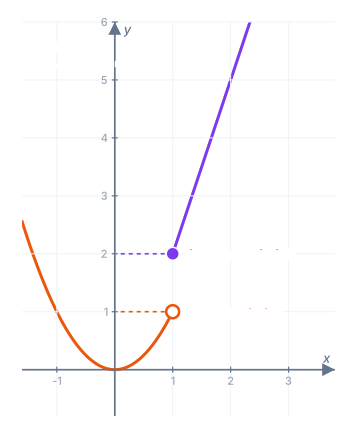
The sides disagree, so
Example 2: Pieces That Meet
Find
From the left:
Example 3: An Absolute Value Quotient
Find the one-sided limits of
Remember that
- For
, is positive, so the fraction is . The right-hand limit is 1. - For
, is negative, so the fraction is . The left-hand limit is .
The two-sided limit does not exist. Fractions with an absolute value over the same expression always behave like this: they’re a jump from
Example 4: The Edge of a Domain
Find
As
Example 5: Infinite One-Sided Limits
Describe
The numerator stays at 1 while the denominator shrinks to 0, so the size of the fraction grows without bound. The sign decides the direction:
- Just right of 2, e.g.
, the denominator is and the fraction is . So . - Just left of 2, e.g.
, the denominator is and the fraction is . So .
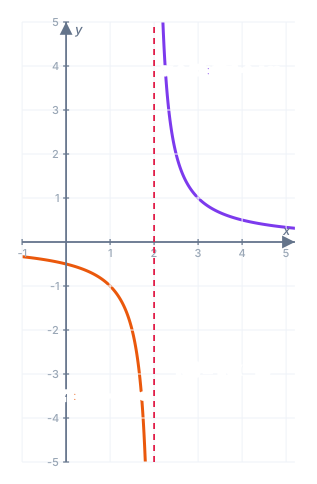
This sign check is the quickest way to describe a function near a vertical asymptote. The lesson on infinite limits builds on it.
Example 6: A Step Function
The floor function
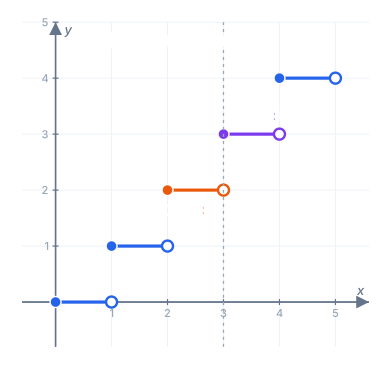
Just below 3, values like 2.99 round down to 2, so
Step functions like this model real prices. A parking garage that charges 4 dollars for each started hour, or postage that rises at each weight band, has a jump at every boundary, and the one-sided limits tell you the price just before and just after it.
Common Mistakes to Avoid
- Reading the minus sign as a negative number.
approaches positive 2 from below. - Using the wrong piece. For
, use the piece for , even if the piece for includes itself. - Assuming the two-sided limit exists because one side does. Both sides must exist and agree.
- Guessing the sign of an infinite limit. Test a value just beside
to see whether the function heads up or down.
Practice Problems
Work each one before opening the answer.
Problem 1. For
Show answer
Left:
Answer: 5 from the left, 2 from the right, so the two-sided limit does not exist
Problem 2. Find
Show answer
For
Answer:
Problem 3. Find
Show answer
For
Answer: 0
Problem 4. Describe
Show answer
At
Answer:
Problem 5. Find
Show answer
Just below 1, values round down to 0; just above 1, they round down to 1.
Answer: 0 from the left, 1 from the right
Next come the limit laws: the rules that let you split a limit into sums, products and quotients and work it out without a table or a graph.