Mathovia

Calculus / Calculus 1 · Integrals

Average Value of a Function

The average value of a function is the height of the rectangle that has the same area as the region under the curve. You find it by integrating over the interval and dividing by the interval's length.

Practice Problems
Written by
MPhil in Mathematics, Founder of Mathovia
Published

Mathematics verification: Mathematical formulas, calculations, worked examples and solutions are reviewed for accuracy before publication. How we check our work

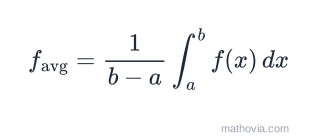
The average value of a function on an interval is the integral of over the interval divided by the interval’s length:

For example, the average value of on is . It’s the calculus version of “add up the values and divide by how many there are”, for a function that has infinitely many values.

The average value formula: f average equals one over b minus a times the integral from a to b of f of x d x
The average value formula

What the Average Value Means

Multiply both sides of the formula by :

The left side is the area of a rectangle with width and height . The right side is the area under the curve. So the average value is the height of the rectangle with the same area as the region under the graph.

Picture the region as water in a tank with a wavy surface. Let the water settle and it becomes flat. The height of that flat surface is the average value. The parts of the graph above the line fill the gaps below it exactly.
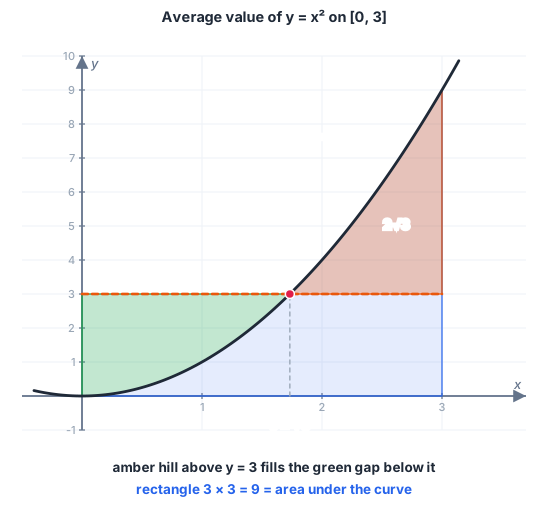
The graph of y equals x squared from 0 to 3 with the area under it shaded. A dashed line at height 3 marks the average value. The part of the curve above the line, from square root of 3 to 3, has area 2 root 3, and exactly fills the gap between the line and the curve from 0 to square root of 3, which also has area 2 root 3. The rectangle of height 3 and width 3 has area 9, equal to the area under the curve
The rectangle of height 3 has the same area, 9, as the region under y = x²

Where the Formula Comes From

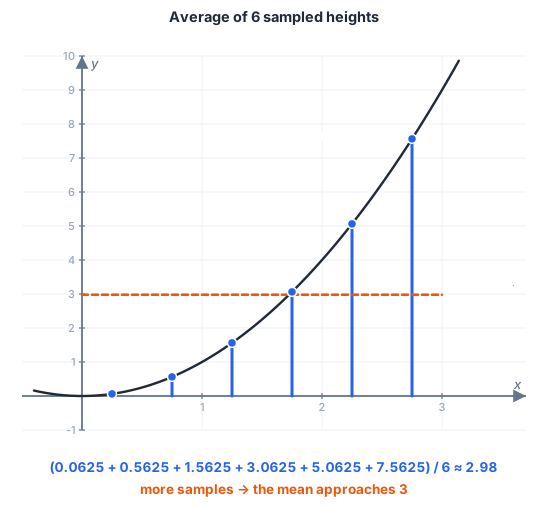
For a list of numbers, the average is the sum divided by the count. To average a function, sample it. Split into equal pieces of width , pick a point in each, and average the heights:

Since , this is

The sum is a Riemann sum. As , it becomes the definite integral, and the sample average becomes .

Six vertical bars at the midpoints 0.25, 0.75, up to 2.75 under y equals x squared, with heights 0.0625, 0.5625, 1.5625, 3.0625, 5.0625 and 7.5625. Their mean, about 2.98, is drawn as a dashed line, already close to the exact average value 3
Six samples of y = x² average 2.98; with more samples the mean approaches 3

How to Find the Average Value of a Function

  1. Identify and the interval .
  2. Integrate: evaluate with the fundamental theorem of calculus.
  3. Divide by the length .
  4. Sanity-check: the answer should lie between the smallest and largest values of on the interval.

Example 1: A Polynomial

Find the average value of on .

The interval has length , so

Check: and , and 16 lies between them.

Example 2: Sine Over Half a Period

Find the average value of on .

The arch reaches 1, but it spends much of its time lower, so the average is about 0.64. Over a full period the average is 0: the positive and negative halves cancel.

Example 3: The Function 1/x

Find the average value of on .

Example 4: Using U-Substitution

Find the average value of on .

Use u-substitution with , so . The limits become and :

Example 5: Average Temperature

The temperature hours after 6 a.m. is degrees Fahrenheit. Find the average temperature from 6 a.m. to 6 p.m.

The interval is . The constant 50 averages to 50. For the sine term, . So

The day peaks at 64°F at noon, but the average over the 12 hours is about 58.9°F.

Example 6: Average Velocity

A particle moves with velocity m/s. Find its average velocity on .

The integral of velocity is the displacement (the net change), so the average value of velocity is displacement divided by time, the same “average velocity” you met in algebra.

Average Value Can Be Zero or Negative

The integral counts area below the x-axis as negative, so the average value can be negative. For on :

That makes sense: the graph spends more of the interval below the axis than above.

Mean Value Theorem for Integrals

The mean value theorem for integrals says a continuous function actually reaches its average value.

Mean value theorem for integrals. If is continuous on , there is at least one number in such that

or equivalently

The reason is that a continuous function on a closed interval has a minimum and a maximum . Its average lies between them, and by the intermediate value theorem the function takes every value between and , including the average.

It’s also the mean value theorem in disguise. Let . The mean value theorem gives a with . Since and , that’s exactly .

To find c: compute the average value, set equal to it, solve, and keep the solutions in .

Example 7. Find the value of guaranteed by the mean value theorem for integrals for on .

The average value is 3, so and . Only is in . This is the point in the first figure where the curve crosses the dashed line.

Example 8. Find for on .

From Example 1, . Solve :

So or . Only lies in .

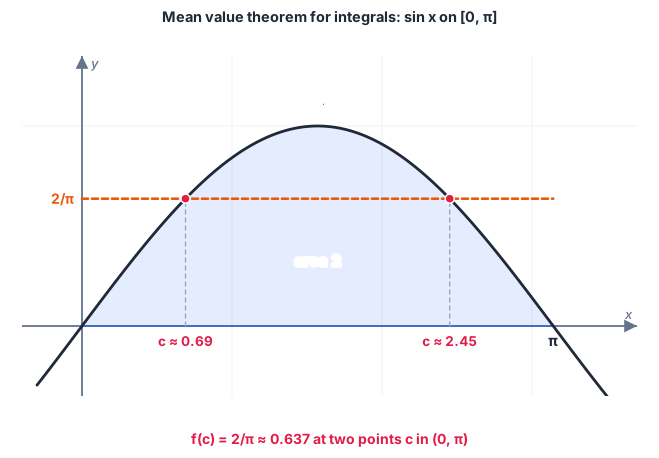
There can be more than one . For on , the average is reached twice:

The arch of y equals sine x from 0 to pi, with area 2 shaded. A dashed line at height 2 over pi, about 0.637, crosses the arch at two points, c approximately 0.69 and c approximately 2.45
sin x reaches its average value 2/π at two points

Average Value vs Average Rate of Change

These two are easy to mix up:

FormulaMeasures
Average value of the average height of the graph
Average rate of change of the average slope of the graph

They’re connected by the fundamental theorem: . So the average rate of change of is the average value of . In Example 6, the average value of velocity is the average rate of change of position.

Common Mistakes

  • Forgetting to divide by . The integral alone is an area, not an average.
  • Dividing by instead of . On , the length is 3, not 4.
  • Using . Averaging the endpoint values only works for linear functions. For on it gives 4.5, not 3.
  • Confusing average value with average rate of change. One averages , the other averages .
  • Keeping a outside the interval in the mean value theorem for integrals.

For more on both topics, see Sections 5.1 and 5.3 of the free textbook OpenStax Calculus Volume 1.

Practice Problems

Try each one before opening the answer. The practice set has 12 more with instant checking.

Problem 1. Find the average value of on .

Show answer

. Divide by .

Answer:

Problem 2. Find the average value of on .

Show answer

. Divide by 2.

Answer:

Problem 3. Find the average value of on .

Show answer

. Divide by .

Answer:

Problem 4. Find the average value of on .

Show answer

. The length is 1.

Answer:

Problem 5. Find the value of guaranteed by the mean value theorem for integrals for on .

Show answer

. Solve and keep the positive root.

Answer:

Problem 6. Find the average value of on .

Show answer

With , . The length is 1.

Answer:

The average value of a function closes the Integrals chapter of Calculus 1. Calculus 2 builds on it with more integration techniques and applications such as area between curves and volume.

Frequently Asked Questions

What is the formula for the average value of a function?+

The average value of on is . Integrate the function over the interval, then divide by the length of the interval.

How do you find the average value of a function on an interval?+

Compute the definite integral with the fundamental theorem of calculus, then divide by . For on , the integral is 9 and the length is 3, so the average value is 3.

What is the mean value theorem for integrals?+

If is continuous on , there is at least one number in where equals the average value: , or equivalently . The function actually reaches its average height somewhere on the interval.

How do you find c in the mean value theorem for integrals?+

First find the average value, then set equal to it and solve for . Keep only the solutions inside . For on , the average value is 3, so and .

Can the average value of a function be negative?+

Yes. The integral measures net signed area, so if more of the graph lies below the x-axis than above, the average value is negative. For on , the integral is and the average value is .

What is the difference between average value and average rate of change?+

The average value of is the average of its outputs, . The average rate of change is the average slope, . They're related: the average rate of change of is the average value of .

Related lessons