
What’s the derivative of
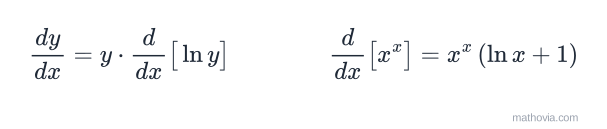
Why the Usual Rules Don’t Work on xˣ
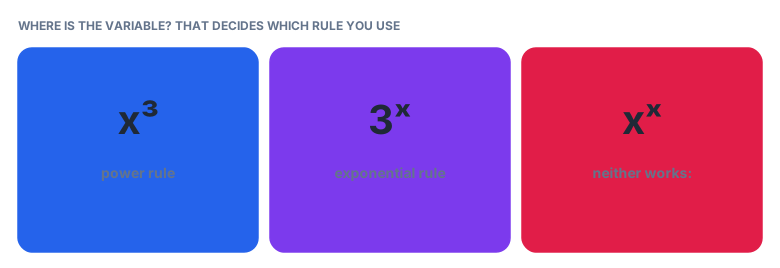
You already have a rule for a variable in the base, the power rule:
The way out is a logarithm. Taking
How to Do Logarithmic Differentiation: 4 Steps
- Take
of both sides of . - Expand with the logarithm rules:
, , and . - Differentiate both sides with respect to
. The left side, , becomes by the chain rule, just as in implicit differentiation. - Multiply both sides by
, then replace with the original function.
Step 4 is the one people forget. After step 3 you’ve found
Example 1: The Derivative of x to the x
Find
Take logs and bring the exponent down:
Differentiate. The right side is a product, so use the product rule:
Multiply by
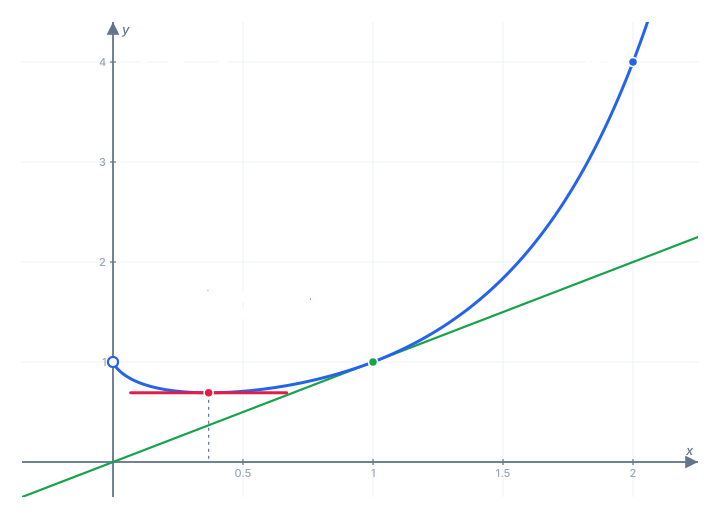
The graph confirms it. At
Here’s a nice check on the answer. Expand it:
Example 2: A Messy Product and Quotient
Find
The quotient rule would work, with the product rule inside the numerator and the chain rule inside that. Logs are faster. Expand completely before differentiating:
Each term is now a simple log, so differentiate term by term:
Multiply by
Leaving the answer in this ”
Example 3: A Variable Power of sin x
Find
Product rule on the right:
Example 4: A Function Raised to a Power of x
Find
The product rule, with the chain rule for
Example 5: Where Is x^(1/x) Largest?
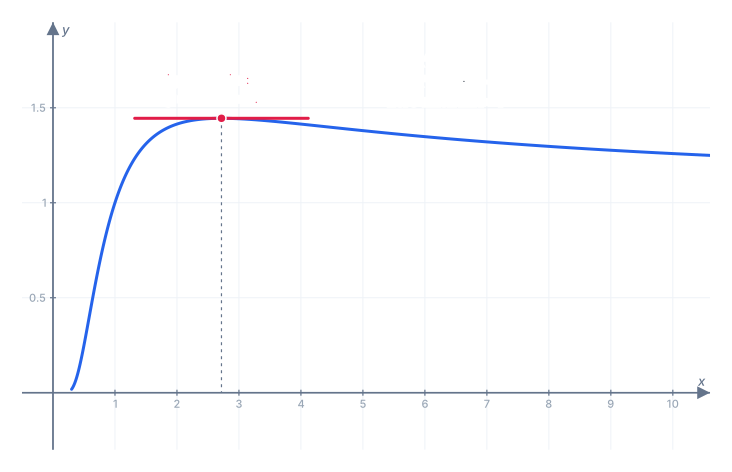
Find where
This is the
So
Example 6: The Power Rule for Any Exponent
The power rule lesson said that
Three lines, and it works for any constant
The Logarithmic Derivative
The quantity
Its most useful property is the one Example 2 relied on: the logarithmic derivative of a product is the sum of the logarithmic derivatives of the factors. For
Multiply through by
When to Use Logarithmic Differentiation
- The variable is in the base and the exponent:
, , . Here it’s essentially required. - A long product or quotient, especially with powers and roots, like Example 2.
- Not for simple functions. For
, the product rule is quicker than taking logs.
Common Mistakes
- Forgetting to multiply by
at the end. Step 3 gives ; the derivative is times that. - Writing
. It’s , because depends on . - Inventing log rules.
does not split into . Only products, quotients and powers expand. - Using the power rule on
. is only half of the answer. - Leaving
in the final answer. Replace it with the original function.
Practice Problems
Try each one before opening the answer. The practice set has 12 more with instant checking.
Problem 1. Differentiate
Show answer
Answer:
Problem 2. Differentiate
Show answer
Answer:
Problem 3. Differentiate
Show answer
Answer:
Problem 4. Differentiate
Show answer
Answer:
Problem 5. Find the slope of
Show answer
Answer:
That’s the last of the differentiation techniques in this chapter. What’s left is putting them to work: higher-order derivatives, and finding tangent lines to any curve you can now differentiate.