Mathovia

Calculus / Calculus 1 · Applications of Derivatives

Concavity and Inflection Points

A graph is concave up where it bends like a cup and concave down where it bends like a cap. The second derivative decides which: f″ > 0 means concave up, f″ < 0 means concave down. An inflection point is where the concavity switches.

Practice Problems
Written by
MPhil in Mathematics, Founder of Mathovia
Published

Mathematics verification: Mathematical formulas, calculations, worked examples and solutions are reviewed for accuracy before publication. How we check our work

The first derivative tells you whether a graph is going up or down. The second derivative tells you how it bends. Two graphs can both be rising, one curving up more and more steeply and the other leveling off. That difference is concavity, and the points where the bending switches direction are inflection points. Together with the sign of , they give you an accurate picture of a graph’s shape.

If f double prime of x is greater than 0, concave up. If f double prime of x is less than 0, concave down
The concavity test in one line

What Concavity Means

A function is concave up on an interval if its slope is increasing there. The graph curves upward like a cup, and each tangent line sits below the curve. A function is concave down if its slope is decreasing. The graph curves downward like a cap, and each tangent line sits above the curve.
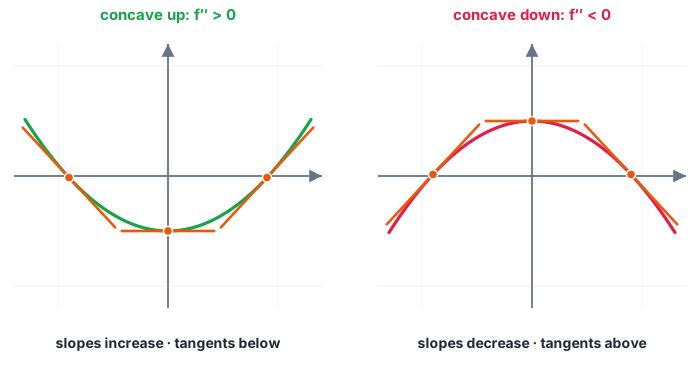
Left: a concave up curve shaped like a cup, with three tangent lines below it whose slopes increase from left to right. Right: a concave down curve shaped like a cap, with three tangent lines above it whose slopes decrease from left to right
Concave up: slopes increase. Concave down: slopes decrease

Concavity is separate from increasing and decreasing. A concave up graph can be falling (the left side of a cup) or rising (the right side). What matters is whether the slope is getting bigger or smaller.

The Concavity Test

Since is the derivative of , its sign tells you whether the slope is increasing or decreasing:

Concavity test.

  • If on an interval, then is concave up on that interval.
  • If on an interval, then is concave down on that interval.

This is the same idea as the first derivative test, moved up one level: is to as is to .

What Is a Point of Inflection?

A point of inflection is a point where is continuous and the concavity changes: concave up on one side, concave down on the other.

If exists at an inflection point, it must be 0 there. So the candidates are the same kind of points as for critical numbers, one level up:

  • points where , and
  • points where is undefined, with in the domain of .

Being a candidate isn’t enough. You still have to check that changes sign.

How to Find Concavity and Inflection Points

  1. Find and simplify or factor it.
  2. Find the candidates: where or is undefined. Also note any points not in the domain.
  3. Make a sign chart for and test one point in each interval.
  4. Read the concavity. + means concave up, − means concave down.
  5. Find the inflection points: candidates in the domain where the sign changes. Plug each into to get the point.

Example 1: A Cubic

Find the intervals of concavity and the inflection point of .

at . Test and : and .

  • Concave down on , concave up on .
  • The concavity changes at , so the inflection point is .

This is the same cubic as in the second derivative test lesson. Its local maximum at is in the concave down part and its local minimum at is in the concave up part. Every cubic has exactly one inflection point, halfway between its turning points when it has two.

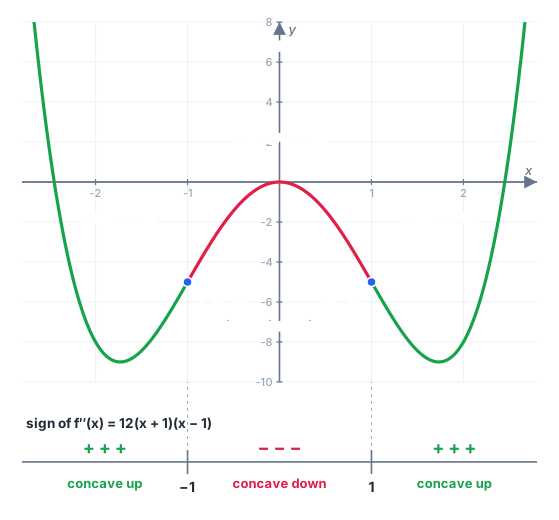
Example 2: A Quartic With Two Inflection Points

Find the intervals of concavity and the inflection points of .

The candidates are and . Test , and :

IntervalTest pointConcavity
up
down
up
Graph of f of x equals x to the fourth minus 6 x squared. It is green and concave up for x less than minus 1 and for x greater than 1, and red and concave down between minus 1 and 1. Inflection points are marked at (minus 1, minus 5) and (1, minus 5). Below, a sign chart of f double prime shows plus, minus, plus
The sign chart of f″ lines up with where the graph bends up and down

The sign changes at both candidates, and . So the inflection points are and .

Example 3: f″ = 0 but No Inflection Point

Does have an inflection point?

, which is 0 at . But on both sides of 0, so the graph is concave up everywhere. The sign never changes, so there is no inflection point.

This is the most common mistake in this topic: only makes a candidate.

Example 4: An Inflection Point Where f″ Is Undefined

Find the inflection point of .

is never 0, but it’s undefined at , which is in the domain of . For , , so : concave up. For , : concave down. The concavity changes and is continuous at 0, so is an inflection point. The graph has a vertical tangent there.

Example 5: An Exponential Function

Find the intervals of concavity and the inflection point of .

From the second derivative test lesson, . Since , the sign of is the sign of .

  • Concave down on , concave up on .
  • Inflection point: .

Example 6: Concavity Changes, but No Inflection Point

Find the intervals of concavity of .
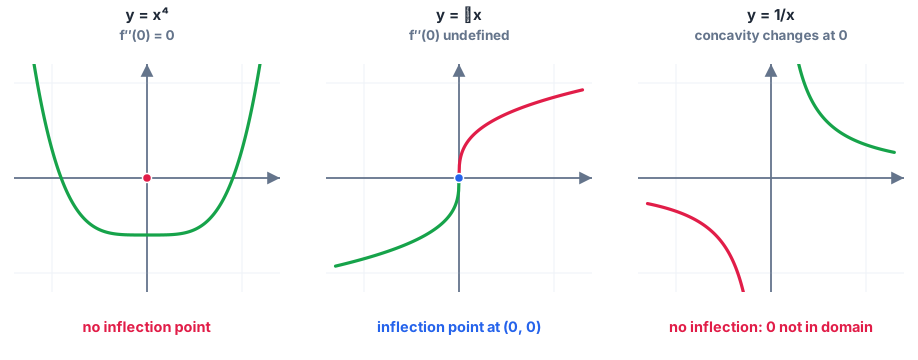
, which is negative for and positive for . So is concave down on and concave up on . The concavity changes at , but 0 isn’t in the domain, so there’s no inflection point. The change happens across a vertical asymptote, not at a point on the graph.

Three graphs. y equals x to the fourth has f double prime of 0 equal to 0 but is concave up everywhere, so no inflection point. y equals the cube root of x has f double prime undefined at 0 but changes from concave up to concave down, so (0, 0) is an inflection point. y equals 1 over x changes concavity at 0, but 0 is not in its domain, so there is no inflection point
Examples 3, 4 and 6: what makes an inflection point is a sign change at a point on the graph

Concavity From the Graph of f′ or f″

Exam questions often show a graph of a derivative instead of .

  • Given the graph of : is concave up where is increasing and concave down where is decreasing. Inflection points of are where has a local max or min.
  • Given the graph of : is concave up where the graph of is above the x-axis and concave down where it’s below. Inflection points are where it crosses the axis, not where it only touches.

For example, if the graph of rises until and falls after, then is concave up on , concave down on , and has an inflection point at .

Concavity and the Second Derivative Test

The second derivative test is concavity applied at a critical point. If , the tangent is horizontal. If the graph is concave up there, it curves away above that flat tangent, so is a local minimum. If it’s concave down, it’s a local maximum.

In applications, an inflection point marks where a rate of change is fastest or slowest. In logistic growth, the population grows fastest at the inflection point, halfway to the carrying capacity. After it, growth keeps going but slows down: the point of diminishing returns.

Common Mistakes

  • Calling every zero of an inflection point. Check the sign change, as in Example 3.
  • Forgetting where is undefined. Example 4 has an inflection point where doesn’t exist.
  • Calling a domain gap an inflection point. In Example 6, the concavity changes across an asymptote.
  • Mixing up concavity and direction. Concave up doesn’t mean increasing.
  • Giving only the x-value. An inflection point is a point , though many questions ask only where it occurs.

Practice Problems

Try each one before opening the answer. The practice set has 12 more with instant checking.

Problem 1. Find the intervals of concavity and the inflection point of .

Show answer

, which is negative for and positive for . .

Answer: concave down on , concave up on , inflection point

Problem 2. Find the intervals of concavity and the inflection points of .

Show answer

The sign is + on , − on , + on . and .

Answer: concave up on and , concave down on ; inflection points and

Problem 3. Find the intervals of concavity of on .

Show answer

, which is negative on and positive on .

Answer: concave down on , concave up on , inflection point

Problem 4. Find the inflection points of the bell curve .

Show answer

By the chain rule, . By the product rule,

The sign is the sign of , which changes at .

Answer:

Problem 5. Does have any inflection points?

Show answer

is 0 only at and is positive on both sides, so it never changes sign.

Answer: no; is concave up everywhere

Problem 6. The derivative is increasing on and decreasing on . Describe the concavity of .

Show answer

is concave up where is increasing and concave down where is decreasing.

Answer: concave up on , concave down on , inflection point at

Concavity and inflection points complete the toolkit for reading a graph from its derivatives. Next, optimization puts these tools to work on real problems: finding the largest area, the lowest cost or the shortest time.

Frequently Asked Questions

What is concavity?+

Concavity describes which way a graph bends. A graph is concave up on an interval if its slopes are increasing there, so it curves upward like a cup. It's concave down if its slopes are decreasing, so it curves downward like a cap. A straight line is neither.

How do you find where a function is concave up or down?+

Find , then find where or is undefined. Mark those points on a number line and test the sign of in each interval. Where , is concave up; where , it's concave down.

What is a point of inflection?+

A point of inflection is a point on the graph where is continuous and the concavity changes, from concave up to concave down or the other way around. For , the origin is an inflection point: the graph is concave down to the left and concave up to the right.

How do you find inflection points?+

Find where or is undefined, for in the domain of . Then check that the sign of actually changes there. Each -value that passes is the location of an inflection point; plug it into to get the point.

If f″(c) = 0, is c always an inflection point?+

No. The sign of has to change. For , , but is positive on both sides, so the graph is concave up everywhere and has no inflection point.

Is convex the same as concave up?+

Yes. Many textbooks, especially outside the US and in economics and optimization, call a concave up function convex and a concave down function concave. The math is the same: convex means .

Related lessons