Mathovia

Calculus / Calculus 1 · Derivatives

Derivatives of Trig Functions

The derivative of sin x is cos x, and the derivative of cos x is −sin x. The other four trig derivatives follow from those two with the quotient rule. Here are all six, where they come from, and how to use them with the chain, product and quotient rules.

Practice Problems
Written by
MPhil in Mathematics, Founder of Mathovia
Published

Mathematics verification: Mathematical formulas, calculations, worked examples and solutions are reviewed for accuracy before publication. How we check our work

Sine and cosine describe anything that repeats: a swinging pendulum, a spinning wheel, the voltage in a wall socket, the height of a tide. To talk about how fast those things are changing, you need the derivatives of the trig functions. The good news is that there are only six, two of them do all the real work, and they fit together in a very tidy pattern.
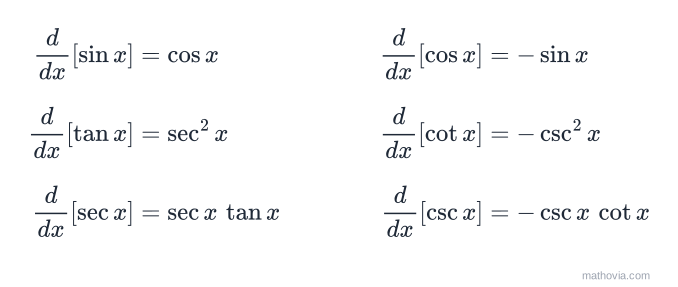
The six trig derivatives: the derivative of sin x is cos x, of cos x is minus sin x, of tan x is sec squared x, of cot x is minus csc squared x, of sec x is sec x tan x, and of csc x is minus csc x cot x
The derivatives of all six trig functions

The Six Trig Derivatives

Here they are as a chart, with each function next to its co-function:

FunctionDerivativeCo-functionDerivative

One condition comes with every line of this chart: is in radians. If you’ve skipped the radians and degrees review, it’s worth a quick look, because the reason for this condition sits right inside the proof of the first rule.

The Derivative of sin x

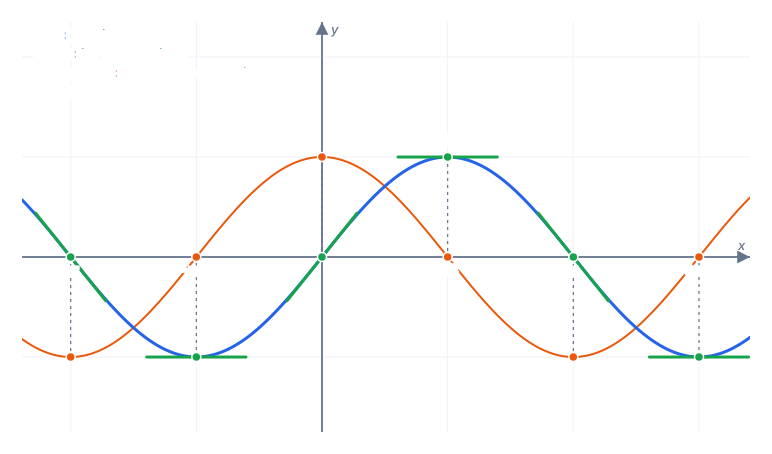
Graph of y equals sin x with short tangent lines at minus pi, minus pi over 2, 0, pi over 2, pi and 3 pi over 2. The slopes are minus 1, 0, 1, 0, minus 1 and 0. Plotting each slope as a height gives orange dots that lie on the curve y equals cos x
Read the slope of sin x at each point, plot it as a height, and you get cos x

Before any algebra, look at the graph. At the sine curve climbs at a 45° angle, so its slope is 1. At the top of the hump, , the curve is flat: slope 0. At it’s heading down as steeply as it ever does, slope . Now plot those slopes as heights: 1, then 0, then . That’s the cosine curve. So

The picture makes the rule believable. The proof makes it certain, and it uses the limit definition of the derivative together with the sine addition formula:

Group the terms and split the fraction in two:

Two special limits finish the job. The first, , goes to 0. The second, , goes to 1, which is the famous result proved with the squeeze theorem. That leaves .

Here’s why radians matter. The limit is only true when is measured in radians. In degrees the limit is , and the derivative of would be instead. Radians are the units that make the rule clean.

The Derivative of cos x

The same argument, using the cosine addition formula, gives

Don’t lose the minus sign. Look back at the figure: cosine starts at its peak at and immediately heads down, so its slope just to the right of 0 is negative, while is positive there. A negative slope needs a negative sign.

There’s also a shortcut proof. Cosine is just sine shifted, , so the chain rule gives .

The Sine and Cosine Derivative Cycle

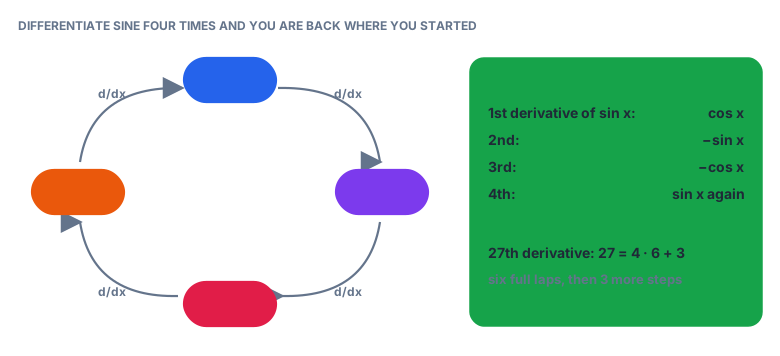
A loop of four boxes joined by arrows labelled d by dx: sin x, then cos x, then minus sin x, then minus cos x, then back to sin x. A side panel lists the 1st to 4th derivatives of sin x and finds the 27th: 27 equals 4 times 6 plus 3, so six full laps and three more steps, giving minus cos x
sin, cos, −sin, −cos, and back to sin

Keep differentiating and something nice happens:

Every fourth derivative brings you back to where you started. That turns a scary-looking question like “find the 27th derivative of ” into a remainder problem: , so go six full laps (which change nothing) and then three steps, landing on . This loop is also why sine and cosine show up in the physics of springs and waves: they’re the functions whose second derivative is their own negative.

The Derivative of tan x

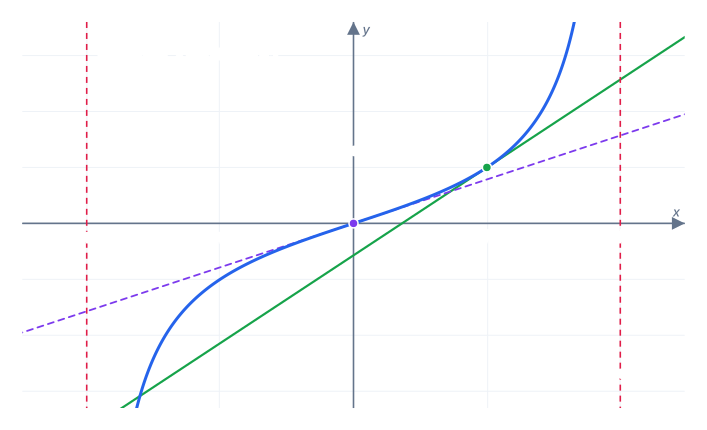
Graph of y equals tan x between its vertical asymptotes at minus pi over 2 and pi over 2. The tangent line at the origin has slope sec squared 0 equals 1, and the tangent line at the point pi over 4, 1 has slope sec squared of pi over 4 equals 2. Since sec squared x is at least 1, every slope is at least 1
tan x is always rising, and its slope sec² x is never less than 1

The other four functions are built from sine and cosine, so their derivatives come from the quotient rule. For tangent, write :

The Pythagorean identity does the simplifying. The graph agrees: is never smaller than 1, so the tangent curve rises everywhere, at slope 1 through the origin and more steeply as it climbs toward its asymptotes.

You may also see the answer written as , which is the same thing by the identity .

The Derivative of sec x

Write . The numerator is a constant, so its derivative is 0:

Splitting into is the step that turns an unfamiliar fraction into the standard form.

The Derivatives of csc x and cot x

Cosecant and cotangent work exactly the same way, starting from and :

A Memory Trick for the Trig Derivative Rules
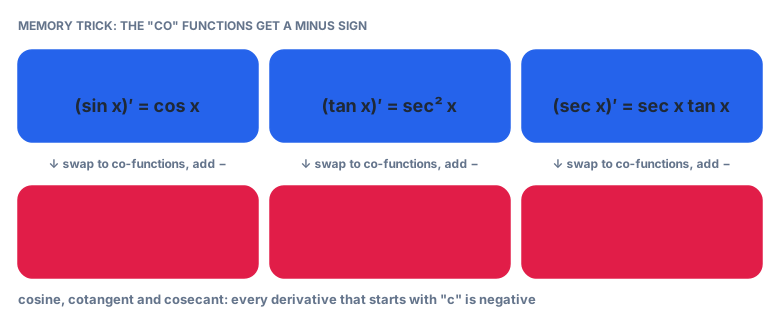
Three pairs. The derivative of sin x is cos x, so the derivative of cos x is minus sin x. The derivative of tan x is sec squared x, so the derivative of cot x is minus csc squared x. The derivative of sec x is sec x tan x, so the derivative of csc x is minus csc x cot x. Every derivative of a function starting with c is negative
Learn the top row; the bottom row follows

You only need to memorise three derivatives: , and . To get the other three, replace every function with its co-function and put a minus sign in front:

  • becomes
  • becomes
  • becomes

A quick check on an exam: the three functions whose names start with “c” (cosine, cotangent, cosecant) are exactly the three with negative derivatives.

Trig Derivatives With the Chain Rule

In real problems the angle is rarely plain . With an inside function , each rule picks up a factor of from the chain rule:

For example:

The same goes for the reciprocal functions: . Keep the inside unchanged in every factor, and multiply by its derivative once.

Example 1: A Constant Times sin x

Differentiate .

Constants ride along, and each term is differentiated separately:

The second term is where the sign slips happen: minus a negative is a plus.

Example 2: A Product With tan x

Differentiate .

The product rule with and :

Example 3: A Quotient That Simplifies

Differentiate .

Replace with 1. The numerator becomes , which cancels one factor of the denominator:

With trig quotients, always look for in the numerator. It’s usually there on purpose.

Example 4: sin² x

Differentiate .

Read it as : the outer layer is the square, the inner layer is . By the chain rule,

The last step uses the double angle identity . Both forms are correct.

Example 5: The Tangent Line to tan x

Find the equation of the tangent line to at .

The point is , since . The slope is . In point-slope form:

That’s the green line in the tan x graph above.

Example 6: A Higher Derivative

Find the 50th derivative of .

The cycle for cosine is . Since , twelve full laps change nothing and two more steps land on .

Common Mistakes With Trig Derivatives

  • Dropping a minus sign. The derivatives of , and are all negative.
  • Forgetting the chain rule. is , not .
  • Writing for the derivative of . That’s the derivative of . The derivative of is .
  • Mixing up and . The first is with derivative ; the second is with derivative .
  • Using degrees. On a calculator, check you’re in radian mode before you evaluate a derivative at a number.

Practice Problems

Try each one before opening the answer. The practice set has 12 more with instant checking.

Problem 1. Differentiate .

Show answer

.

Answer:

Problem 2. Differentiate .

Show answer

Product rule: .

Answer:

Problem 3. Differentiate .

Show answer

Chain rule: .

Answer:

Problem 4. Differentiate .

Show answer

Product rule: .

Answer:

Problem 5. Find the slope of at .

Show answer

, so .

Answer:

With the trig functions done, there are two more families to add to your toolkit: exponentials and logarithms, whose derivatives come next, and the inverse trig functions, which turn out to have derivatives with no trig in them at all.

Frequently Asked Questions

What are the derivatives of the six trig functions?+

, , , , and . All six assume is measured in radians.

What is the derivative of sin x?+

The derivative of is . You can see it on the graph: the slope of the sine curve is 1 at , 0 at the peak and at , which are exactly the values of at those points.

What is the derivative of cos x?+

The derivative of is . The minus sign is there because cosine starts out decreasing: just to the right of the graph of goes down, so its slope is negative while is positive.

What is the derivative of tan x?+

The derivative of is , which can also be written or . It comes from writing and using the quotient rule.

What is the derivative of sec x?+

The derivative of is . Write and differentiate: .

How do you remember the trig derivatives?+

Learn three: , and . For the other three, swap every function for its co-function and add a minus sign. So every trig function whose name starts with c (cosine, cotangent, cosecant) has a negative derivative.

Why do trig derivatives need radians?+

The rule depends on the limit , which is only true when is in radians. In degrees, the derivative of would be , and that stray factor would follow every calculation.

Related lessons