Mathovia

Calculus / Calculus 1 · Applications of Derivatives

Second Derivative Test

The second derivative test classifies a critical point in one step. If f′(c) = 0 and f″(c) < 0, the graph is concave down there, so it's a local maximum. If f″(c) > 0, it's concave up, a local minimum. If f″(c) = 0, the test tells you nothing.

Practice Problems
Written by
MPhil in Mathematics, Founder of Mathovia
Published

Mathematics verification: Mathematical formulas, calculations, worked examples and solutions are reviewed for accuracy before publication. How we check our work

The first derivative test classifies a critical point by checking the sign of on both sides of it. The second derivative test does the same job with one number. At a critical point where the tangent is horizontal, you only need to know which way the graph bends: if it curves down like a cap, you’re at a peak; if it curves up like a cup, you’re at a valley. The second derivative measures exactly that.

If f prime of c equals 0 and f double prime of c is less than 0, local max. If f double prime of c is greater than 0, local min
The second derivative test in one line

Concavity in One Paragraph

The second derivative is the rate of change of the slope. Where , the slope is increasing, so the graph bends upward. It’s concave up, shaped like a cup. Where , the slope is decreasing and the graph is concave down, shaped like a cap. Concavity gets its own lesson next; for this test, that picture is all you need.

The Second Derivative Test

Second derivative test. Suppose and exists near .

  • If , then has a local maximum at .
  • If , then has a local minimum at .
  • If , the test is inconclusive: it could be a max, a min or neither.

Why does it work? If , then is increasing at . Since , must be negative just before and positive just after. That’s the − to + pattern from the first derivative test, so is a local minimum. The case works the same way with the signs flipped.
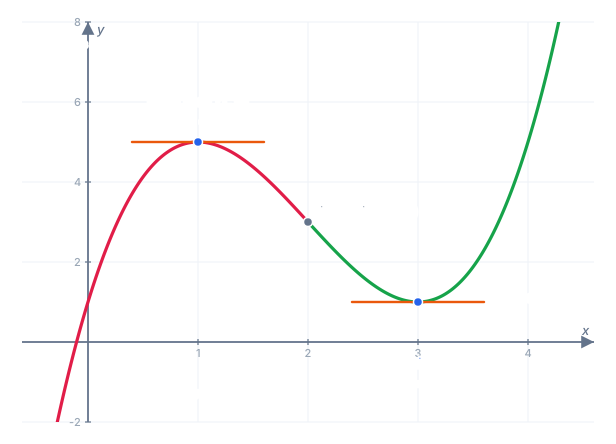
Graph of f of x equals x cubed minus 6 x squared plus 9 x plus 1. Left of x equals 2 it is red and concave down, with a local maximum at (1, 5) where f double prime of 1 equals minus 6. Right of x equals 2 it is green and concave up, with a local minimum at (3, 1) where f double prime of 3 equals 6. The inflection point (2, 3) is marked between them
Concave down at the peak, concave up at the valley

How to Use the Second Derivative Test

  1. Find and solve to get the critical points.
  2. Find .
  3. Plug each critical point into .
  4. Read the sign. Negative is a local max, positive is a local min, zero means use the first derivative test instead.
  5. Plug each extremum into to get the max or min value.

Example 1: A Cubic

Find the local extrema of .

Step 1 — critical points.

so and .

Step 2 — second derivative.

Steps 3 and 4 — test each point.

  • : local maximum .
  • : local minimum .

Compare this with the sign chart from the first derivative test: there you test three intervals, here you evaluate one formula at two points.

Example 2: A Quartic

Find the local extrema of .

The critical points are , and . Next,

Critical pointResultValue
local min
local max
local min

Example 3: A Trig Function

Find the local extrema of on .

when , so or . The second derivative is

  • : local maximum .
  • : local minimum .

Notice that here, so the sign of is just the opposite of the sign of . Shortcuts like that are why the second derivative test is often quicker.

Example 4: An Exponential Function

Find the local extremum of .

By the product rule,

so the only critical point is . Differentiating again,

, so there’s a local maximum .

Example 5: When the Test Is Inconclusive

Classify the critical points of .

  • : local minimum .
  • : the test says nothing.

To finish, fall back on the first derivative test at . The factor is never negative, so has the sign of , which is negative on both sides of 0. The sign doesn’t change, so is neither a max nor a min.

When the Second Derivative Test Fails

When , anything can happen. These three functions all have and :
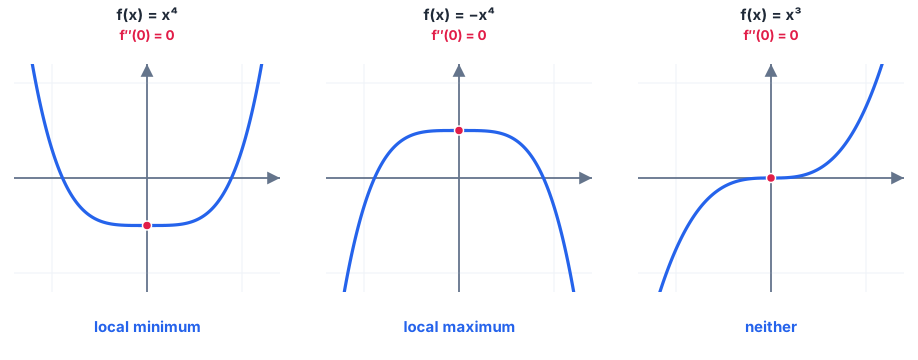
Three graphs, each with f double prime of 0 equal to 0. f of x equals x to the fourth has a local minimum at 0. f of x equals negative x to the fourth has a local maximum at 0. f of x equals x cubed has neither, rising through a flat spot
Same f′(0) and f″(0), three different answers
  • has a local minimum at 0.
  • has a local maximum at 0.
  • has neither.

So never means “no extremum”. It means “this test can’t decide”. The test also can’t be used at all at a critical point where is undefined, like the corner of or the cusp of , because there doesn’t exist. In both cases, use the first derivative test.

Using the Test in Applied Problems

The second derivative test is the quickest way to confirm an answer in an optimization problem. For example, a rectangle with perimeter 40 and width has length and area

at , and . So gives a maximum: the best rectangle is a 10 by 10 square with area 100. Because is negative everywhere, this is the absolute maximum on the domain, not just a local one.

First Derivative Test vs Second Derivative Test

First derivative testSecond derivative test
What you checkSign of on both sides of Sign of at the point
Local max changes + to −
Local min changes − to +
Inconclusivenever, if is continuous at when or doesn’t exist
Works where is undefinedyesno
Best when is messy, or the test fails factors easily and is simple

Common Mistakes

  • Mixing up the signs. Negative means a maximum. Think “frown at the top, smile at the bottom”.
  • Concluding “neither” when . The test is inconclusive, not negative. In Example 5 the point was neither, but for it’s a maximum.
  • Plugging the critical point into instead of . is always 0 at these points, so it tells you nothing.
  • Using the test where is undefined. It only applies when .
  • Stopping at the x-value. The local maximum value is .

Practice Problems

Try each one before opening the answer. The practice set has 12 more with instant checking.

Problem 1. Find the local extrema of .

Show answer

at , and . and .

Answer: local maximum , local minimum

Problem 2. Find the local extrema of .

Show answer

and .

Answer: local maximum , local minimum

Problem 3. Classify the critical points of .

Show answer

at , and . and .

Answer: local minimum , local maximum

Problem 4. Find the local extremum of for .

Show answer

when , so . Then , and .

Answer: local minimum

Problem 5. What does the second derivative test say about at ? What is the actual answer?

Show answer

and , so and : the test is inconclusive. Since on both sides, the first derivative test shows no sign change.

Answer: inconclusive; is neither a max nor a min

Problem 6. Find the local extremum of on .

Show answer

at in . Then , and .

Answer: local maximum

The second derivative test uses the sign of at a single point. Next, concavity and inflection points look at the sign of everywhere, to see how the whole graph bends.

Frequently Asked Questions

What is the second derivative test?+

The second derivative test classifies a critical point where . If , has a local maximum at . If , has a local minimum at . If , the test is inconclusive and you have to use the first derivative test instead.

How do you do the second derivative test?+

Find and solve to get the critical points. Then find and plug in each critical point. A negative result means a local max, a positive result a local min, and zero means no conclusion. Plug each extremum into to get its value.

When does the second derivative test fail?+

It fails when or doesn't exist. Then the point could be a maximum, a minimum or neither: , and all have , and they give a min, a max and neither. The test also doesn't apply at critical points where is undefined.

What is the difference between the first and second derivative tests?+

The first derivative test checks the sign of on both sides of a critical point. The second derivative test checks the sign of at the point itself. The second test is faster when is easy, but it can be inconclusive; the first test always gives an answer for a continuous function.

What does the second derivative tell you?+

It tells you about concavity. Where , the graph is concave up, bending like a cup. Where , it's concave down, bending like a cap. At a point with a horizontal tangent, a cup shape means a minimum and a cap shape a maximum.

Is there a second derivative test for two variables?+

Yes. In multivariable calculus, critical points of are classified with : if and it's a local min, if and a local max, and if a saddle point. This lesson covers the one-variable test.

Related lessons