Mathovia

Calculus / Calculus 1 · Derivatives

Derivatives of Inverse Trig Functions

The derivative of arcsin x is 1/√(1 − x²) and the derivative of arctan x is 1/(1 + x²). The inverse trig derivatives have no trig left in them at all. Here are all six, why they look the way they do, and how to use them with the chain rule.

Practice Problems
Written by
MPhil in Mathematics, Founder of Mathovia
Published

Mathematics verification: Mathematical formulas, calculations, worked examples and solutions are reviewed for accuracy before publication. How we check our work

Ask “what angle has a sine of 0.6?” and you’re using an inverse trig function. These functions turn ratios back into angles, which is how a surveyor gets an angle of elevation from two distances, or how a game engine works out which way a character should face. Their derivatives come with a surprise. You start with trig functions, differentiate, and every trace of trig disappears. What’s left is a square root or a simple fraction.
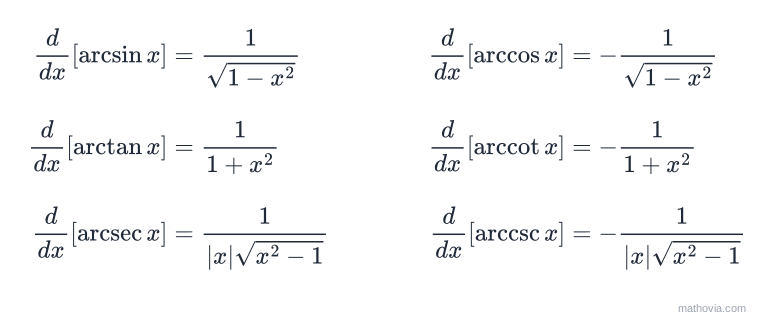
The six inverse trig derivatives: arcsin x gives 1 over the square root of 1 minus x squared, arccos x gives the negative of that, arctan x gives 1 over 1 plus x squared, arccot x gives the negative of that, arcsec x gives 1 over the absolute value of x times the square root of x squared minus 1, and arccsc x gives the negative of that
The derivatives of all six inverse trig functions

The Six Inverse Trig Derivatives

FunctionDerivativeValid for
all
all

Two notations mean the same thing: and , and , and so on. The means “inverse function”, not “one over”. If you’d like a refresher on what these functions are and why their ranges are restricted, the inverse trigonometric functions review lesson covers it.

In practice, arcsin and arctan are the two you’ll use most. Learn those two, and the other four come almost for free.

The Derivative of arcsin x
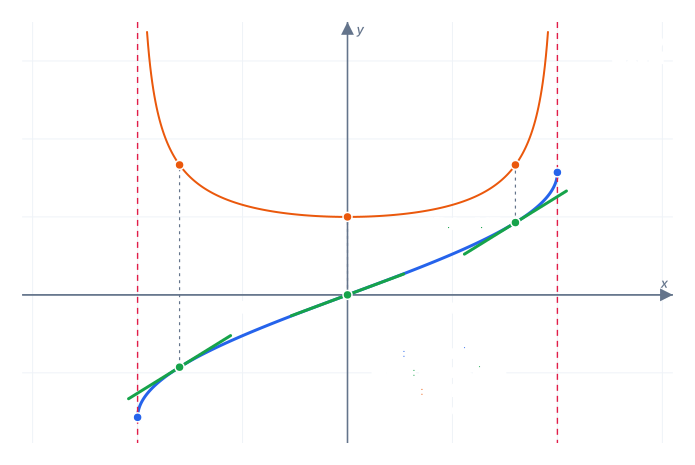
Graph of y equals arcsin x from the point minus 1, minus pi over 2 to the point 1, pi over 2. Tangent lines at x equals minus 0.8, 0 and 0.8 have slopes 1.67, 1 and 1.67. The orange curve y equals 1 over the square root of 1 minus x squared shows the slope at each x and shoots up toward vertical asymptotes at x equals minus 1 and 1
arcsin x is flattest at 0 and gets steeper toward x = ±1, where its slope blows up

Look at the graph first. The arcsin curve is an S lying on its side, squeezed between and . It crosses the origin at slope 1, gets steeper as it moves out, and by the time it reaches the ends it’s going straight up. The formula says the same thing: at it gives , at it gives , and as approaches the denominator approaches 0 and the slope runs off to infinity.

Here’s where the formula comes from. Let . That means is the angle whose sine is :

Differentiate both sides with respect to . On the left, the chain rule gives ; on the right you get 1:

That’s correct, but it’s in terms of , and we want . This is where trig disappears. Since ,

The square root is positive, not , because arcsin only returns angles between and , and cosine is positive there. So .

The Right-Triangle Trick

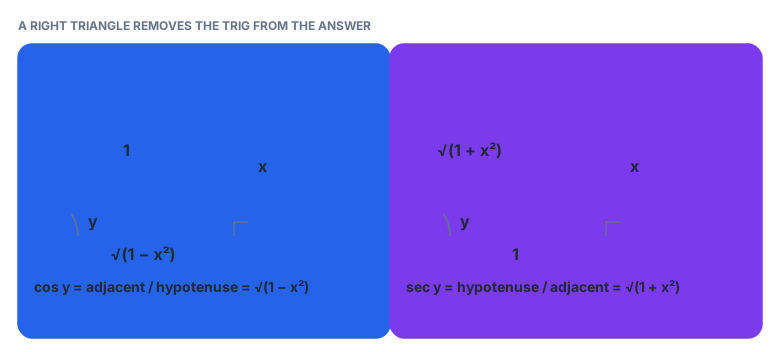
Two right triangles. Left: angle y with opposite side x and hypotenuse 1, so the adjacent side is the square root of 1 minus x squared, cos y equals the square root of 1 minus x squared, and the derivative of arcsin x is 1 over that. Right: angle y with opposite side x and adjacent side 1, so the hypotenuse is the square root of 1 plus x squared, sec y equals the square root of 1 plus x squared, and the derivative of arctan x is 1 over sec squared y, which is 1 over 1 plus x squared
Draw the triangle, read off the side you need, and the trig turns into algebra

If the identity step feels like magic, draw a triangle instead. For , you know , so draw a right triangle with angle , opposite side and hypotenuse 1. By Pythagoras, the third side is . Now is adjacent over hypotenuse, which you can read straight off the picture: .

This trick is worth remembering beyond this lesson. Any time you see something like or , a quick triangle turns it into algebra.

The Derivative of arctan x

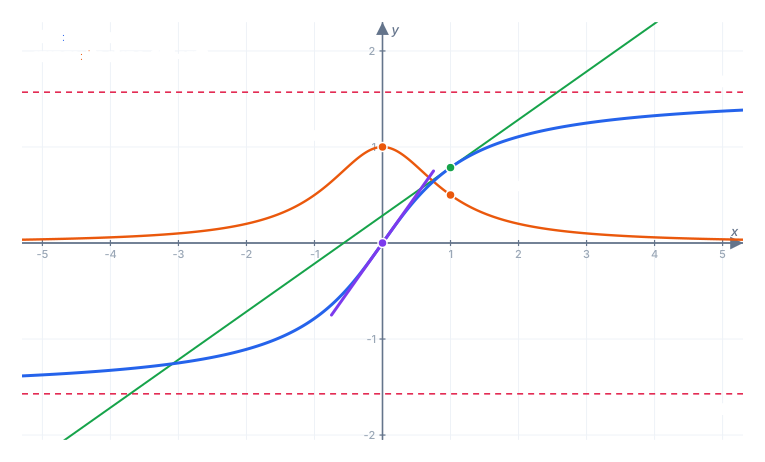
Graph of y equals arctan x, which rises from the horizontal asymptote y equals minus pi over 2 to y equals pi over 2. Its tangent line at the origin has slope 1 and at the point 1, pi over 4 has slope one half. The orange bell-shaped curve y equals 1 over 1 plus x squared shows the slope, peaking at 1 when x is 0
arctan x always rises, steepest at the origin; its slope 1/(1 + x²) is a bell curve

The same steps work. If , then . Differentiating both sides, using the fact from the derivatives of trig functions that :

The identity turns that into , and you’re done. The right-hand triangle in the figure shows the same thing: opposite side , adjacent side 1, hypotenuse .

Check it against the graph. Arctan is defined for every , it always increases, and it flattens out toward its asymptotes at . Its derivative is defined for every , always positive, largest at (where it equals 1), and shrinks toward 0 as gets large. Every feature matches.

The Derivative of arccos x

Arccos and arcsin are tied together by a simple identity: for every between and 1,

(Think of a right triangle: the two acute angles add up to , and the sine of one is the cosine of the other.) So , and differentiating kills the constant:

The minus sign makes sense: arccos runs downhill, from at to 0 at .

arccot, arcsec and arccsc

The other three follow the same pattern:

The absolute value in the arcsec formula is there because arcsec is increasing on both of its pieces, and , so its derivative has to be positive on both. Some textbooks define arcsec with a different range and drop the absolute value; if yours does, follow your textbook.

A Memory Trick for the Inverse Trig Derivatives

You may remember the trick from the trig derivatives: the “co” functions get a minus sign. It works again here, even better. The derivatives come in three pairs, and each co-function’s derivative is just the negative of its partner’s:

  • and :
  • and :
  • and :

So there are really only three formulas to learn. And to tell from : arcsin only takes inputs between and 1, where is positive. Arcsec only takes inputs beyond , where is positive. The square root always holds whichever one is positive.

Inverse Trig Derivatives With the Chain Rule

With an inside function , each formula picks up a factor of , and every in the formula becomes :

The step people rush is squaring the inside. If , then , not .

Example 1: arcsin of 2x

Differentiate .

With and :

This only makes sense for , which is exactly where is between and 1.

Example 2: arctan of x²

Differentiate .

With and , and :

Example 3: A Product With arctan x

Differentiate .

The product rule with and :

The answer still contains . That’s fine: it came from , where the arctan wasn’t differentiated.

Example 4: arctan of e^x

Differentiate .

Here the inside is an exponential, so this uses the derivative of e^x as well. With , and :

Example 5: A Derivative That Comes Out Zero

Differentiate .

A function whose derivative is zero everywhere on an interval is constant. This is the identity from the arccos section, , found by calculus instead of geometry.

Example 6: A Tangent Line to arctan x

Find the equation of the tangent line to at .

The point is , since . The slope is . In point-slope form:

That’s the green line in the arctan graph above.

Common Mistakes

  • Reading as . The derivative of is , a completely different answer.
  • Forgetting to square the inside. , not .
  • Forgetting the chain-rule factor on top. has a 2 in the numerator.
  • Swapping and . arcsin and arccos use ; arcsec and arccsc use .
  • Dropping the minus sign on arccos, arccot and arccsc.
  • Plugging in . arcsin and arccos have vertical tangents there, so their derivatives don’t exist at the endpoints.

Practice Problems

Try each one before opening the answer. The practice set has 12 more with instant checking.

Problem 1. Differentiate .

Show answer

Each term on its own.

Answer:

Problem 2. Differentiate .

Show answer

, , .

Answer:

Problem 3. Differentiate .

Show answer

, , .

Answer:

Problem 4. Differentiate .

Show answer

Product rule: .

Answer:

Problem 5. Find the slope of at .

Show answer

.

Answer:

That completes the list of basic derivatives: powers, trig functions, exponentials, logarithms and now inverse trig. Next comes implicit differentiation, which turns the “differentiate both sides” trick used in this lesson into a general method for curves like circles, where isn’t written as a function of .

Frequently Asked Questions

What are the derivatives of the inverse trig functions?+

, , , , and .

What is the derivative of inverse sin x?+

The derivative of (also written ) is , for . At the graph has vertical tangent lines, so the derivative doesn't exist there.

What is the derivative of arctan x?+

The derivative of (also written ) is . It works for every real , it is always positive, and it is largest, equal to 1, at .

What is the derivative of arccos x?+

The derivative of is , the negative of the derivative of . That's because , and the constant has derivative 0.

Why don't inverse trig derivatives have any trig functions in them?+

Differentiating gives , and can be rewritten in terms of with a right triangle or the identity . Since , , which is pure algebra.

Does sin⁻¹ x mean 1/sin x?+

No. is the inverse function , the angle whose sine is . The reciprocal is , and its derivative is , which is completely different.

Why is there an absolute value in the derivative of arcsec x?+

The graph of is rising on both of its pieces, and , so its derivative must be positive on both. Without the absolute value, would be negative for .

Related lessons