Mathovia

Calculus / Calculus 1 · Limits

Infinite Limits

An infinite limit describes a function that doesn't settle on a number near x = a but shoots up or down without bound. You can't give a value, but you can say which way it goes on each side, and that tells you exactly where the graph has a vertical asymptote and what it looks like there.

Practice Problems
Written by
MPhil in Mathematics, Founder of Mathovia
Published

Mathematics verification: Mathematical formulas, calculations, worked examples and solutions are reviewed for accuracy before publication. How we check our work

When substitution gives , evaluating limits shows how to simplify. When it gives something like , no simplifying will help, because the function really is blowing up. Infinite limits describe that behaviour precisely: whether the function heads to or , and on which side. Learning how to determine an infinite limit is mostly a matter of keeping track of signs.
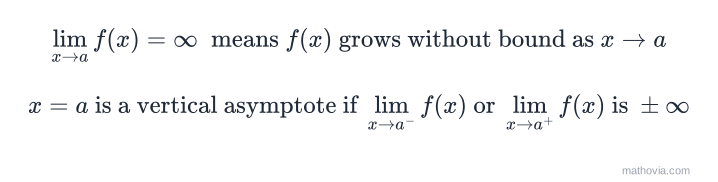
The limit of f of x as x approaches a equals infinity means f of x grows without bound; x = a is a vertical asymptote if either one-sided limit is plus or minus infinity
Infinite limits and vertical asymptotes

What Is an Infinite Limit?

We write when gets larger than any number you name, 1,000 or a million or more, as long as is close enough to . Similarly means the values fall below any negative number. The same notation works for one-sided limits: describes the right side only.

Infinity isn’t a number, so an infinite limit is a kind of limit that doesn’t exist. The notation is still useful, because it tells you how the limit fails, and that’s exactly what you need to sketch the graph.
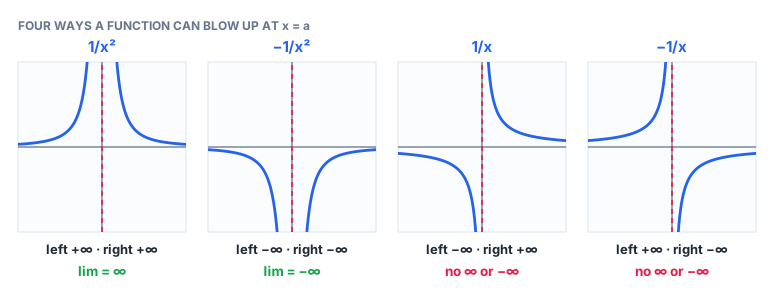
Four graphs with a vertical asymptote at x = 0: 1 over x squared rises on both sides, so the limit is infinity; minus 1 over x squared falls on both sides, so the limit is minus infinity; 1 over x falls on the left and rises on the right; minus 1 over x rises on the left and falls on the right
Two sides, two directions: four possible pictures

How to Determine an Infinite Limit

  1. Substitute . If you get a nonzero number over 0, the limit is infinite (at least from each side). If you get , simplify first; the factor may cancel and leave a hole instead.
  2. Find the sign just left of . Plug in a value like , or reason about each factor. If the result is positive, the left-hand limit is ; if it’s negative, the left-hand limit is .
  3. Find the sign just right of the same way.
  4. Combine. If both sides agree, the two-sided limit is that infinity. If they disagree, write the two one-sided limits separately.

Example 1: Both Sides Agree

Determine .

Substitution gives . The denominator is a square, so it’s positive on both sides of 3, and the numerator is positive. Both one-sided limits are , so

By the same reasoning, : a negative numerator over a positive square.

Example 2: Sign Analysis on Each Side

Determine the one-sided limits of at .
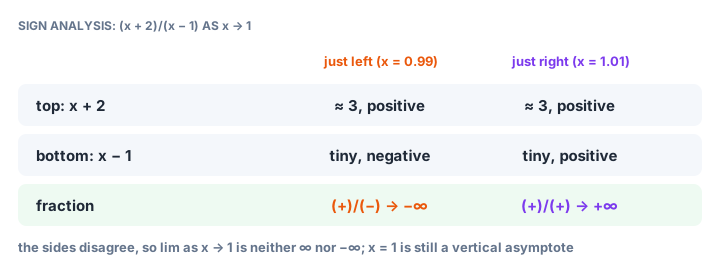
Sign table for (x + 2) over (x − 1) near 1: the top is about 3 and positive on both sides; the bottom is tiny and negative on the left, tiny and positive on the right; so the fraction goes to minus infinity on the left and plus infinity on the right
Track the sign of each piece

The top approaches 3. The bottom is a tiny negative number just left of 1 and a tiny positive number just right of it. So

Since the sides disagree, there’s no single infinite limit, but is a vertical asymptote either way.

Example 3: Several Factors

Determine the behaviour of at and .

Factor the denominator: . At , the top is about 4 (positive) and the factor is about 4 (positive), so only changes sign: from the left and from the right.

At , the top is about and is about , so their quotient is positive and the sign depends only on : negative on the left gives , positive on the right gives . Working one factor at a time like this keeps the sign bookkeeping manageable.

Infinite Limits and Vertical Asymptotes

A line is a vertical asymptote of when at least one one-sided limit at is or . This is the limit-based version of the definition in the vertical asymptotes lesson, and it settles a common question: does every zero of the denominator give an asymptote? No.
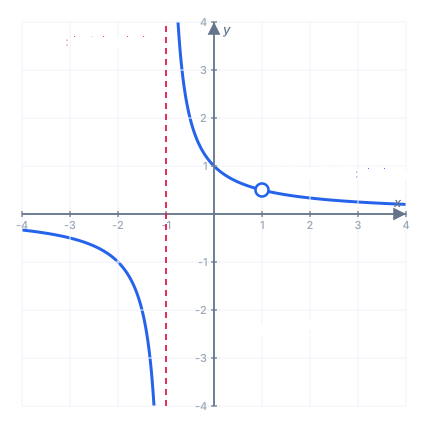
Graph of (x − 1)/(x² − 1), which equals 1/(x + 1) except at x = 1: a vertical asymptote at x = −1 and an open circle at (1, 1/2)
A hole at x = 1, an asymptote at x = −1

Take . The denominator is zero at and . At , substitution gives ; cancelling leaves , which approaches . That’s a finite limit, so the graph has a hole, not an asymptote. At , the simplified form gives , so the limits are infinite and is the vertical asymptote.

Beyond Rational Functions

Infinite limits aren’t only about fractions. The natural logarithm plunges near 0: , which is why its graph hugs the -axis from below. Tangent blows up at every odd multiple of : and , because sine stays near 1 while cosine passes through 0, positive then negative.

Infinite Limits vs Limits at Infinity

The names are similar but the questions are opposite. An infinite limit has approaching a number and running off to infinity (a vertical asymptote). A limit at infinity has running off to infinity and asks what approaches (often a horizontal asymptote). That’s the next lesson.

Common Mistakes to Avoid

  • Saying the limit exists because it’s . An infinite limit is a way of describing non-existence.
  • Writing when the sides disagree. Check both sides; at 0 is on one side and on the other.
  • Calling every zero of the denominator an asymptote. Cancel common factors first; a cancelled factor gives a hole.
  • Losing track of signs. Decide the sign of each factor separately, then multiply.

Practice Problems

Work each one before opening the answer.

Problem 1. Determine .

Show answer

Positive over a positive square on both sides.

Answer:

Problem 2. Determine .

Show answer

The top approaches 4; the bottom is a tiny negative number.

Answer:

Problem 3. Determine .

Show answer

For small negative , is a tiny negative number.

Answer:

Problem 4. Determine .

Show answer

The top approaches ; the bottom is a tiny positive number, so the quotient is very negative.

Answer:

Problem 5. Find the vertical asymptotes of .

Show answer

for . At the limit is , a hole; at the limits are infinite.

Answer: only

Next, limits at infinity: what happens to as grows without bound, and how to find horizontal asymptotes with limits.

Frequently Asked Questions

What is an infinite limit?+

An infinite limit describes a function whose values grow without bound as approaches . We write if becomes larger than any number you choose once is close enough to , and if it becomes more negative than any number. The limit still doesn't exist as a real number.

How do you determine an infinite limit?+

Substitute . If you get a nonzero number over 0, the limit is infinite on each side. Then check the sign of the numerator and denominator for just below and just above : a positive result gives and a negative result gives . The two-sided limit is or only if both sides agree.

What is the difference between infinite limits and limits at infinity?+

An infinite limit is about the output: blows up as approaches a finite number, which gives a vertical asymptote. A limit at infinity is about the input: grows without bound and you ask what approaches, which can give a horizontal asymptote.

How do you find vertical asymptotes using limits?+

Find the values of that make the denominator zero. For each one, check whether either one-sided limit is . If it is, is a vertical asymptote. If the factor cancels and the limit is a finite number, the graph has a hole there instead.

Does a limit exist if it equals infinity?+

No. Writing is a precise way of saying how the limit fails to exist: the values grow without bound instead of approaching a real number.

Related lessons