Mathovia

Calculus / Calculus 1 · Limits

Continuity

A continuous function is one whose graph has no breaks: no holes, no jumps, no blow-ups. Calculus makes that precise with a single equation, the limit equals the value, and turns it into a three-step check you can run on any function at any point.

Practice Problems
Written by
MPhil in Mathematics, Founder of Mathovia
Published

Mathematics verification: Mathematical formulas, calculations, worked examples and solutions are reviewed for accuracy before publication. How we check our work

Ask someone to draw a continuous graph and they’ll draw it without lifting the pencil. That intuition is right, but it isn’t something you can check with algebra. Continuity in calculus replaces it with a precise condition built from limits, and that condition is what lets the big theorems of calculus work: the intermediate value theorem, the extreme value theorem and, later, derivatives all depend on it.
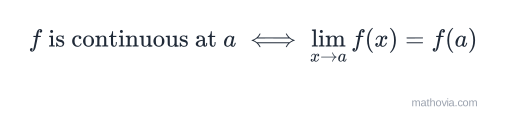
f is continuous at a exactly when the limit of f of x as x approaches a equals f of a
The definition of continuity at a point

The Definition of Continuity

A function is continuous at if

That short equation contains three separate requirements, and a function is continuous at only if all three hold:

  1. is defined. There’s a point on the graph at .
  2. exists. Both one-sided limits agree on a finite number.
  3. They’re equal. The point sits exactly where the curve is heading.
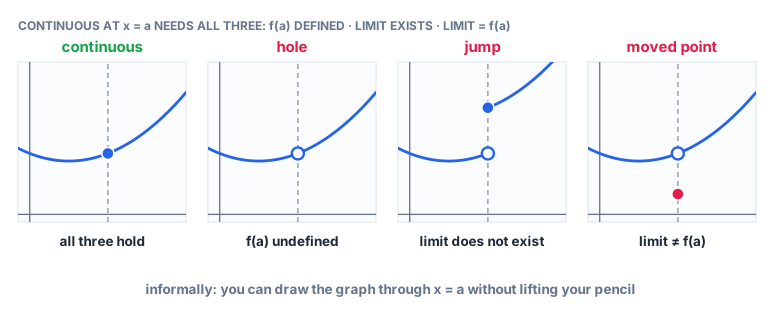
Four graphs at x = a: a continuous curve where all three conditions hold; a hole where f(a) is undefined; a jump where the limit does not exist; and a moved point where the limit is not equal to f(a)
One continuous graph and the three ways to fail

Each picture of a break matches one failed condition. A hole fails the first, a jump fails the second, and a point that’s been moved off the curve fails the third. The finding limits from a graph lesson used the same graphs to read limits; continuity is the question of whether the limit and the dot agree.

How to Check Continuity at a Point

Work through the three conditions in order and stop at the first one that fails.

Example 1. Is continuous at ?

is undefined, so condition 1 fails and is not continuous at 2. The limit exists (it’s 4), so the break is just a hole, but a hole is still a break.

Example 2. Is this piecewise function continuous at ?

  1. , so it’s defined.
  2. From the left, ; from the right, . The limit exists and equals 2.
  3. The limit and the value are both 2.

All three hold, so is continuous at 1, even though it’s built from two different formulas.

Which Functions Are Continuous?

You almost never need to check every point. Most familiar functions are continuous wherever they’re defined, and the limit laws show that combining them keeps them continuous.
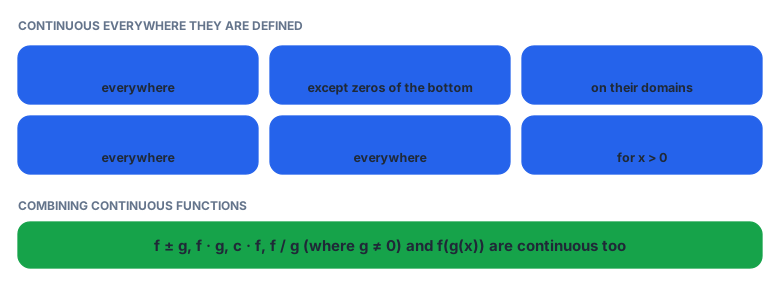
Functions that are continuous where defined: polynomials everywhere, rational functions except where the denominator is zero, roots on their domains, sine and cosine everywhere, exponentials everywhere, ln x for x greater than 0. Sums, differences, products, constant multiples, quotients where the denominator is nonzero, and compositions of continuous functions are continuous
The building blocks and the rules for combining them

So the real work is to find the points where something could go wrong, usually where a denominator is zero, where a root or logarithm leaves its domain, or where a piecewise function switches formulas, and check only those.

Example 3. Where is continuous?

It’s a rational function, so it’s continuous everywhere except where , at . In interval notation: .

Example 4. Where is continuous?

is always at least 1, so the logarithm is always defined. A composition of continuous functions is continuous, so is continuous for every real .

Continuity on an Interval

A function is continuous on an open interval if it’s continuous at every point inside it. At the ends of a closed interval , only the side that’s inside the interval matters: needs at the left end and at the right end.

That’s why counts as continuous on . There’s nothing to the left of 0, but the right-hand limit at 0 is 0, which matches . Likewise is continuous on .

Making a Piecewise Function Continuous

Find so that this function is continuous everywhere:

Each piece is a polynomial, so the only question is . The left side approaches ; the right side approaches (and equals) . For continuity they must match:
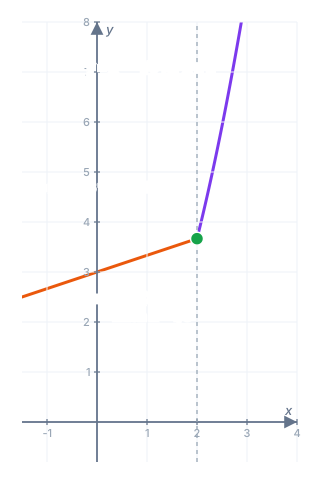
Graph of the piecewise function with k = 1/3: the line y = x/3 + 3 for x less than 2 meets the curve y = x squared minus 1/3 at the point (2, 11/3) with no gap
With k = 1/3 the two pieces meet at (2, 11/3)

This “set the pieces equal at the join” move is one of the most common continuity questions, and it’s exactly the skill piecewise functions set up in algebra.

Using Continuity to Find Limits

Continuity runs both ways. If you know a function is continuous at , its limit there is simply . So , because is a composition of continuous functions. This is the reason direct substitution works so often.

Why Continuity Matters

Continuity is the hypothesis behind several key results. The intermediate value theorem, coming next in this chapter, says a continuous function on hits every value between and . The extreme value theorem says it reaches a maximum and a minimum there. And every differentiable function is continuous, so you can’t have a derivative at a break.

Common Mistakes to Avoid

  • Checking only that the limit exists. A hole or moved point can have a perfectly good limit and still be discontinuous.
  • Checking only one side at a piecewise join. Both sides must approach the value at the join.
  • Calling a function discontinuous outside its domain. is continuous on its whole domain; simply isn’t in it.
  • Forgetting endpoints. At a closed endpoint, use the one-sided limit from inside.

Practice Problems

Work each one before opening the answer.

Problem 1. Is continuous at ?

Show answer

Every polynomial is continuous everywhere.

Answer: yes

Problem 2. Where is not continuous?

Show answer

, which is zero at 2 and 3.

Answer: and

Problem 3. Is continuous at ?

Show answer

Left: . Right and : . All three conditions hold.

Answer: yes

Problem 4. Find so that for and for is continuous.

Show answer

Set the pieces equal at : .

Answer:

Problem 5. On what interval is continuous?

Show answer

It’s defined when , that is, , and continuous on all of that domain.

Answer:

Next, types of discontinuity: removable, jump and infinite discontinuities, and how to tell them apart.

Frequently Asked Questions

What is the definition of continuity in calculus?+

A function is continuous at if . That one equation hides three conditions: is defined, the limit as exists, and the two are equal.

How do you know if a function is continuous?+

At a single point, check the three conditions: exists, exists, and they are equal. For a whole function, start from the fact that polynomials, rational functions, roots, trig, exponential and log functions are continuous wherever they are defined, then check any special points, such as where the denominator is zero or where a piecewise function switches formulas.

Is a polynomial always continuous?+

Yes. Every polynomial is continuous at every real number, because direct substitution always gives its limit.

How do you make a piecewise function continuous?+

Make the pieces meet. At the switching point, set the left-hand limit equal to the right-hand limit and to the function's value there, then solve for the unknown constant.

What does it mean for a function to be continuous on an interval?+

It is continuous at every point inside the interval. At a closed endpoint, only the one-sided limit from inside the interval has to match the value, so is continuous on .

Related lessons