
A ladder slides down a wall. Air is pumped into a balloon. Water pours into a cone-shaped tank. In each of these, several quantities change at once, and an equation keeps them linked. Related rates problems use that link: if you know how fast one quantity is changing, the derivative tells you how fast another one is changing. They’re one of the most common applications of the derivative, and a regular on AP Calculus exams.
What Are Related Rates?
Suppose a circle’s radius
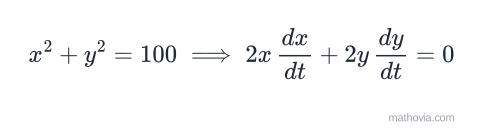
That’s a related rates equation. It links the two rates
The key step is the same one as in implicit differentiation, except the variable you differentiate with respect to is time. Every changing quantity is secretly a function of
How to Solve Related Rates Problems: 5 Steps
- Draw a picture and give every changing quantity a variable name.
- List the rates. Write the rate you’re given and the rate you want, both as derivatives with respect to
. A quantity that’s decreasing has a negative rate. - Write an equation that relates the quantities. Geometry usually supplies it: the Pythagorean theorem, an area or volume formula, or similar triangles.
- Differentiate both sides with respect to
. - Substitute and solve. Only now plug in the values at the moment the question asks about, then solve for the unknown rate. Include units.
Step 5 is where most mistakes happen. Plugging in numbers before differentiating turns the variables into constants, and their rates disappear.
Example 1: A Spreading Ripple
A stone dropped in a pond makes a circular ripple whose radius grows at 2 cm/s. How fast is the area growing when the radius is 10 cm?
Steps 1 and 2 — quantities and rates: radius
Step 3 — the equation:
Step 4 — differentiate with respect to
Step 5 — substitute:
The radius grows at a steady rate, but the area grows faster and faster, because each new ring has a longer circumference.
Example 2: Blowing Up a Balloon
This is a version of the “bubble gum problem”, where a growing bubble is treated as a sphere. Air is pumped into a spherical balloon at 100 cm³/s. How fast is the radius increasing when the radius is 5 cm?
Steps 1 and 2:
Step 3 — the volume of a sphere:
Step 4 — differentiate:
Step 5 — substitute and solve:
At
Example 3: The Sliding Ladder
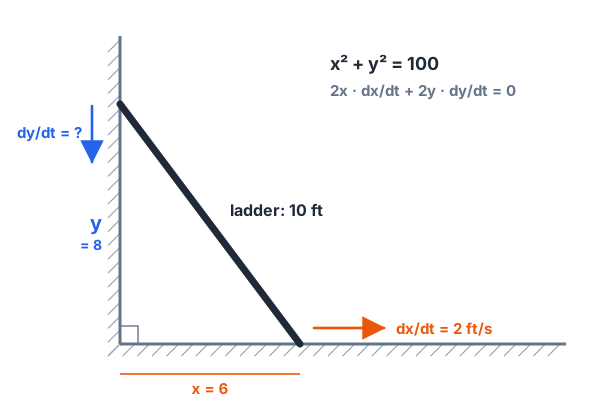
A 10 ft ladder leans against a wall. The bottom slides away from the wall at 2 ft/s. How fast is the top sliding down when the bottom is 6 ft from the wall?
Steps 1 and 2: let
Step 3 — Pythagorean theorem:
Step 4 — differentiate:
Step 5 — find
The negative sign means
Example 4: Filling a Conical Tank
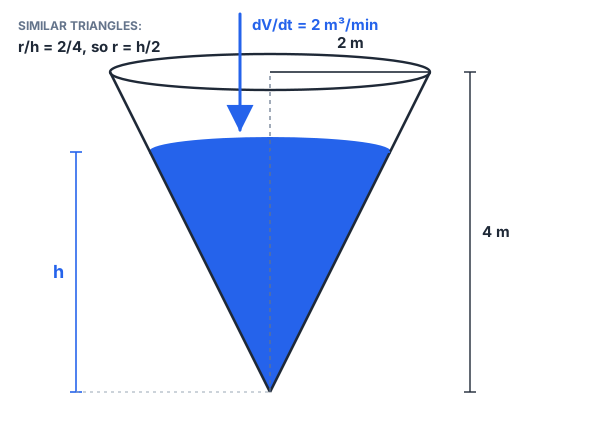
Water pours at 2 m³/min into a tank shaped like an upside-down cone, 4 m tall with a top radius of 2 m. How fast is the water level rising when the water is 3 m deep?
Steps 1 and 2: water depth
Step 3 — volume of a cone, then remove
Step 4 — differentiate:
Step 5 — substitute and solve:
Eliminating a variable before differentiating is a common move. Use a relationship that is true at every moment, like the similar triangles here, not a value that is only true at one instant.
Example 5: A Shadow Problem
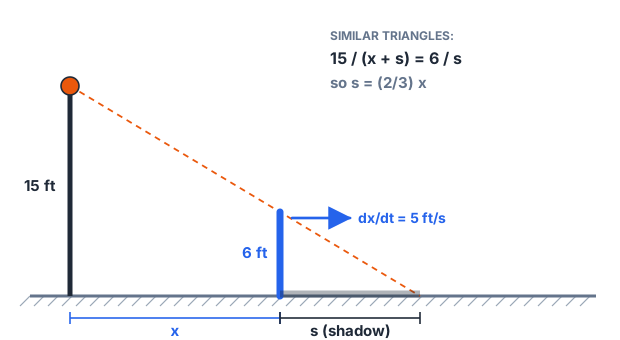
A 6 ft tall person walks away from a 15 ft lamppost at 5 ft/s. How fast is the person’s shadow getting longer?
Steps 1 and 2:
Step 3 — similar triangles. The big triangle (lamppost) and the small one (person) share the angle at the tip of the shadow:
Step 4 — differentiate:
Step 5 — substitute:
The answer doesn’t depend on where the person is, so the question doesn’t need to give a distance. A follow-up question often asks how fast the tip of the shadow moves. The tip is at distance
Example 6: Two Cars and an Intersection
Car A is 3 miles north of an intersection, driving south toward it at 30 mph. Car B is 4 miles east of the intersection, driving east at 40 mph. Is the distance between the cars increasing or decreasing, and how fast?
Steps 1 and 2:
Step 3 — Pythagorean theorem:
Step 4 — differentiate and cancel the 2s:
Step 5 — substitute. At this moment
The distance is increasing at 14 mph. Car A is closing in, but car B is pulling away faster.
Common Mistakes
- Substituting before differentiating. In the ladder problem, writing
first makes a constant, so vanishes. Keep every changing quantity as a variable until after step 4. - Forgetting the rate factor.
, not . Every variable that changes gets its own . - Wrong signs. A quantity that is shrinking has a negative rate. Car A’s distance to the intersection decreases, so its rate is
, not . - Treating a fixed quantity as a variable, or the other way round. The ladder’s length (10) and the tank’s dimensions (2 and 4) are constants. The water depth and the shadow are not.
- Missing values at the instant. You often need to find a quantity the problem didn’t give, like
in the ladder problem, from the original equation.
Practice Problems
Try each one before opening the answer. The practice set has 12 more with instant checking.
Problem 1. The side of a square grows at 3 cm/s. How fast is the area growing when the side is 5 cm?
Show answer
Step 1 — the equation:
Step 2 — differentiate:
Step 3 — substitute:
Answer:
Problem 2. A circle’s area grows at
Show answer
Step 1 — differentiate
Step 2 — substitute and solve:
Answer:
Problem 3. The edge of a cube grows at 0.5 cm/s. How fast is the volume growing when the edge is 4 cm?
Show answer
Answer:
Problem 4. A 13 ft ladder leans against a wall, and its bottom slides away at 3 ft/s. How fast is the top sliding down when the bottom is 5 ft from the wall?
Show answer
Step 1 — the equation and its derivative:
Step 2 — find
Step 3 — substitute:
Answer: the top slides down at
Problem 5. A snowball melts so that its radius shrinks at 0.2 cm/min. How fast is its volume changing when the radius is 10 cm?
Show answer
The radius is decreasing, so
Answer:
Problem 6. A plane flies horizontally at an altitude of 6 km and a speed of 800 km/h, passing directly over a radar station. How fast is its distance from the station increasing when that distance is 10 km?
Show answer
Step 1 — the equation. With
Step 2 — find
Step 3 — substitute:
Answer:
Related rates use the derivative to compare how fast things change. Next, the derivative goes the other way: using the tangent line to estimate values of a function near a point you know.