
Most people learn to measure angles in degrees: 90° for a right angle, 360° for a full turn. Calculus does something different. It measures angles in radians, and it does so for a very practical reason, which this lesson gets to below. The good news is that converting between the two takes a single multiplication, and after a little practice the common angles in radians,

What Is a Radian?
Draw a circle and mark off an arc exactly as long as its radius. The angle that arc makes at the centre is one radian.
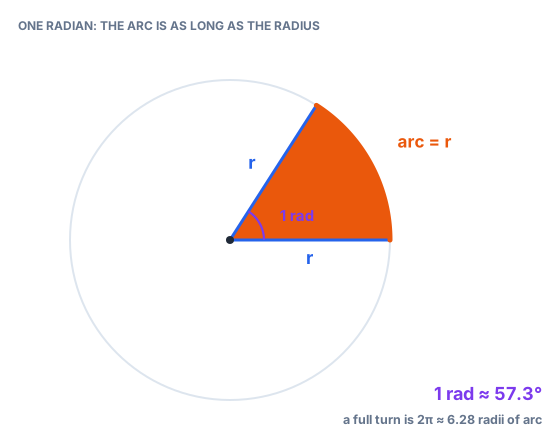
Since a circle’s circumference is
That single fact is the basis of every conversion. It also tells you that one radian is
How to Convert Radians to Degrees
Multiply by
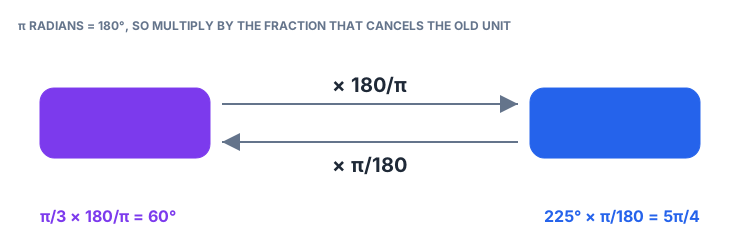
Example 1: An Angle With π
Convert
The
Example 2: A Plain Number of Radians
Convert 2.5 radians to degrees.
There’s no
How to Convert Degrees to Radians
Multiply by
Example 3: Degrees to an Exact Radian Value
Convert
Divide 225 and 180 by their greatest common factor, 45, and leave
Example 4: An Awkward Angle
Convert
Common Angles in Radians and Degrees
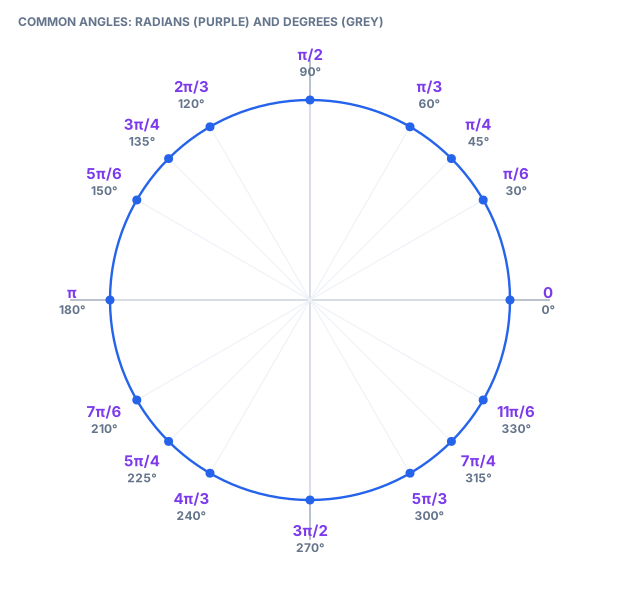
| Degrees | 0° | 30° | 45° | 60° | 90° | 120° | 135° | 150° | 180° | 270° | 360° |
|---|---|---|---|---|---|---|---|---|---|---|---|
| Radians | 0 |
A quick way to rebuild the table:
Negative Angles and Angles Bigger Than 2π
Angles aren’t limited to one turn. A positive angle turns counterclockwise from the positive
The conversion formulas work exactly the same way for these angles:
Why Calculus Uses Radians
Radians aren’t just a different unit; they make the formulas of calculus simple. Two facts sit at the heart of the trig parts of the course:
Both are true only when
There’s a practical warning in that, too: when you evaluate a trig function on a calculator during a calculus problem, check that it’s in RAD mode, not DEG.
Arc Length and Sector Area
Radians also give the simplest formulas for parts of a circle. With
For a circle of radius 6 cm and
Common Mistakes to Avoid
- Using the wrong fraction. To get degrees, multiply by
, so the cancels. To get radians, multiply by , so the degrees cancel. - Treating a plain number as degrees.
means the sine of 2 radians, not 2 degrees. - Leaving the calculator in degree mode for a calculus problem.
- Not simplifying.
should be reduced to . - Converting
to 180 inside a radian answer. radians is 180°, but on its own is the number 3.14159…, not 180.
Practice Problems
Work each one before opening the answer.
Problem 1. Convert
Show answer
Answer:
Problem 2. Convert
Show answer
Answer:
Problem 3. Convert 1.2 radians to degrees, to two decimal places.
Show answer
Answer:
Problem 4. Convert
Show answer
Answer:
Problem 5. Convert
Show answer
The sign carries through:
Answer:
Problem 6. A circle has radius 8 cm. How long is the arc cut off by a central angle of
Show answer
Answer:
With radians in hand, the trigonometric functions themselves come next: what sine, cosine and tangent mean on the unit circle, and how their graphs behave.