
How much area can 2,400 feet of fence enclose? What’s the cheapest shape for a soda can? Where should you land a boat to get to town fastest? These are optimization problems: find the largest or smallest value of some quantity. Calculus solves all of them the same way. Write the quantity as a function of one variable, find the critical points, and check which one gives the absolute maximum or minimum.

The Steps for Solving Optimization Problems
- Read and draw. Sketch the situation and label every quantity that can change.
- Name the goal. Write a formula for the quantity you want to maximize or minimize (the objective function).
- Use the constraint. Find the equation that links the variables, solve it for one of them, and substitute. The objective is now a function of one variable.
- Find the domain. Decide which values of the variable make physical sense.
- Differentiate and solve
for the critical points in the domain. - Confirm it’s the absolute max or min (see the next section).
- Answer the question. Reread it. Does it ask for the dimensions, the maximum value, or both? Include units.
Most of the work is in steps 1 to 4. Once you have the right function, the calculus is usually short.
Making Sure It’s the Absolute Max or Min
A critical point is only a candidate. You need a reason it gives the absolute maximum or minimum, not just a local one. Use whichever fits:
- Closed interval method. If the domain is a closed interval
, evaluate at the critical points and the endpoints and compare. This is the method from the extreme value theorem lesson. - Only one critical point. If
is continuous on an interval and has just one critical point there, and the first derivative test shows it’s a local max, it’s the absolute max. (The same goes for a min.) - One concavity. If
on the whole domain, any critical point is the absolute max; if everywhere, it’s the absolute min. This is the second derivative test applied to the whole interval.
Example 1: Fencing Along a River
A farmer has 2,400 ft of fencing to enclose a rectangular field along a straight river. No fence is needed along the river. What dimensions give the largest area?
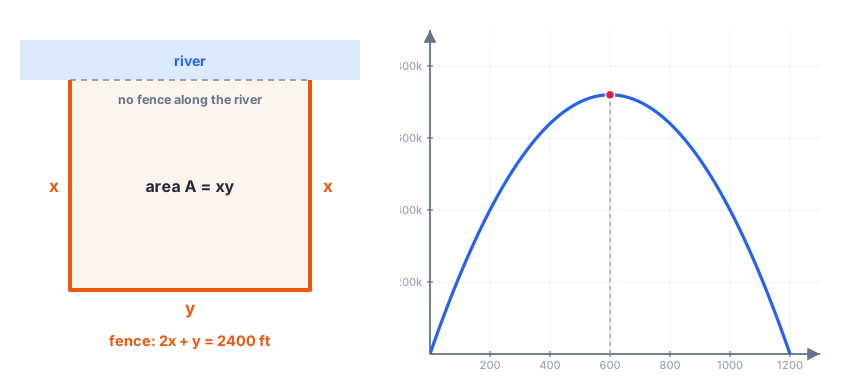
Goal: maximize
Constraint: the fence covers two sides of length
One variable:
Critical point:
Check: on the closed interval
Answer: the field should be 600 ft by 1,200 ft (the long side along the river), enclosing 720,000 ft².
Example 2: The Open Box
A box with an open top is made from a 12-inch square of cardboard by cutting an
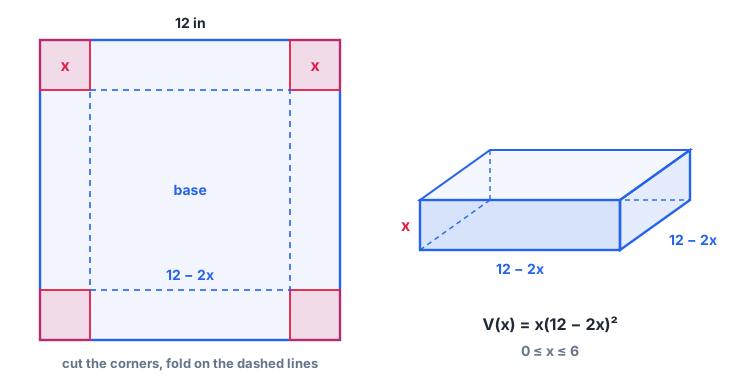
After folding, the box has height
By the product rule and the chain rule,
Factor out
Answer: cut 2-inch squares. The box is 8 in by 8 in by 2 in, with volume 128 in³.
Example 3: The Can That Uses the Least Material
A cylindrical can must hold 1,000 cm³. What radius makes the surface area (top, bottom and side) as small as possible?
Goal: minimize
Constraint:
Critical point:
Check:
Then
Answer:
Example 4: The Closest Point on a Curve
Find the point on the curve
A point on the curve is
Answer: the closest point is
Example 5: The Fastest Route
You’re in a boat 3 km from the nearest point on a straight shore. A town is 8 km down the shore from that point. You can row at 3 km/h and walk at 5 km/h. Where should you land to reach the town as fast as possible?
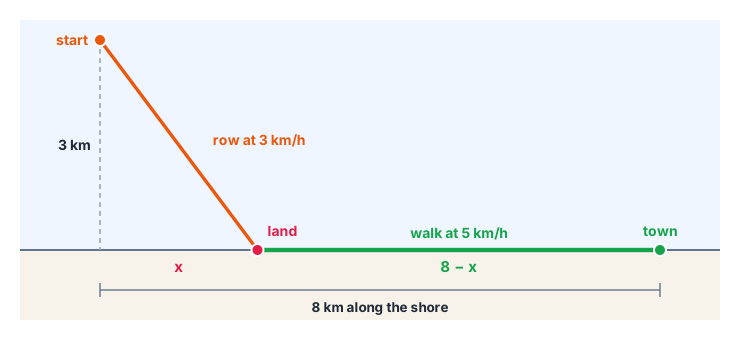
Land
Squaring both sides,
Check the closed interval
Answer: land 2.25 km down the shore. The trip takes 2.4 hours, 12 minutes faster than rowing straight to shore.
Example 6: The Largest Rectangle Under a Parabola
A rectangle has its base on the x-axis and its top two corners on the parabola
By symmetry, put the corners at
Answer: the largest area is 32, for a rectangle 4 wide and 8 tall.
Justifying Your Answer on the AP Calculus Exam
AP Calculus AB and BC free-response questions usually award a point for justifying that your answer is an absolute maximum or minimum. Finding
- Candidates test: “The absolute maximum on
occurs at a critical point or an endpoint. , , , so the maximum is .” Show the table. - Only critical point: ”
changes from positive to negative at , the only critical point on the interval, so has its absolute maximum at .” - Concavity: ”
for all in the domain, so the critical point is the absolute maximum.”
Use the function’s name in the sentence, and make it clear which test you’re using.
Common Mistakes
- Optimizing a function of two variables. Use the constraint to get down to one variable before differentiating.
- Ignoring the domain. In Example 2,
makes but it’s an endpoint with zero volume. - Skipping the check. A critical point can be a minimum when you wanted a maximum.
- Answering the wrong question. If the problem asks for the dimensions, give both of them, not just
. - Forgetting units. Area is in square units and volume in cubic units.
Practice Problems
Try each one before opening the answer. The practice set has 12 more with instant checking.
Problem 1. Find two positive numbers whose product is 100 and whose sum is as small as possible.
Show answer
With
Answer: 10 and 10, with sum 20
Problem 2. A rectangular plot of 1,800 m² is fenced on three sides; the fourth side is a river. What is the least fencing needed?
Show answer
Let
Answer: 120 m of fence, for a plot 30 m by 60 m
Problem 3. An open box is made from a 10-by-16-inch sheet by cutting
Show answer
Answer: 144 in³, with 2-inch cuts
Problem 4. Find the points on
Show answer
Minimize
Answer:
Problem 5. A theater sells 500 tickets at $20. For each $1 drop in price, it sells 50 more. What price maximizes revenue?
Show answer
After
Answer: $15 a ticket, for revenue
Problem 6. Find the largest rectangle that fits in a semicircle of radius 5, with its base on the diameter.
Show answer
With top corners at
The endpoints give 0, and
Answer: area 25, for a rectangle
Optimization brings together everything in this chapter: critical points, the extreme value theorem and the derivative tests. Next, curve sketching uses the same tools to draw an accurate graph from a formula.