Mathovia

Calculus / Calculus 1 · Derivatives

Product Rule for Derivatives

The derivative of a product is not the product of the derivatives. The product rule gives the right answer: differentiate the first factor and keep the second, then add the first factor times the derivative of the second. It's the tool for any function built by multiplying two simpler ones.

Practice Problems
Written by
MPhil in Mathematics, Founder of Mathovia
Published

Mathematics verification: Mathematical formulas, calculations, worked examples and solutions are reviewed for accuracy before publication. How we check our work

The power rule handles sums of powers, and when two polynomials are multiplied you can always expand first. But you can’t expand or , and expanding by hand is nobody’s idea of fun. The product rule differentiates a product directly, and it comes with one warning: the derivative of a product is not the product of the derivatives.
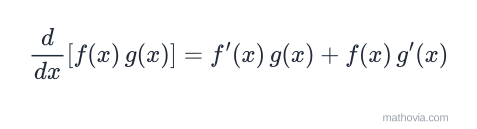
The product rule: the derivative of f of x times g of x equals f prime of x times g of x, plus f of x times g prime of x
The product rule

What Is the Product Rule?

If and are both differentiable, then

In words: differentiate the first factor and keep the second, then add the first factor times the derivative of the second. Many students learn it as a chant, “first times derivative of second, plus second times derivative of first”, which is the same formula with the terms swapped. Because the two terms are added, the order doesn’t matter.

You’ll also see the product rule written with and , or in Leibniz notation:

Why You Can’t Just Multiply the Derivatives
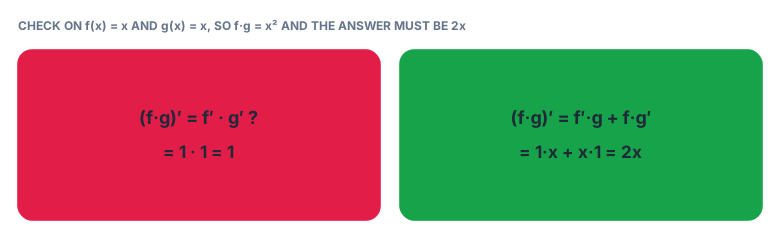
Two cards checking the rules on f of x equals x and g of x equals x, whose product is x squared with derivative 2x. Multiplying the derivatives gives 1 times 1 equals 1, which is wrong. The product rule gives 1 times x plus x times 1 equals 2x, which matches the power rule
The tempting shortcut fails on the simplest possible example

It’s natural to guess that , since derivatives split nicely over sums. Test it on the simplest product there is: . The real derivative is . The guess gives . It isn’t even close, so the shortcut is out, and the product rule is what replaces it.

Why the Product Rule Works

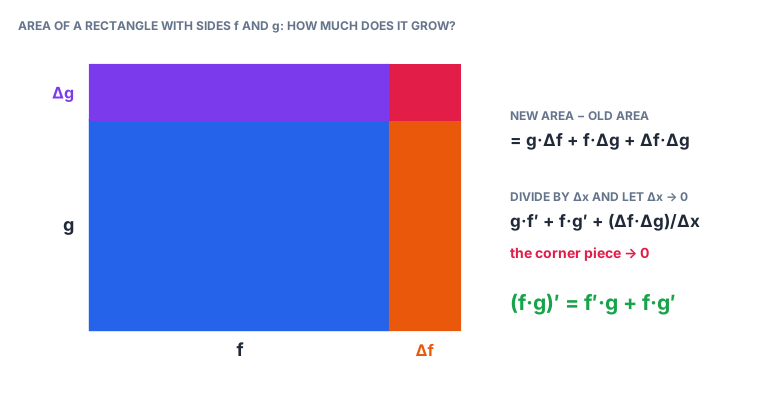
A rectangle with width f and height g has area f times g. When f grows by delta f and g grows by delta g, the area grows by a strip g times delta f on the right, a strip f times delta g on top, and a small corner delta f times delta g. Dividing by delta x and letting delta x go to 0, the corner piece vanishes, leaving f prime g plus f g prime
The two strips are the two terms of the product rule; the corner disappears in the limit

Picture as the area of a rectangle with width and height . Nudge a little, and both sides grow: the width by and the height by . The extra area comes in three pieces:

  • a strip down the right side, ,
  • a strip along the top, ,
  • a tiny corner, .

Divide by to get a rate, and let . The strips become and . The corner is a product of two small changes, so even after dividing by it still shrinks to 0. What’s left is .

The formal proof uses the limit definition of the derivative with one clever step: add and subtract in the numerator.

As , the first fraction tends to , the second to , and because a differentiable function is continuous. That gives .

How to Use the Product Rule, Step by Step
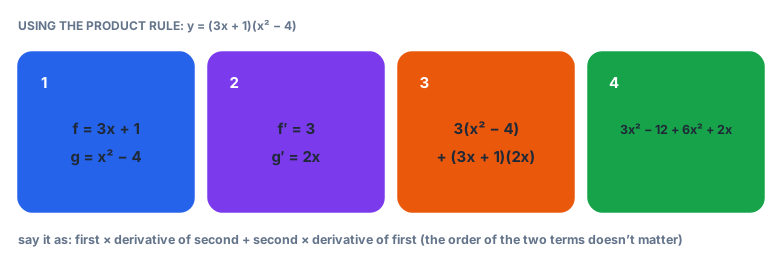
Four steps for y equals 3x plus 1 times x squared minus 4. Step 1, name the factors: f equals 3x plus 1, g equals x squared minus 4. Step 2, differentiate each: f prime equals 3, g prime equals 2x. Step 3, form f prime g plus f g prime: 3 times x squared minus 4, plus 3x plus 1 times 2x. Step 4, simplify: y prime equals 9x squared plus 2x minus 12
Label, differentiate, combine, simplify
  1. Name the two factors and . Writing them down stops you mixing them up halfway.
  2. Differentiate each one separately to get and .
  3. Write , with brackets around every factor.
  4. Simplify only as far as the question needs. A factored answer is often more useful than an expanded one.

Example 1: Checking Against the Power Rule

Differentiate with the product rule.

With and : . Since , the power rule gives too. In practice you’d simplify first, but it’s reassuring that the two methods agree.

Example 2: Two Polynomials

Differentiate .

This is the example in the step-by-step card: , , so

Expanding first, , and differentiating gives the same answer. For polynomials either route works; choose whichever is less work.

Example 3: A Power Times a Trig Function

Differentiate .

This one can’t be expanded, so the product rule is the only way. Using (proved in the lesson on derivatives of trig functions):

Example 4: x Times e to the x

Differentiate .

Using :

Factoring out shows at a glance that the slope is zero only at , since is never zero.

Example 5: A Root Times a Polynomial

Differentiate .

Write , so and :

To combine the terms, rewrite as so both share the denominator .

Example 6: Three Factors

Differentiate .

The product rule extends naturally: differentiate one factor at a time, keep the rest, and add the results.

Here every factor has derivative 1, so

which matches differentiating the expanded form .

Example 7: Horizontal Tangent Lines

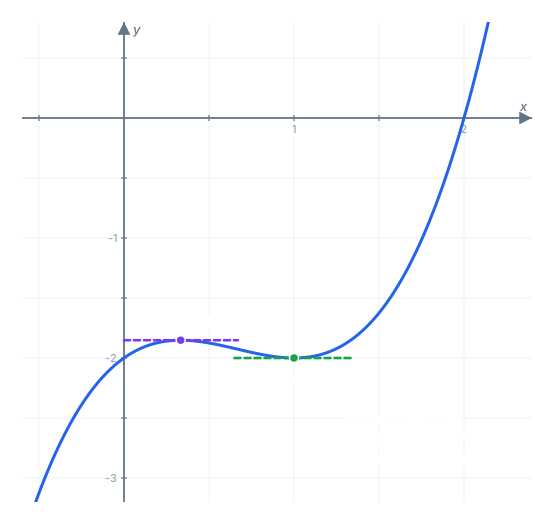
Graph of y equals x squared plus 1 times x minus 2, with dashed horizontal tangent lines at the point one third, negative 50 over 27, a small peak, and at the point 1, negative 2, a small dip. The derivative 2x times x minus 2 plus x squared plus 1 equals zero at x equals one third and x equals 1
Setting y′ = 0 finds the peak and the dip

Where does have a horizontal tangent line?

By the product rule, . This is zero at and . At , , so the tangent there is the line . At , . The graph has a small peak and a small dip, close together, which you’d easily miss without the derivative.

Example 8: Using a Table of Values

Exam questions often give values instead of formulas. Suppose , , and . Find .

You never need the functions themselves, just their values and slopes at the point.

When You Don’t Need the Product Rule

  • A constant times a function. For or , the constant multiple rule is quicker. (The product rule still works: the constant’s derivative is 0, so one term vanishes.)
  • A product that simplifies. , and . Simplify first.
  • Small polynomial products, where expanding is just as fast, as in Example 2.

Common Mistakes With the Product Rule

  • Multiplying the derivatives. . Check any rule you’re unsure of on .
  • Dropping one of the two terms. Every factor gets its turn to be differentiated, so two factors means two terms, three factors means three.
  • Forgetting brackets. In , the brackets matter. Drop them and the algebra goes wrong.
  • Using a minus sign. The product rule adds. The minus sign belongs to the quotient rule.

Practice Problems

Try each one before opening the answer. The practice set has 12 more with instant checking.

Problem 1. Differentiate .

Show answer

.

Answer:

Problem 2. Differentiate .

Show answer

.

Answer:

Problem 3. Differentiate .

Show answer

.

Answer:

Problem 4. If , , and , find .

Show answer

.

Answer:

Problem 5. Find the tangent line to at .

Show answer

The point is . The slope is , which is 9 at . So .

Answer:

The product rule’s partner is the quotient rule, for functions like that are one expression divided by another. That’s next.

Frequently Asked Questions

What is the product rule?+

The product rule says that the derivative of a product of two functions is : the derivative of the first times the second, plus the first times the derivative of the second. For example, .

What is the product rule formula?+

If , then . In Leibniz notation, . The two terms can be written in either order because they are added.

Why can't you just multiply the derivatives?+

Because it gives wrong answers. Take : the product is , whose derivative is , but . When both factors change at once, each one's change is scaled by the size of the other, which is exactly what the two terms of the product rule capture.

How do you use the product rule with three functions?+

Differentiate one factor at a time and keep the other two: . There is one term for each factor. For this gives .

When should you use the product rule?+

Use it when a function is two (or more) expressions multiplied together and expanding is impossible or messy, such as , or . You don't need it for a constant times a function, like : the constant multiple rule is quicker.

What is the difference between the product rule and the quotient rule?+

The product rule handles and adds two terms: . The quotient rule handles , subtracts in a fixed order and divides by : . The quotient rule is the next lesson.

Related lessons