Mathovia

Calculus / Calculus 1 · Algebra & Trigonometry Review

Solving Trigonometric Equations

A trig equation like 2 sin x − 1 = 0 doesn't have one answer, it has infinitely many, because sine repeats. Solving one means finding every angle in a single turn and then describing the rest with the period. The method is the same four steps every time.

Practice Problems
Written by
MPhil in Mathematics, Founder of Mathovia
Published

Mathematics verification: Mathematical formulas, calculations, worked examples and solutions are reviewed for accuracy before publication. How we check our work

Solving gives one answer. Solving gives infinitely many, because every time the sine wave comes back up through , there’s another solution. That’s the only real difference between solving trigonometric equations and the equations from algebra: once the trig function is isolated, you have to find every angle that works, not just the first one. In calculus this comes up whenever you look for where a derivative is zero, so a systematic method pays off.

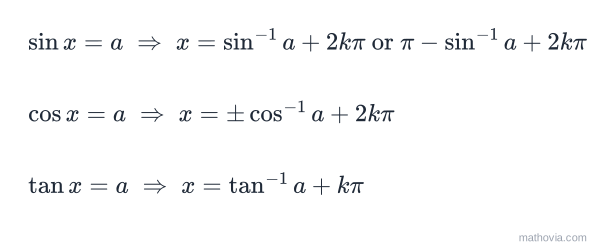
General solutions: sin x = a gives x = inverse sine of a plus 2 k pi or pi minus inverse sine of a plus 2 k pi; cos x = a gives x = plus or minus inverse cosine of a plus 2 k pi; tan x = a gives x = inverse tangent of a plus k pi
The general solutions of the three basic trig equations

How to Solve a Trigonometric Equation
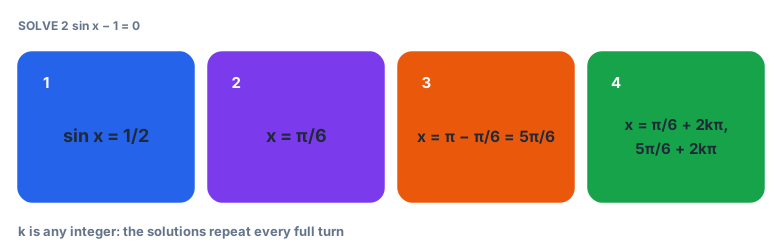
Four steps for 2 sin x − 1 = 0: isolate to get sin x = 1/2; first angle x = π/6; other quadrant x = π − π/6 = 5π/6; add the period to get x = π/6 + 2kπ and 5π/6 + 2kπ
The four steps
  1. Isolate the trig function, using ordinary algebra, until you have , or .
  2. Find the first angle. Use the special-angle values or an inverse trig function.
  3. Find the other angle in one turn. Sine and cosine usually give two solutions in ; the sign tells you which quadrants.
  4. Add the period if the question asks for all solutions: for sine and cosine, for tangent, where is any integer.

Example 1: A Basic Sine Equation

Solve .

Step 1 — isolate. .

Step 2 — first angle. , so .

Step 3 — the other angle. Sine is positive in quadrants I and II, and the quadrant II angle with the same reference angle is .
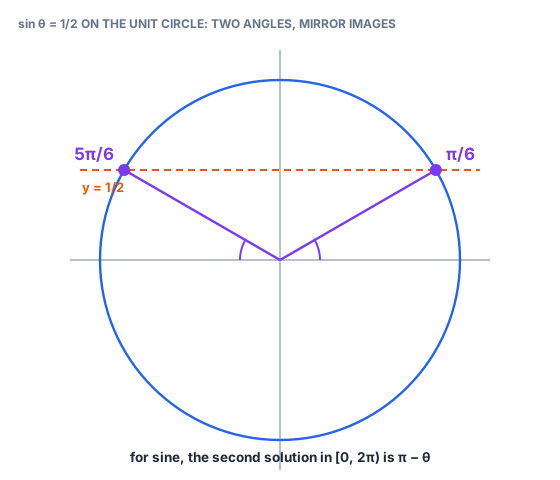
The unit circle cut by the horizontal line y = 1/2 at two points, at angles π/6 and 5π/6, mirror images across the y-axis
The line y = 1/2 meets the circle twice

Step 4 — the general solution.

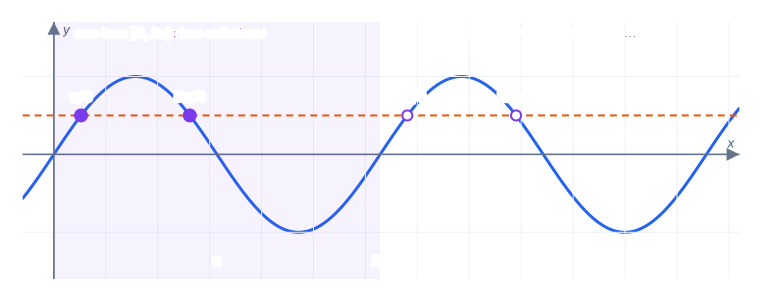
The graph of y = sin x crossing the line y = 1/2 at π/6 and 5π/6 in the first turn, and again at 13π/6 and 17π/6 in the next turn
Two solutions per turn, repeating every 2π

Example 2: A Cosine Equation

Solve for .

Isolate: . The reference angle is , and cosine is negative in quadrants II and III:

Example 3: A Tangent Equation

Solve for .

. Tangent repeats every , so the other solution in one turn is . The general solution is simply .

Example 4: A Quadratic Trig Equation

Solve for .

Treat like a variable and factor, just as with quadratic equations:

First factor. : reference angle , sine negative in quadrants III and IV, so or .

Second factor. : only .

The solutions are , and .

Example 5: Using an Identity First

Solve for .

Two different functions appear, so rewrite one in terms of the other with :

So , giving and , or , giving .

Example 6: A Multiple Angle

Solve for .

Let . Since runs over one turn, runs over two, , so find all four values of first:

Then halve them: . Forgetting to extend the range for is the classic way to lose half the answers.

When the Value Isn’t Special

Not every equation lands on a special angle. For , use a calculator in radian mode: , and the quadrant II solution is . The method doesn’t change; only the first angle comes from a calculator instead of the table.

Cosine works the same way with its own symmetry. For , the calculator gives , already in quadrant II, and the matching quadrant III angle is . For cosine, the second solution in one turn is always minus the first.

Equations With Cosecant, Secant and Cotangent

Rewrite them in terms of sine, cosine and tangent first. For , flip both sides: , so or . For , , so . Watch for values that make the original function undefined: and don’t exist where , so those angles can never be solutions.

Checking Your Solutions

Substitute each answer back into the original equation. For Example 4, gives , and , as it should. A graph is a quick second check: plot both sides and count the crossings in one turn. If the graph shows three crossings and you found two angles, one is missing.

Why This Matters in Calculus

In Calculus 1 you’ll find the highest and lowest points of a function by solving “derivative ”, and with trig functions that means solving a trig equation. For , the derivative is , and setting it to zero gives : exactly Example 1. The turning points of on are at and . Every step of this lesson gets reused there.

Common Mistakes to Avoid

  • Stopping at one solution. has two in .
  • Dividing by a trig function. It throws away solutions; factor instead.
  • Using for tangent. Tangent’s period is , so the general solution adds .
  • Not widening the range for multiple angles. For , solve over , then divide.
  • Accepting impossible values. or has no solution; discard that factor.

Practice Problems

Work each one before opening the answer.

Problem 1. Solve for .

Show answer

: cosine is positive in quadrants I and IV.

Answer:

Problem 2. Solve for .

Show answer

: quadrants III and IV, reference angle .

Answer:

Problem 3. Find the general solution of .

Show answer

, and tangent repeats every .

Answer: (equivalently )

Problem 4. Solve for .

Show answer

: gives 0 and ; gives 0.

Answer:

Problem 5. Solve for .

Show answer

, which happens at a reference angle of in every quadrant.

Answer:

Problem 6. Solve for .

Show answer

With over : . Halve each.

Answer:

That completes the algebra and trigonometry review. With functions, logarithms and trig in place, Calculus 1 begins properly with limits: what happens to a function as its input gets closer and closer to a value.

Frequently Asked Questions

How do you solve a trigonometric equation?+

Isolate the trig function, find the first angle with the inverse function or the unit circle, find any second angle in using symmetry, then add multiples of the period for the general solution. For : , so and , plus .

Why do trig equations have infinitely many solutions?+

Because sine and cosine repeat every and tangent every . Any angle that works keeps working when you add a full period, so the solutions come in repeating families.

What is the general solution of sin x = a?+

For : or , where is any integer. If is outside , there's no solution.

How do you solve a quadratic trig equation?+

Treat the trig function as the variable. For , factor as , then solve and separately. In that gives , and .

Can you divide both sides of a trig equation by sin x?+

Not safely, because you lose every solution where . Move everything to one side and factor instead: becomes , which keeps both families of solutions.

Related lessons