Mathovia

Calculus / Calculus 1 · Applications of Derivatives

Mean Value Theorem

The mean value theorem says that somewhere on a smooth curve, the instantaneous rate of change equals the average rate of change. If you averaged 75 mph on a trip, your speedometer read exactly 75 mph at some moment.

Practice Problems
Written by
MPhil in Mathematics, Founder of Mathovia
Published

Mathematics verification: Mathematical formulas, calculations, worked examples and solutions are reviewed for accuracy before publication. How we check our work

Drive 100 miles in 80 minutes and your average speed is 75 mph. You may have sped up and slowed down along the way, but at some instant your speedometer must have read exactly 75 mph. The mean value theorem turns that observation into mathematics: for a smooth function, the instantaneous rate of change equals the average rate of change at least once on every interval. It’s one of the most important theorems in calculus, because it links what a derivative says at single points to how the function behaves over a whole interval.
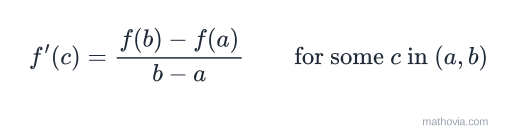
f prime of c equals f of b minus f of a over b minus a, for some c in the open interval from a to b
The mean value theorem formula: some tangent slope equals the average slope

What Is the Mean Value Theorem?

Mean value theorem. Suppose is

  1. continuous on the closed interval , and
  2. differentiable on the open interval .

Then there is at least one number in such that

The right side is the average rate of change of from to . Geometrically, it’s the slope of the secant line joining the endpoints and . The left side is the slope of the tangent line at . So the theorem says:

Somewhere between and , the tangent line is parallel to the secant line.

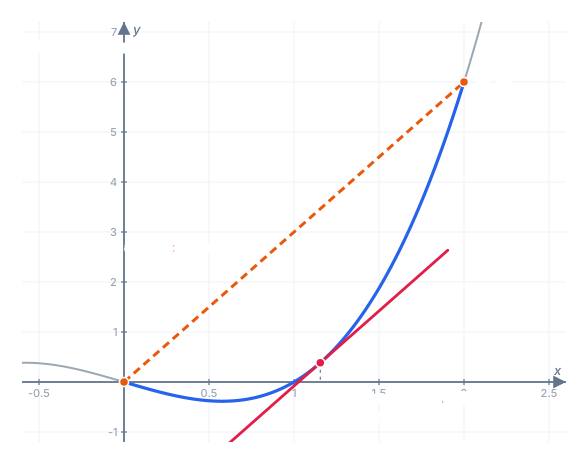
Graph of f of x equals x cubed minus x on the interval from 0 to 2. A dashed secant line joins (0, 0) to (2, 6) with slope 3. At c approximately 1.155 a tangent line touches the curve with the same slope 3, parallel to the secant
The secant from (0, 0) to (2, 6) has slope 3, and so does the tangent at c ≈ 1.155

Slide a line parallel to the secant across the graph. The last place it touches the curve before leaving it is a point of tangency, and that’s . The theorem tells you such a point exists, not where it is. To find it, solve the equation for .

The Two Conditions

The mean value theorem has two requirements, and both are needed:

  • Continuous on : no holes, jumps or asymptotes anywhere in the interval, including the endpoints.
  • Differentiable on : no corners, cusps or vertical tangents strictly inside the interval.

Polynomials, , and satisfy both on every interval. For rational functions, roots and absolute values, check where the function or its derivative breaks down, and see whether that point is inside the interval. The differentiability lesson covers the ways a function can fail to have a derivative.

How to Use the Mean Value Theorem

  1. Check the conditions: continuity on and differentiability on .
  2. Compute the average rate of change: .
  3. Find and set equal to that number.
  4. Solve for and keep only the solutions with .

Example 1: Finding c for a Polynomial

Find the value of guaranteed by the mean value theorem for on .

Step 1 — conditions. is a polynomial, so it’s continuous and differentiable everywhere.

Step 2 — average rate of change.

Step 3 — set the derivative equal to it. , so

Step 4 — keep the ones inside . is negative, so only

This is the point shown in the graph above.

Example 2: A Square Root Function

Verify the mean value theorem for on and find .

is continuous for and differentiable for , so both conditions hold on . The average rate of change is

With :

is inside .

Example 3: More Than One Value of c

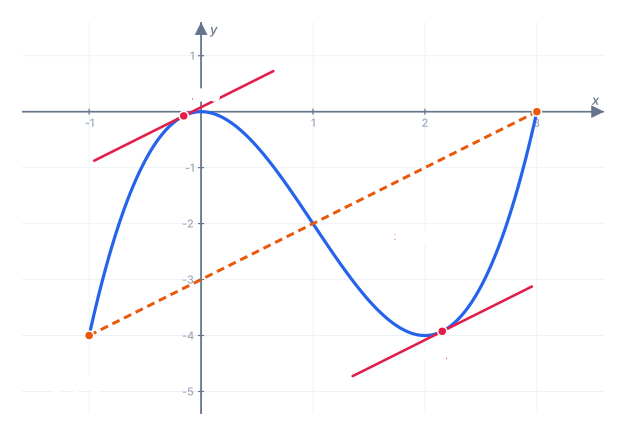
Graph of f of x equals x cubed minus 3 x squared on minus 1 to 3. A dashed secant joins (minus 1, minus 4) to (3, 0) with slope 1. Two tangent lines with slope 1 touch the curve, at c approximately minus 0.155 near the peak and at c approximately 2.155 near the valley
The theorem promises at least one c. This curve has two tangents parallel to the secant

Find every for on .

The end values are and , so the average rate of change is

Set equal to 1 and use the quadratic formula:

So and . Both are inside , so both count.

Example 4: A Mean Value Theorem Word Problem
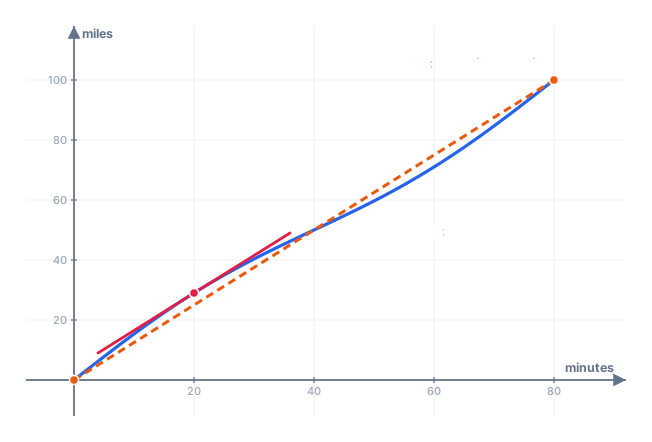
Graph of distance in miles against time in minutes for a trip from booth A at 0 miles to booth B at 100 miles after 80 minutes. The dashed secant line has slope 75 miles per hour. A tangent line at 20 minutes has the same slope, so the speed there is exactly 75 miles per hour
Average speed 75 mph means the speedometer read 75 mph at some moment

A driver passes toll booth A at 1:00 p.m. and toll booth B, 100 miles further along the highway, at 2:20 p.m. The speed limit is 65 mph. Can the driver be proven to have sped?

Let be the distance traveled after hours. Position changes smoothly, so is continuous and differentiable. The trip took 80 minutes, or hours, so the average speed was

By the mean value theorem, there’s a time with . Since is the speed, the driver was going exactly 75 mph at that moment, faster than the 65 mph limit. Some toll roads use this to issue speeding tickets.

Example 5: Using a Table of Values

AP calculus questions often give a table instead of a formula. Suppose is differentiable on with these values:

0258
410713

Must there be a value in with ?

Yes. is differentiable, so it’s also continuous on . The average rate of change there is

so by the mean value theorem some in has .

Must there be a value in with ? Yes, by the same reasoning: .

When you write the justification, name the theorem, state that the conditions hold, and show the average rate of change.

Example 6: When the Mean Value Theorem Doesn’t Apply
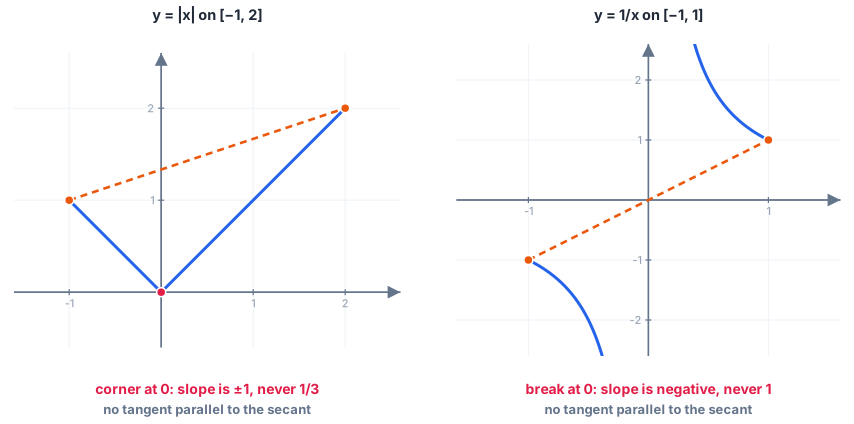
Two graphs where the mean value theorem fails. The absolute value of x on minus 1 to 2 has a secant of slope one third, but its slope is only ever minus 1 or 1 because of the corner at 0. One over x on minus 1 to 1 has a secant of slope 1, but its slope is always negative and it breaks at 0
A corner or a break inside the interval can destroy the conclusion
  • on . The secant slope is , but the slope of is or , never . The theorem fails because isn’t differentiable at 0.
  • on . The secant slope is , but is always negative. Here isn’t even continuous on : it’s undefined at 0.

A failed condition doesn’t always mean there’s no such . It means the theorem makes no promise.

Example 7: Bounding a Function With Its Derivative

The mean value theorem also turns information about into information about . Suppose and for all . How large and how small can be?

By the theorem, for some in ,

Since is between 2 and 5, is between 6 and 15. So

The same idea proves inequalities. For sine, for some , and , so for all and .

Why the Mean Value Theorem Is True

The proof tilts the picture so that Rolle’s theorem applies. Let be the secant slope, and subtract the secant line from :

is the vertical distance between the curve and the secant line.

  • is continuous on and differentiable on , because is and the secant line is a polynomial.
  • and , since the secant meets the curve at both ends.

So Rolle’s theorem gives a in with . But , so . That’s the mean value theorem.

What the Mean Value Theorem Tells You

Several facts used throughout calculus follow from the theorem. Each applies on an interval where is differentiable.

  • If everywhere, is constant. For any two points, .
  • If everywhere, then and differ by a constant. Apply the first fact to . This is why every antiderivative ends in .
  • If , is increasing; if , it’s decreasing. For , has the same sign as . This is the basis of the first derivative test.

Mean Value Theorem vs Rolle’s Theorem vs the Intermediate Value Theorem

TheoremConditionsConclusion
Rolle’s theoremcontinuous on , differentiable on , for some in
Mean value theoremcontinuous on , differentiable on for some in
Intermediate value theoremcontinuous on for every between and

Rolle’s theorem is the mean value theorem with a horizontal secant. The intermediate value theorem is different in kind: it’s about the values of , not its slopes, and it doesn’t need a derivative.

There’s also a mean value theorem for integrals, which says a continuous function equals its average value at some point: . It comes up with definite integrals and the average value of a function.

Common Mistakes

  • Skipping the conditions. Check continuity on and differentiability on before solving. On tests, the justification is worth points.
  • Keeping a outside the interval. In Example 1, solves the equation but isn’t in .
  • Setting instead of equal to the average rate. The theorem is about the slope at , not the height.
  • Mixing up the order in the fraction. Use with first on top and bottom.

Practice Problems

Try each one before opening the answer. The practice set has 12 more with instant checking.

Problem 1. Find for on .

Show answer

and , so the average rate is .

Answer:

Problem 2. Find for on .

Show answer

The average rate is .

Only is in .

Answer:

Problem 3. Find for on .

Show answer

is continuous and differentiable on , since 0 is outside it. The average rate is .

Only is in .

Answer:

Problem 4. Find for on .

Show answer

The average rate is .

Answer:

Problem 5. Does the mean value theorem apply to on ?

Show answer

is continuous, but is undefined at , which is inside the interval (the graph has a cusp there). So the theorem doesn’t apply.

In fact the conclusion fails: the average rate is , and only at , an endpoint.

Answer: no, is not differentiable at 0

Problem 6. Suppose and for all . What is the largest possible value of ?

Show answer

By the mean value theorem, for some in , and . So

Answer: 7

The mean value theorem connects the sign of to whether rises or falls. Next, the first derivative test uses that connection to decide whether a critical point is a maximum, a minimum, or neither.

Frequently Asked Questions

What is the mean value theorem?+

The mean value theorem says that if is continuous on and differentiable on , then there is at least one number in where . In words, at some point the instantaneous rate of change equals the average rate of change over the whole interval.

What is the formula for the mean value theorem?+

. The right side is the slope of the secant line through and , and the left side is the slope of the tangent line at . The theorem says the two are equal for some strictly between and .

What are the conditions of the mean value theorem?+

There are two: must be continuous on the closed interval , and differentiable on the open interval . Polynomials, , and meet both on any interval. Watch for corners, cusps, vertical asymptotes and division by zero inside the interval.

How do you find c in the mean value theorem?+

Compute the average rate of change , set equal to it, solve for , and keep only the solutions strictly between and . For on , the average rate is 3, so and .

What is the difference between Rolle's theorem and the mean value theorem?+

Rolle's theorem is the special case where . Then the secant line is horizontal, and the mean value theorem's conclusion becomes . The mean value theorem works for any end values and is proved by applying Rolle's theorem to a tilted version of .

Is the middle value theorem the same as the mean value theorem?+

"Middle value theorem" isn't a standard name, and people use it for two different results. The intermediate value theorem is about function values: a continuous function hits every value between and . The mean value theorem is about derivatives: some tangent slope equals the average slope.

Related lessons