Mathovia

Calculus / Calculus 1 · Limits

Introduction to Limits

A limit asks one question: as x gets closer and closer to some number, what value is f(x) closing in on? It doesn't matter what happens exactly at that number, only what happens near it. That small idea is the foundation of everything else in calculus.

Practice Problems
Written by
MPhil in Mathematics, Founder of Mathovia
Published

Mathematics verification: Mathematical formulas, calculations, worked examples and solutions are reviewed for accuracy before publication. How we check our work

Algebra asks what equals at a particular . Calculus asks a subtler question: as gets closer and closer to a number, what value is heading towards? That value is called the limit, and it’s the idea that every later topic in calculus is built on. Derivatives, integrals, continuity and infinite series are all limits underneath.

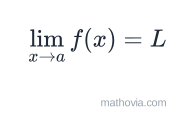
Limit notation: the limit of f of x as x approaches a equals L
The limit of f(x) as x approaches a is L

What Is a Limit?

Here is the definition of a limit in calculus, in plain words: means that gets as close to as you like when is close enough to , from either side. Three details matter:

  • approaches but never has to equal it. The limit is about the neighbourhood of , not the point itself.
  • Both sides count. Values of just below and just above must lead to the same .
  • is a single, finite number. If the values run off to infinity or never settle, there is no limit.

You read the notation as “the limit of as approaches equals ”. The arrow is the important symbol: it means “gets closer and closer to”, never “equals”. This informal idea is all you need for now; the precise version, with and , comes at the end of this chapter.

Example 1: A Function With a Hole

Find .

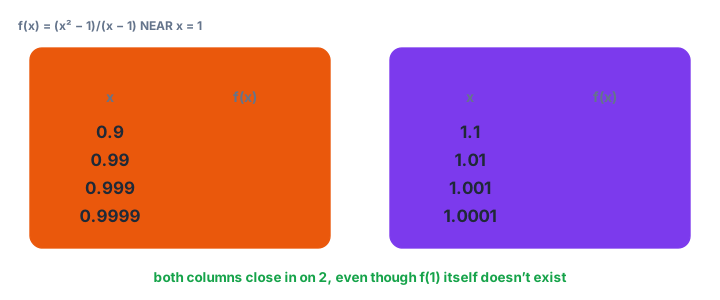
You can’t just plug in : that gives , which isn’t a number. So doesn’t exist. But the limit doesn’t need . It only asks what happens near 1, so try some nearby values.

Table of values of (x squared minus 1) over (x minus 1). From the left, x = 0.9, 0.99, 0.999, 0.9999 give 1.9, 1.99, 1.999, 1.9999. From the right, x = 1.1, 1.01, 1.001, 1.0001 give 2.1, 2.01, 2.001, 2.0001
Closing in on x = 1 from both sides

From both sides the outputs close in on 2. The graph shows why: for every , the expression simplifies to , because . So the graph is the line with a single point missing.
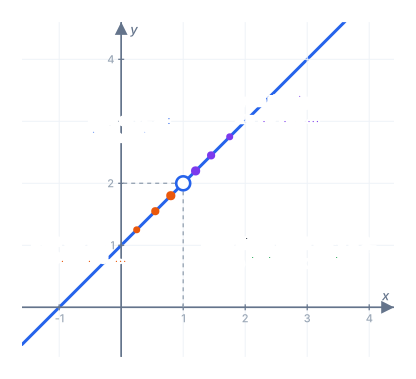
The line y = x + 1 with an open circle at (1, 2). Orange points approach the hole along the line from the left and violet points from the right, both heading for y = 2
A hole at (1, 2), and both sides still head for 2

The function has no value at 1, yet the limit is perfectly clear. That gap between “the value at a point” and “the value it approaches” is exactly what limits are designed to handle.

Example 2: When You Can Just Substitute

Find .

Nothing goes wrong at , and the graph is a smooth curve with no breaks. As approaches 3, approaches :

For polynomials and most everyday functions at points where they’re defined, the limit equals the value. Those functions are called continuous, and they have a lesson of their own later in this chapter. The interesting limits are the ones where substitution fails, as in Example 1.

The Limit Doesn’t Care About f(a)
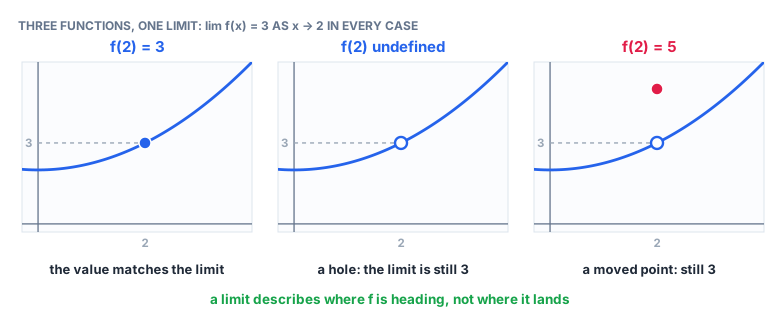
Three graphs of the same curve approaching height 3 at x = 2. In the first f(2) = 3 with a filled dot, in the second f(2) is undefined with a hole, in the third the hole is at height 3 but f(2) = 5 is a separate dot. All three have limit 3
Three different values at x = 2, the same limit every time

All three graphs follow the same curve towards the point . The first has , the second has a hole, and the third has moved the point to . In every case , because the limit only looks at the values around 2. The piecewise functions lesson shows how functions like the third one are built.

Example 3: Estimating a Limit With a Table

Estimate , with in radians.

Substituting gives again, and this time no algebra cancels the problem. A table gives a convincing estimate:

x0.10.010.001
sin x / x0.998330.999980.9999998

Because is even, negative inputs give exactly the same outputs. The values close in on 1, so . Tables are a good way to estimate, but they never prove anything: a function could change behaviour closer in than you checked. The squeeze theorem, later in this chapter, proves this one properly.

When a Limit Does Not Exist

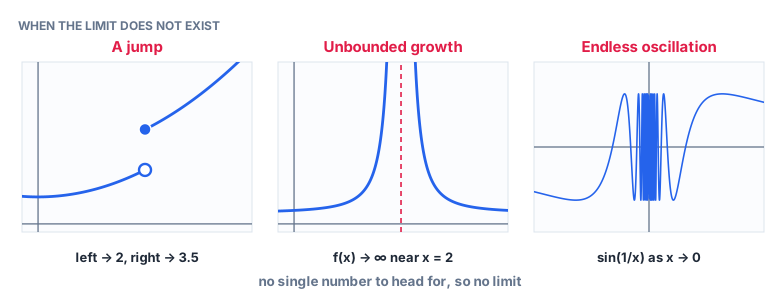
Three graphs where the limit fails: a jump where the left side approaches 2 and the right side 3.5; a curve that shoots up on both sides of a dashed vertical line at x = 2; and sin(1/x), which oscillates faster and faster near 0
A jump, unbounded growth and endless oscillation

A limit has to be one finite number that both sides agree on. It fails in three typical ways:

  1. A jump. The left side heads for one value and the right side for another, so there’s no single . Comparing the two sides separately is the idea behind one-sided limits.
  2. Unbounded growth. Near a vertical asymptote, grows without bound. We sometimes write to describe how it fails, but infinity isn’t a number, so the limit still doesn’t exist.
  3. Oscillation. swings between and 1 faster and faster as and never settles on any value.

Why Limits Matter

Suppose a ball has fallen metres after seconds. What is its speed at exactly ? Speed is distance over time, but at a single instant no time passes, so you get . Instead, take the average rate of change over a short interval from 1 to :

For the average speed is 10.5, 10.05 and 10.005 m/s. As , it approaches 10 m/s, the instantaneous speed. That limit is a derivative, and it’s where Calculus 1 is heading.

Common Mistakes to Avoid

  • Treating the limit as . They match for continuous functions, but the limit can exist when doesn’t, or differ from it.
  • Stopping at . It doesn’t mean the limit is 0 or doesn’t exist. It means more work is needed: simplify, or estimate.
  • Checking only one side. Both sides must approach the same value.
  • Trusting a table as proof. A table suggests a limit; algebra or a theorem confirms it.

Practice Problems

Work each one before opening the answer.

Problem 1. Find .

Show answer

Nothing breaks at , so substitute: .

Answer: 5

Problem 2. Find .

Show answer

Substitution gives , but for , which approaches 6.

Answer: 6

Problem 3. Use a table to estimate .

Show answer

gives about 1.00502 and gives about 0.99502. Both sides close in on 1.

Answer: 1

Problem 4. A function has for , and . Find and .

Show answer

Near 1 the function follows , which approaches 1. The single point at height 4 doesn’t affect the limit.

Answer: the limit is 1, and

Problem 5. Does exist?

Show answer

For the expression is 1, and for it is . The two sides disagree, so this is a jump.

Answer: no, the limit does not exist

Next, you’ll read limits straight off a graph, including graphs with holes, jumps and asymptotes.

Frequently Asked Questions

What is a limit in calculus?+

A limit is the value a function approaches as its input gets closer and closer to a given number. We write when can be made as close to as we like by taking close enough to , from both sides, without ever needing .

How do you read lim x → a f(x) = L?+

Read it as "the limit of f of x, as x approaches a, equals L". The arrow means "gets closer and closer to", not "equals".

Can a limit exist if f(a) is undefined?+

Yes. A limit only looks at values near . For , is undefined, but the values near close in on 2, so .

When does a limit not exist?+

The three common cases are a jump, where the left and right sides head for different values; unbounded growth, where heads to ; and endless oscillation, like near 0, where the values never settle down.

Why are limits important in calculus?+

Both big ideas of calculus are limits. The derivative is the limit of average rates of change over shorter and shorter intervals, and the definite integral is the limit of sums of thinner and thinner rectangles.

Related lessons