Mathovia

Calculus / Calculus 1 · Applications of Derivatives

Rolle's Theorem

Rolle's theorem says that if a smooth function starts and ends at the same height, somewhere in between its graph must level off. That simple fact is the key step behind the mean value theorem.

Practice Problems
Written by
MPhil in Mathematics, Founder of Mathovia
Published

Mathematics verification: Mathematical formulas, calculations, worked examples and solutions are reviewed for accuracy before publication. How we check our work

Chapter 4 · Lesson 5 of 5Calculus 1 · Applications of Derivatives
  1. 1.Related Rates
  2. 2.Linear Approximation
  3. 3.Critical Points
  4. 4.Extreme Value Theorem
  5. 5.Rolle's Theorem
See all calculus chapters →

Throw a ball straight up and catch it at the same height. At some moment in between, it must have stopped rising and started falling: its velocity was exactly zero. Rolle’s theorem is the mathematical version of that idea. If a smooth function starts and ends at the same value, then somewhere in between its derivative is zero. It looks almost too obvious to state, but it’s the stepping stone to the mean value theorem, one of the most important results in calculus.

If f of a equals f of b, then f prime of c equals 0 for some c in the open interval from a to b
Equal heights at the ends force a horizontal tangent in between

What Is Rolle’s Theorem?

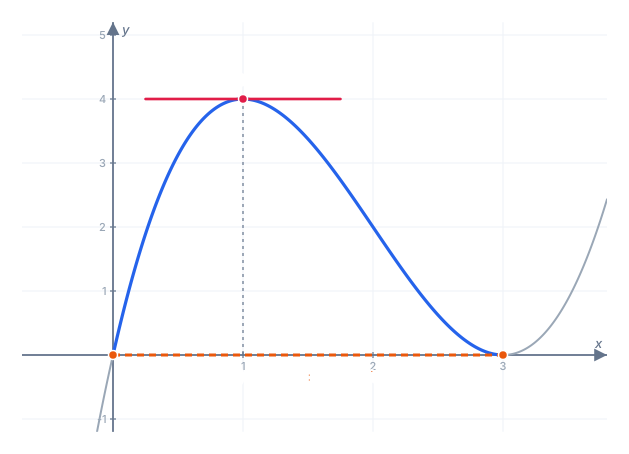
Graph of f of x equals x times x minus 3 squared on the interval from 0 to 3. Both endpoints are at height 0. At c equals 1 the curve reaches its top at height 4, where the tangent line is horizontal
f(0) = f(3), so somewhere between them the tangent line is flat

Rolle’s theorem. Suppose is

  1. continuous on the closed interval ,
  2. differentiable on the open interval , and
  3. .

Then there is at least one number in such that .

In the picture, the curve leaves height 0 at and comes back to height 0 at . To go up and come back down smoothly, it has to turn around, and at the turning point the tangent line is horizontal. That point is .

The theorem tells you that exists. It doesn’t tell you where it is or how many there are. To find it, solve .

Why Each Condition Matters

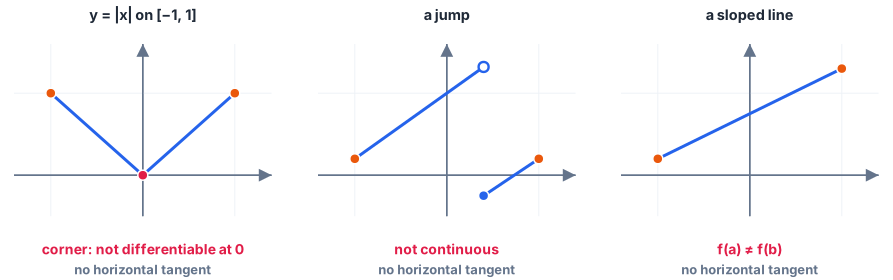
Three graphs with no horizontal tangent. The absolute value of x on minus 1 to 1 has equal end heights but a corner at 0, so it is not differentiable. A sawtooth with a jump has equal end heights but is not continuous. A sloped line has unequal end heights
Drop any one condition and the horizontal tangent can disappear
  • Differentiable on . on has , but the bottom is a sharp corner. Its slope is on the left and on the right, never 0. The theorem fails because isn’t differentiable at 0.
  • Continuous on . A function can start and end at the same height but jump in the middle, rising the whole time on both pieces. Without continuity there’s no reason to level off.
  • . A sloped line is as smooth as it gets, but it never levels off because it doesn’t come back to its starting height.

Note the difference between the two intervals: continuity is needed on the closed interval, including the endpoints, while differentiability is only needed on the open interval. So on qualifies even though its slope is infinite at the endpoints.

How to Apply Rolle’s Theorem

  1. Check continuity on .
  2. Check differentiability on .
  3. Check .
  4. Solve and keep the solutions with .

Polynomials, , and are continuous and differentiable everywhere, so for them only step 3 needs real work.

Example 1: Finding c

Verify Rolle’s theorem for on , and find .

Step 1 — check the conditions. is a polynomial, so it’s continuous and differentiable everywhere. The end values match:

Step 2 — differentiate. Expand first: , so

Step 3 — solve inside . The solutions are and , but 3 is an endpoint, not strictly inside. So , where the curve reaches its peak, .

Example 2: More Than One Value of c

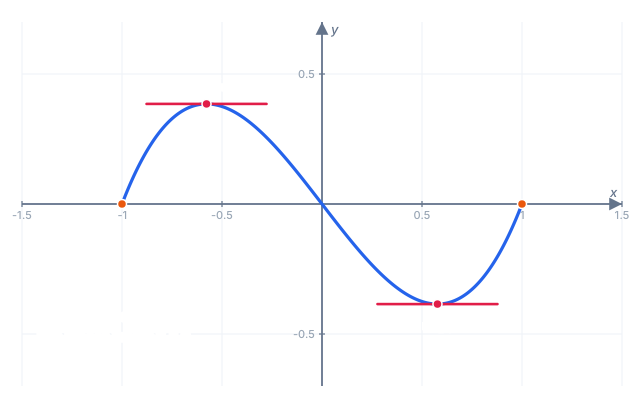
Graph of f of x equals x cubed minus x on minus 1 to 1. Both endpoints are at height 0. There are two horizontal tangent lines, a peak at c equals minus 1 over root 3 and a valley at c equals 1 over root 3
Rolle's theorem promises at least one c; here there are two

Find every for on .

and , and is a polynomial, so the theorem applies. Then

Both are inside , so both count: one at the peak and one at the valley.

Example 3: A Trig Function

Find for on .

, and sine is differentiable everywhere. gives in : the top of the arch.

Example 4: When Rolle’s Theorem Doesn’t Apply

Does Rolle’s theorem apply to on ?

The function is continuous, and . But

is undefined at , which is inside the interval. So is not differentiable on , and the theorem doesn’t apply. Indeed is never 0: the graph has a cusp at the bottom instead of a flat spot.

This isn’t a contradiction. Rolle’s theorem only promises a horizontal tangent when all three conditions hold.

Example 5: Proving an Equation Has Exactly One Root

Rolle’s theorem is also used to count roots. Show that has exactly one real solution.

Step 1 — there is at least one. Let . Then and , and is continuous, so by the intermediate value theorem there’s a root between and .

Step 2 — there can’t be two. Suppose there were two roots, . Then , and Rolle’s theorem would give some between them with . But

for every , so is impossible. That contradiction means there’s only one root.

The pattern works for any function whose derivative is never zero: between two roots there would have to be a horizontal tangent.

Why Rolle’s Theorem Is True

The proof uses the extreme value theorem and the fact from the critical points lesson that an interior maximum or minimum has a flat tangent.

  • If is constant on , then everywhere, and any in works.
  • If is not constant, it goes above or below somewhere. Since is continuous on , the extreme value theorem says it has an absolute maximum and minimum there. At least one of them differs from , so it happens at a point strictly inside , not at an endpoint. An interior maximum or minimum of a differentiable function has (Fermat’s theorem).

All three conditions are used: continuity for the extreme value theorem, equal end values to push the extreme inside, and differentiability for Fermat’s theorem.

Rolle’s Theorem vs the Mean Value Theorem

Tilt the picture. If , you can’t expect a horizontal tangent, but you can expect a tangent line parallel to the line joining the endpoints. That’s the mean value theorem:

When the right side is 0, and the mean value theorem becomes Rolle’s theorem. So Rolle’s theorem is the special case, and it’s also the main tool for proving the general one.

Common Mistakes

  • Not checking the conditions. Always confirm continuity, differentiability and before using the theorem.
  • Keeping an endpoint as . must be strictly between and . In Example 1, is excluded.
  • Thinking and must be 0. They only have to be equal. on works with .
  • Reading the theorem backwards. A function can have without meeting the conditions. The theorem only goes one way.

Practice Problems

Try each one before opening the answer. The practice set has 12 more with instant checking.

Problem 1. Find for on .

Show answer

and , and is a polynomial.

Answer:

Problem 2. Find every for on .

Show answer

and .

Both are inside .

Answer: and

Problem 3. Find for on .

Show answer

. gives ; only is strictly inside.

Answer:

Problem 4. Find for on .

Show answer

is continuous and differentiable on (0 is outside it), and .

Only is in .

Answer:

Problem 5. Does Rolle’s theorem apply to on ?

Show answer

and is continuous, but it has a corner at , so it is not differentiable on . The slope is or , never 0.

Answer: no, is not differentiable at

Problem 6. Show that has exactly one real root.

Show answer

At least one: and , so the intermediate value theorem gives a root in .

At most one: for all . Two roots would give, by Rolle’s theorem, a point with , which is impossible.

Answer: exactly one real root, between 0 and 1

Rolle’s theorem handles the case where the ends are level. Next, the mean value theorem tilts the picture and says the same thing about any smooth function.

Frequently Asked Questions

What is Rolle's theorem?+

Rolle's theorem says that if is continuous on , differentiable on , and , then there is at least one number strictly between and with . Geometrically, the graph has a horizontal tangent line somewhere between two points at the same height.

What are the three conditions of Rolle's theorem?+

1. is continuous on the closed interval . 2. is differentiable on the open interval . 3. . If all three hold, some in has .

How do you find the value of c in Rolle's theorem?+

Check the three conditions, then solve and keep only the solutions strictly inside . For on , gives .

Is Rolle's theorem the same as the mean value theorem?+

Rolle's theorem is a special case of the mean value theorem. The mean value theorem drops the condition and says some tangent line is parallel to the line joining the endpoints. When that line is horizontal, which is exactly Rolle's theorem.

Can there be more than one value of c?+

Yes. The theorem guarantees at least one. For on , there are two: and .

What happens if a condition of Rolle's theorem fails?+

Then there's no guarantee. on has , but it isn't differentiable at 0, and its derivative is never 0. A failed condition doesn't forbid a horizontal tangent; it just means the theorem doesn't promise one.

Related lessons