Mathovia

Calculus / Calculus 1 · Limits

Epsilon-Delta Definition of a Limit

Every limit so far has relied on the phrase "gets close to". The epsilon-delta definition says exactly what that means, using two small positive numbers: ε for how close the output has to be, and δ for how close the input needs to be to guarantee it.

Practice Problems
Written by
MPhil in Mathematics, Founder of Mathovia
Published

Mathematics verification: Mathematical formulas, calculations, worked examples and solutions are reviewed for accuracy before publication. How we check our work

The introduction to limits described a limit informally: gets as close to as we like when is close enough to . That’s the right idea, but “close enough” is vague, and you can’t build proofs on vague words. The epsilon-delta definition of a limit makes every part of that sentence precise. It looks intimidating at first, but each symbol has a plain meaning, and the proofs follow one template.
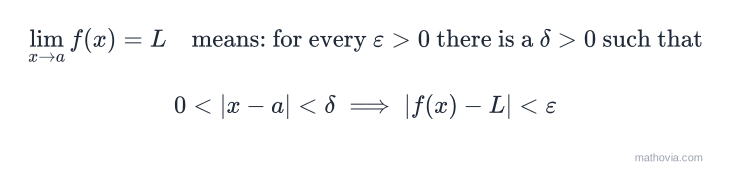
The limit of f of x as x approaches a equals L means: for every epsilon greater than 0 there is a delta greater than 0 such that 0 < |x − a| < delta implies |f(x) − L| < epsilon
The epsilon-delta definition

The Definition, Piece by Piece

We say if for every there is a such that

  • says the output is within of . Epsilon is the target accuracy.
  • says the input is within of , but not equal to . The limit never looks at itself.
  • “For every there is a ” says it doesn’t matter how demanding the target is; some input distance always delivers it.

Absolute values are distances here, as in absolute value inequalities: means lies in the interval .

The Picture: Two Bands

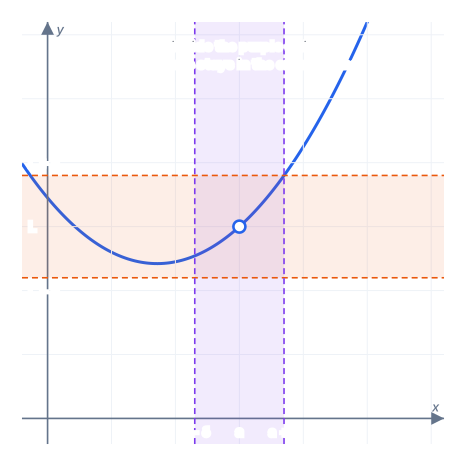
A curve approaching the point (a, L). A horizontal orange band runs from L − epsilon to L + epsilon. A vertical purple strip runs from a − delta to a + delta. Inside the purple strip the curve stays within the orange band
Choose δ so the graph stays in the ε-band

Draw a horizontal band of half-width around . The definition says you can always find a vertical strip of half-width around such that the graph, inside that strip (apart from the single point at ), stays inside the band. If someone narrows the band, you narrow the strip to match. A limit exists exactly when this works for every band, however thin.

It helps to think of it as a game. A challenger names an , say 0.01. You must answer with a that works. If you have a winning answer for every possible , the limit is .

Example 1: A Linear Limit

Prove that .

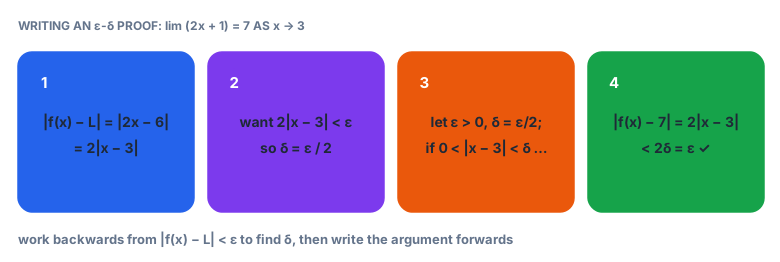
Scratch work. Simplify the distance from the limit and rewrite it in terms of :

We want , which happens when . So choose .

Proof. Let and set . If , then

so .

Four steps for the proof that 2x + 1 approaches 7 as x approaches 3: scratch work shows |f(x) − L| = 2|x − 3|; choose delta = epsilon over 2; write the proof starting with let epsilon be positive; check that |f(x) − 7| = 2|x − 3| < 2 delta = epsilon
Every epsilon-delta proof follows this shape

To see it with numbers: if the challenger picks , you answer , and every within 0.05 of 3 gives an output within 0.1 of 7.
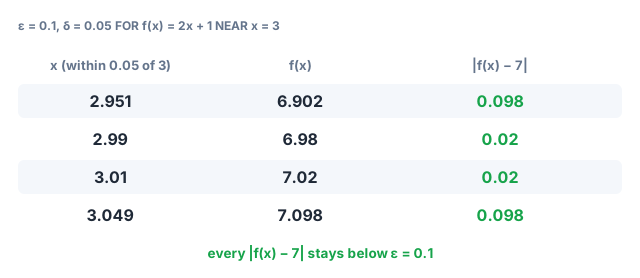
Table for epsilon = 0.1 and delta = 0.05: x = 2.951, 2.99, 3.01, 3.049 give f(x) = 6.902, 6.98, 7.02, 7.098, all within 0.1 of 7
ε = 0.1 is met with δ = 0.05

A Shortcut for Any Line

The same scratch work works for any linear function with : , so . Steeper lines need smaller , because a small change in causes a bigger change in . For a constant function, always, so any at all works.

Example 2: A Quadratic Limit

Prove that .

Scratch work. . The factor is what controls, but changes with . The standard trick is to keep first. Then is between 2 and 4, so , and

That is less than when . We need both conditions, so choose .

Proof. Let and . If , then , so , and also . Therefore .

Example 3: Proving a Limit Does Not Exist

The definition can also show a limit fails. Let for and for , a jump at 0. Suppose some were the limit. Take . Every interval contains points where and points where , so we’d need both and . Then , a contradiction. So no limit exists, confirming what the one-sided limits already suggested.

Variations: One-Sided and Infinite Limits

The same pattern adapts to every kind of limit in this chapter by changing what “close” means:

  • One-sided limits. For , only use inputs on the right: . For , use .
  • Limits at infinity. ” close to ” becomes ” large”: for every there is an such that implies .
  • Infinite limits. ” close to ” becomes ” large”: for every there is a such that implies .

In each case the structure is identical: a challenge on the output side, answered by a guarantee on the input side.

Why the Definition Matters

You won’t write epsilon-delta proofs for every limit. The limit laws do that work for you, and they themselves are proved from this definition. What the definition gives you is certainty: it’s the foundation that makes limits, continuity, derivatives and integrals rigorous rather than intuitive. The same pattern, “for every there is a ”, also defines continuity: is continuous at when the definition holds with .

Common Mistakes to Avoid

  • Letting depend on . may depend on (and ) only.
  • Writing the scratch work as the proof. Scratch work runs backwards; the proof starts from “let ”.
  • Forgetting to bound the extra factor in nonlinear limits. Restrict first, then take the minimum.
  • Choosing yourself. is given; your job is to find .

Practice Problems

Work each one before opening the answer.

Problem 1. For , find in terms of .

Show answer

, so .

Answer:

Problem 2. For and , what is the largest that works?

Show answer

, so .

Answer: 0.0075

Problem 3. For , find in terms of .

Show answer

.

Answer:

Problem 4. For , which works?

Show answer

for every .

Answer: any , for example

Problem 5. For , choose using the ”” trick.

Show answer

. If , then , so .

Answer:

Next, L’Hôpital’s rule: a derivative-based shortcut for limits of the form 0/0 and ∞/∞, and the last lesson in the limits chapter.

Frequently Asked Questions

What is the epsilon-delta definition of a limit?+

means that for every there is a such that whenever , we have . In words: however close you want to be to , you can make it that close by taking close enough to .

What do epsilon and delta stand for?+

(epsilon) is the allowed error in the output, how far may be from . (delta) is the allowed distance in the input, how far may be from . The definition says a suitable exists for every choice of .

How do you write an epsilon-delta proof?+

First do scratch work: simplify until it's written in terms of , and see how small must be to make it less than . That gives your . Then write the proof forwards: let , choose that , assume , and show .

Why is there a 0 < |x − a| in the definition?+

It excludes itself. A limit only describes what happens near , never at , so the value , or whether it exists at all, has no effect on the limit.

What is delta for a linear function?+

For with , , so works. For example, for , .

Related lessons