
Infinite limits were about the output blowing up near a number. Limits at infinity flip the question: let the input
What Is a Limit at Infinity?
We write
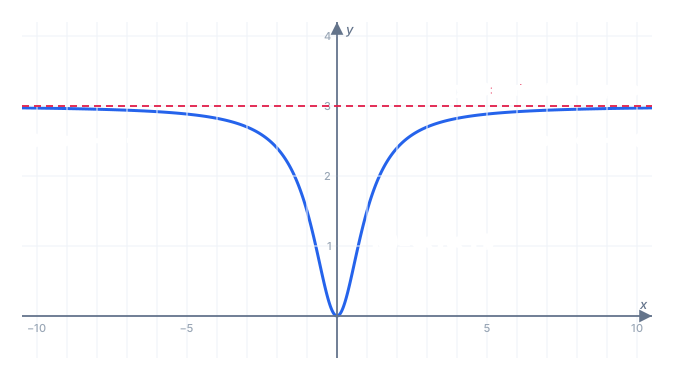
The most important basic fact is
A fixed number divided by something enormous is tiny. The same is true as
Rules for Limits Involving Infinity
The limit laws still apply as
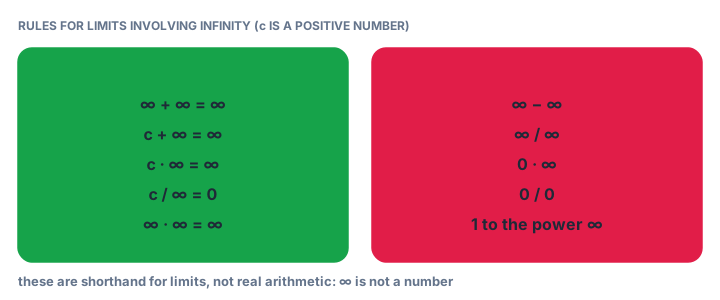
The indeterminate forms are where the work is.
How to Find a Limit at Infinity: Divide by the Highest Power
For a rational function, divide every term on the top and bottom by the highest power of
Find
A table shows the same thing happening:
| x | 10 | 100 | 1,000 | 10,000 |
|---|---|---|---|---|
| f(x) | 0.64128 | 0.60401 | 0.60040 | 0.60004 |
Each extra zero on
Comparing Degrees
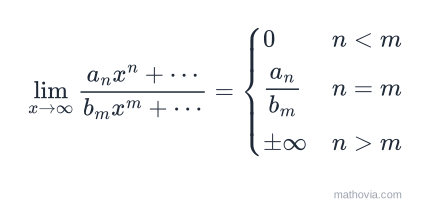
Doing that division in general gives a shortcut. If the top has degree
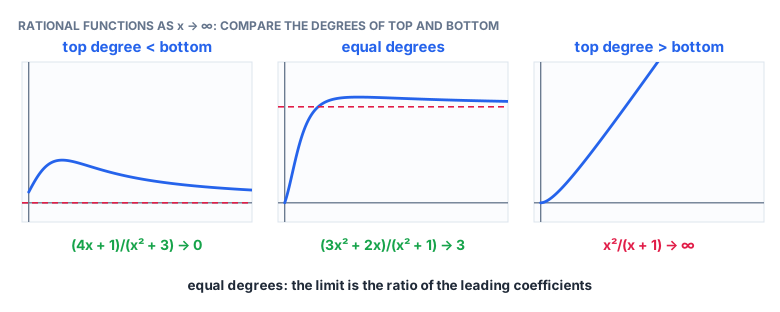
: the bottom grows faster, so the limit is 0. Example: . : the limit is the ratio of the leading coefficients, as in the example. : the top wins and the function grows without bound. This is an infinite limit at infinity: , because the expression behaves like .
For
Limits at Infinity With Square Roots
Find
Divide by
For
Infinity Minus Infinity
Find
Both terms grow without bound, so this is
Now divide top and bottom by
Exponentials and Other Functions
and : exponential decay gives the asymptote . : the inverse tangent levels off at two horizontal asymptotes, . - Growth rates: as
, grows slower than any power of , and any power of grows slower than . So and . L’Hôpital’s rule, at the end of this chapter, proves these. has no limit at infinity; it keeps oscillating. But by the squeeze theorem.
Common Mistakes to Avoid
- Treating
as 0 or as 1. Both are indeterminate. - Forgetting
. As , pulling out of a square root introduces a minus sign. - Dividing by the wrong power. Use the highest power in the denominator.
- Confusing the two kinds of limit.
is a limit at infinity; is an infinite limit.
Practice Problems
Work each one before opening the answer.
Problem 1. Find
Show answer
Equal degrees: the ratio of leading coefficients is
Answer: 3
Problem 2. Find
Show answer
The bottom has the higher degree.
Answer: 0
Problem 3. Find
Show answer
The top degree is higher, and the expression behaves like
Answer:
Problem 4. Find
Show answer
Conjugate:
Answer: 2
Problem 5. Find the horizontal asymptotes of
Show answer
As
Answer:
Next, continuity: what it means for a function to have no breaks, and the three conditions that make it precise.