
How would you differentiate
What Is the Chain Rule?
If
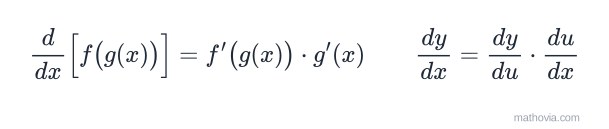
In words: differentiate the outside function, leaving the inside exactly as it is, then multiply by the derivative of the inside. Writing the inside as
To use it you need to see the function as an outer layer wrapped around an inner one. That decomposition skill comes from function composition in algebra:
Chain Rule Explanation: Why Rates Multiply
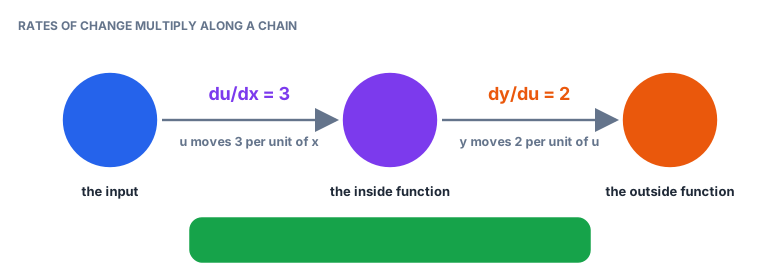
Think of gears. If the middle gear turns 3 times for every turn of the first, and the last gear turns 2 times for every turn of the middle one, then the last gear turns
A composite function is exactly that kind of chain. Changing
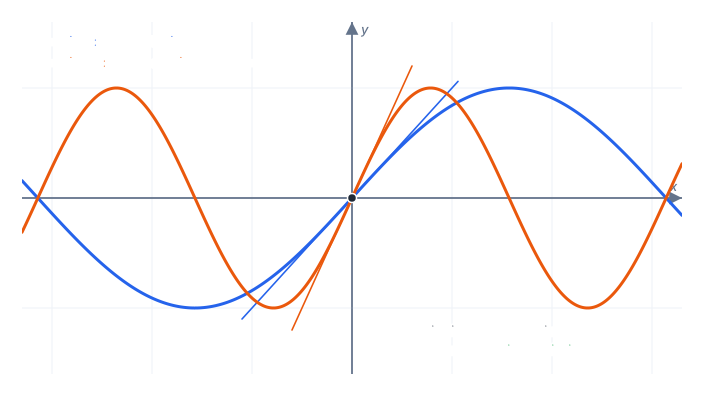
The picture shows it on a real graph.
How to Use the Chain Rule
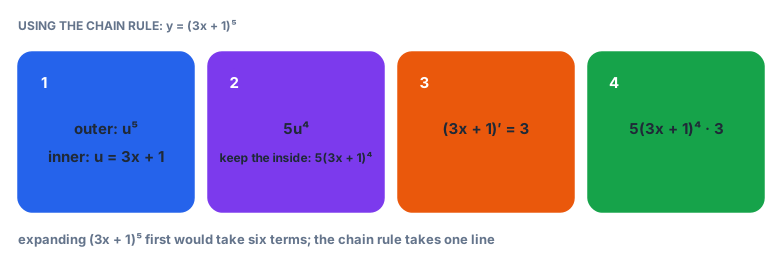
- Split the function into an outer function and an inner one. Ask: “what’s the last thing I’d do if I were calculating this?” That’s the outer layer.
- Differentiate the outer function, keeping the inside untouched in its slot.
- Differentiate the inner function.
- Multiply the two results.
The most common mistake by far is stopping after step 2. The inner derivative is not optional: forgetting it is like saying the last gear turns twice per turn of the first gear because it turns twice per turn of the middle one.
The Chain Rule and the Power Rule Together
The most frequent use of the chain rule is a whole expression raised to a power. Combining it with the power rule gives the general power rule:
Bring the exponent down, lower it by one, keep the inside, then multiply by the derivative of the inside. For example,
Example 1: A Power of a Linear Expression
Differentiate
Outer:
Example 2: A Square Root
Differentiate
Write it as
Example 3: A Trig Function With a Non-Trivial Inside
Differentiate
The outer function is sine, whose derivative is cosine; the inside
Compare
Example 4: Exponentials
Differentiate
Since
Example 5: One Over a Power
Differentiate
Rewrite as
Example 6: The Chain Rule With Three Functions
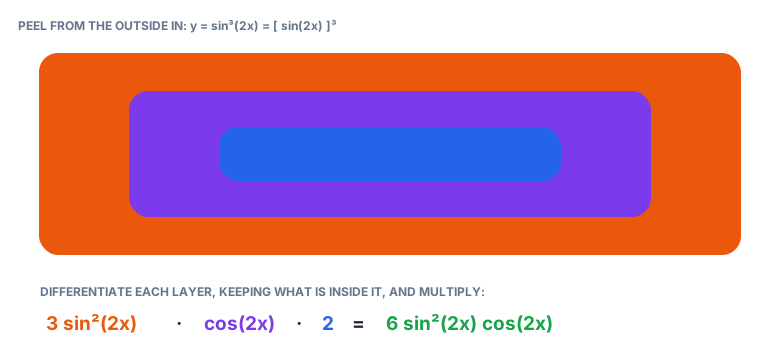
Differentiate
Using the chain rule is like peeling an onion: work from the outside in, one layer at a time. Here there are three layers, the cube, the sine and
The rule for any number of layers is the same: one derivative per layer, each with everything inside it left alone, all multiplied together.
Example 7: The Chain Rule With the Product Rule
Differentiate
This is a product, so start with the product rule. The second factor needs the chain rule, but its inner derivative is just 1:
Factoring out the common
Example 8: Using a Table of Values
Suppose
The key step is that
Example 9: The Chain Rule With Logs
Differentiate
Using
For any
Why the Chain Rule Works
The derivation of the chain rule starts from the average rate of change. If a small change
As
Common Mistakes With the Chain Rule
- Forgetting the inner derivative.
is , not . - Changing the inside. The outer derivative keeps the inside as it is:
, not . - Stopping one layer early with three or more layers. Count the layers and make sure you have that many factors.
- Evaluating
at the wrong point with tables: it’s , not . - Mixing up
and . The first is a square of a sine; the second is a sine of a square.
Practice Problems
Try each one before opening the answer. The practice set has 12 more with instant checking.
Problem 1. Differentiate
Show answer
Answer:
Problem 2. Differentiate
Show answer
Answer:
Problem 3. Differentiate
Show answer
Answer:
Problem 4. Differentiate
Show answer
Answer:
Problem 5. If
Show answer
Answer:
With the power, product, quotient and chain rules in hand, you can differentiate almost any formula built from powers. Next come the derivatives of trig functions, where the chain rule gets put to work straight away.