
Where is a function largest? Where is it smallest? To answer these questions you don’t need to check every point. Peaks and valleys can only happen where the graph levels off or has a sharp point, and those places are called critical points. Finding them is the first step of optimization, curve sketching and the first and second derivative tests that come next in this chapter.

What Is a Critical Point?
A critical point of
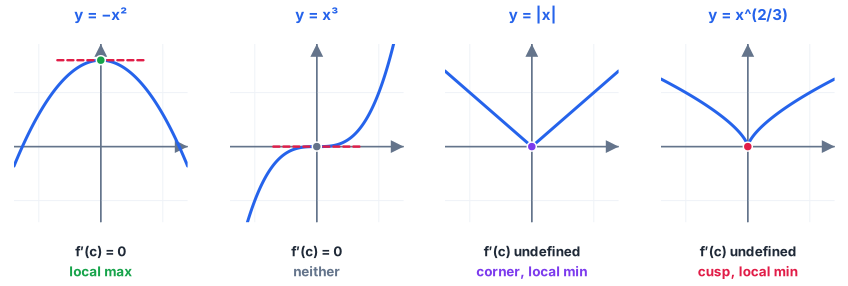
There are two kinds:
- Stationary points, where
. The tangent line is horizontal there. - Singular points, where
doesn’t exist but does: corners, cusps and vertical tangent lines.
The words “in the domain” matter. A value where
Why Critical Points Matter
A local maximum is a point that is higher than every point near it, and a local minimum is lower than every point near it. At a smooth peak or valley, the tangent line has to be flat: if the slope were positive, the graph would still be rising, and if it were negative, it would be falling. That’s Fermat’s theorem:
If
has a local maximum or minimum at , and exists, then .
If
The reverse is not true. A critical point is only a candidate. In the picture above,
How to Find Critical Points
- Find the domain of
. - Find
and simplify it, ideally into a factored fraction. - Solve
. For a fraction, that means numerator . - Find where
is undefined. For a fraction, that means denominator . - Keep only values in the domain of
. Those are the critical points.
Example 1: A Cubic
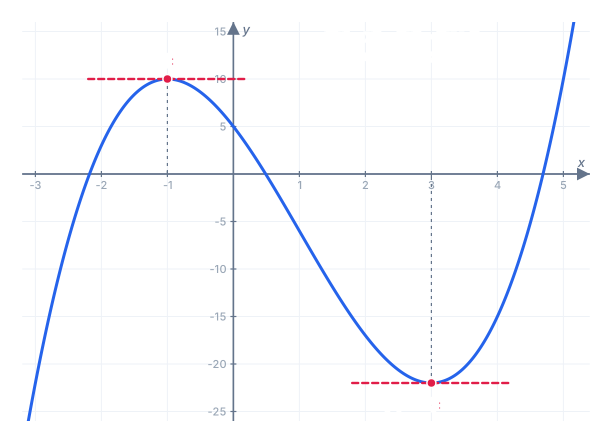
Determine all critical points of
Step 1 — differentiate and factor:
Step 2 — solve
Step 3 — check for undefined points.
The critical points are
Example 2: A Critical Point That Isn’t an Extreme
Find the critical points of
Both are critical points, but they behave differently. Near
A squared factor like
Example 3: Where the Derivative Is Undefined
Find the critical points of
The numerator is never 0, so there are no stationary points. The denominator is 0 at
Example 4: Both Kinds at Once
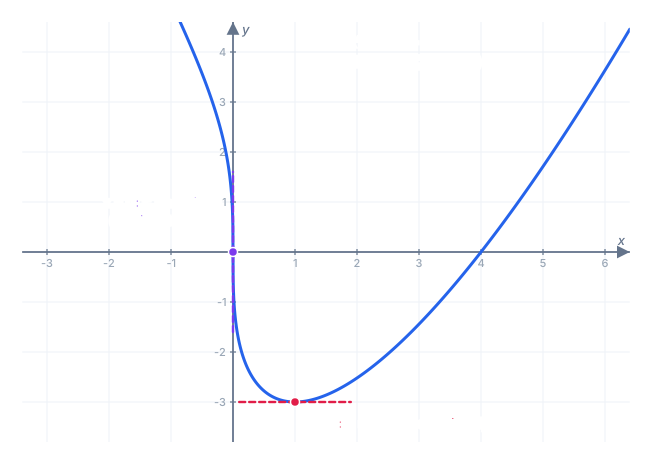
Find the critical points of
Step 1 — expand so the power rule applies:
Step 2 — differentiate:
Step 3 — factor out the smaller power,
Step 4 — read off both kinds. The numerator is 0 at
Factoring into a single fraction is what makes both kinds visible. Leaving
Example 5: A Rational Function
Find the critical points of
By the quotient rule:
The numerator is 0 at
Example 6: Check the Domain
Find the critical points of
Example 7: Trig and Exponential Functions
Find the critical points of
Dividing by
Find the critical points of
Since
What Comes Next: Classifying Critical Points
Finding critical points gives you the candidates. The next lessons decide what each one is:
- The first derivative test checks whether
changes sign at : from to is a maximum, from to a minimum, no change means neither. That’s the same sign reasoning as increasing and decreasing intervals, now done with the derivative. - The second derivative test uses the sign of
, as in the higher-order derivatives lesson. - On a closed interval, the extreme value theorem adds the endpoints to the list of candidates.
Common Mistakes
- Only solving
. Points where is undefined count too. In Example 4, skipping them misses . - Including points outside the domain.
is not a critical point of or . - Assuming every critical point is a maximum or minimum.
at 0 is a critical point and neither. - Solving
instead of . That finds x-intercepts, not critical points. - Dividing away a factor that can be zero. Factor instead:
has the solution , which disappears if you divide by .
Practice Problems
Try each one before opening the answer. The practice set has 12 more with instant checking.
Problem 1. Find the critical points of
Show answer
Answer:
Problem 2. Find the critical points of
Show answer
Answer:
Problem 3. Find the critical points of
Show answer
This is never 0, and it’s undefined at
Answer:
Problem 4. Find the critical points of
Show answer
Since
Answer:
Problem 5. Find the critical points of
Show answer
The numerator is 0 at
Answer:
Problem 6. Find the critical points of
Show answer
The only one inside
Answer:
Critical points tell you where to look. Next, the extreme value theorem uses them to find the absolute highest and lowest values of a function on a closed interval.