Some limits can't be found by substituting, factoring or rationalizing, usually because a sine or cosine keeps wiggling. The squeeze theorem handles them by trapping the function between two simpler ones. If both of those head for the same value, the function in the middle has nowhere else to go.
Mathematics verification: Mathematical formulas, calculations, worked examples and solutions are reviewed for accuracy before publication. How we check our work
Try to find with the methods so far. Substitution fails because means nothing. The product law fails because has no limit at 0; it swings between and 1 faster and faster. There’s nothing to factor or rationalize. The squeeze theorem, also called the sandwich theorem or pinching theorem, gets around all of this by not computing the limit directly at all. It traps the function instead.
The squeeze theorem
What Is the Squeeze Theorem?
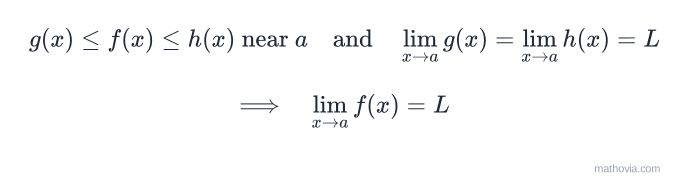
Suppose three functions satisfy for every near (the value at itself doesn’t matter). If the lower function and the upper function both approach the same number , then , which is stuck between them, must approach too.
Think of two people walking towards the same doorway with a friend between them, arm in arm. Wherever they go, the friend goes too. The friend can wobble around as much as they like in the middle, as long as they stay between the other two.
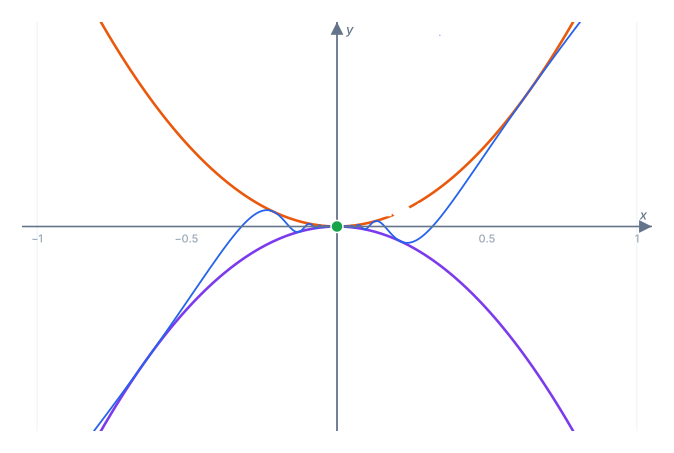
Squeeze Theorem Example 1: x² sin(1/x)
The wiggles get trapped between −x² and x²
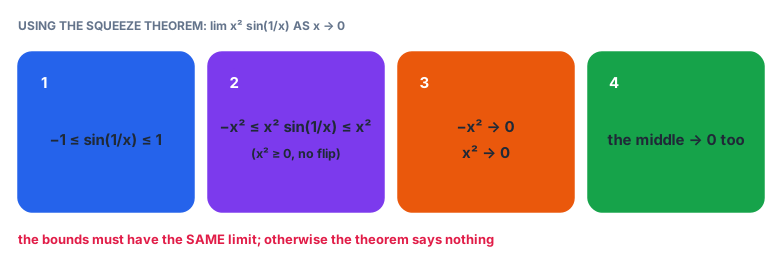
Step 1: bound the part that misbehaves. Whatever is, a sine is always between and 1:
Step 2: build the other parts in. Multiply every part by . Since , the inequalities keep their direction:
Step 3: take the limits of the bounds. and . They agree.
Step 4: conclude. By the squeeze theorem, .
How to use the squeeze theorem
Example 2: When the Multiplier Can Be Negative
Find .
This time the factor is negative on the left, and multiplying an inequality by a negative number flips it. The fix is to bound the absolute value instead. Since ,
Both and approach 0, so the limit is 0. Using like this works on both sides at once and is the safest habit whenever the multiplier changes sign.
Example 3: Proving sin x / x → 1
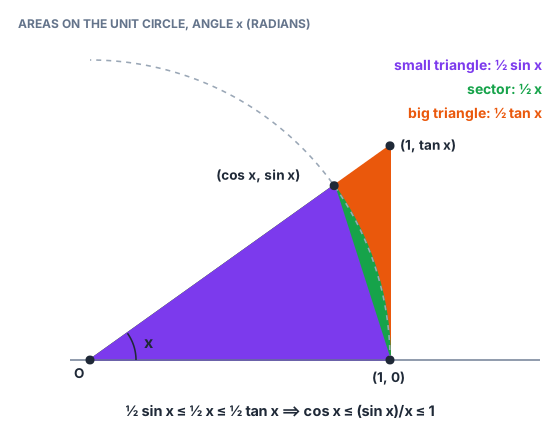
The special limit from evaluating limits, , is the squeeze theorem’s most famous result. For a small positive angle in radians, compare three areas on the unit circle:
Small triangle ≤ sector ≤ big triangle
The small triangle fits inside the sector, which fits inside the big triangle, so
Divide everything by (positive for small ) and flip each fraction, which reverses the inequalities:
As , , and the upper bound is already 1. The squeeze theorem gives from the right, and because is an even function, the left side matches. This is also why the limit needs radians: the sector’s area is only when is measured in radians.
Example 4: A Limit at Infinity
Find .
For , divide by : . Both bounds go to 0 as grows, so the limit is 0. The squeeze theorem works for limits at infinity exactly as it does at a point.
Example 5: Using Given Inequalities
Suppose for all . Find .
You don’t need to know what is. The lower bound approaches and the upper bound approaches . They agree, so . Test questions often look like this, because they check that you understand the theorem rather than a particular trick.
Example 6: An Exponential Squeeze
Find .
Since and is increasing, . Multiplying by gives , and both bounds approach 0. So the limit is 0. The pattern is always the same: bounded times something going to 0 gives 0.
Why the Squeeze Theorem Works
Pick any small band around , say everything within 0.001 of it. Because , eventually (close enough to ) all of ‘s values sit inside that band. The same is true for . Once both bounds are inside the band, everything between them is inside it too, and that includes . Since this works for every band, however narrow, gets as close to as you like. That’s exactly what a limit means, and the formal version of this argument appears in the lesson on the epsilon-delta definition of a limit.
The Squeeze Theorem for Sequences
The same idea works for sequences, where runs through the whole numbers. Take , which flips sign every term: . It’s trapped between and , and both of those approach 0 as , so . In Calculus 2 this version is used constantly to decide whether series converge.
Common Mistakes to Avoid
Using bounds with different limits. alone proves nothing, because .
Multiplying by a negative without flipping. Bound the absolute value when the multiplier can change sign.
Applying the product law first. doesn’t exist, so the product law can’t split .
Forgetting the inequality must hold near . It only needs to hold close to , but it does need to hold there.
Practice Problems
Work each one before opening the answer.
Problem 1. Find .
Show answer
, and both bounds approach 0.
Answer: 0
Problem 2. If for all , find .
Show answer
Both bounds approach 2.
Answer: 2
Problem 3. Find .
Show answer
for , and both bounds approach 0.
Answer: 0
Problem 4. Find .
Show answer
Use absolute values: , and both bounds approach 0.
Answer: 0
Problem 5. If for , find .
Show answer
The lower bound approaches 3 and the upper bound approaches .
Answer: 3
Next, infinite limits: what it means for a function to grow without bound near a point, and how to find vertical asymptotes with limits.
Frequently Asked Questions
What is the squeeze theorem?+
If for all near (except possibly at ), and , then . A function trapped between two others that meet at the same limit must have that limit too.
Is the squeeze theorem the same as the sandwich theorem?+
Yes. The squeeze theorem is also called the sandwich theorem, the pinching theorem and the squeeze principle. All four names describe the same result.
When should you use the squeeze theorem?+
Use it when a limit contains a bounded part that oscillates, such as or , multiplied by something that goes to 0, or when a problem gives you inequalities around an unknown function. It's also how is proved.
How do you find the bounds for the squeeze theorem?+
Start from a bound you know, usually or , and multiply through by the rest of the expression. If that factor can be negative, use its absolute value so the inequalities don't flip.
What if the two bounds have different limits?+
Then the squeeze theorem tells you nothing. The function in the middle could have any limit between them, or none at all, so you need tighter bounds or a different method.