Mathovia

Calculus / Calculus 1 · Integrals

U-Substitution

U-substitution is the chain rule run backwards. When an integrand contains a function g(x) and also its derivative g′(x), setting u = g(x) turns the integral into a simpler one in u. It's the most-used integration technique in Calculus 1.

Practice Problems
Written by
MPhil in Mathematics, Founder of Mathovia
Published

Mathematics verification: Mathematical formulas, calculations, worked examples and solutions are reviewed for accuracy before publication. How we check our work

U-substitution (also called integration by substitution) is a way to integrate composite functions. It undoes the chain rule. If an integral has the form , set . Then , and

For example, in , the inside function is and its derivative is right there. With , the integral becomes .

The substitution rule: the integral of f of g of x times g prime of x d x equals the integral of f of u d u, where u equals g of x and d u equals g prime of x d x
The substitution rule

Why U-Substitution Works

The chain rule says . Read backwards, as an antiderivative:

Write and . The right side is , which is exactly . So the substitution rule is the chain rule in integral form.

The notation helps too. From , the derivative is , which you can write as . That differential is what replaces in the integral.

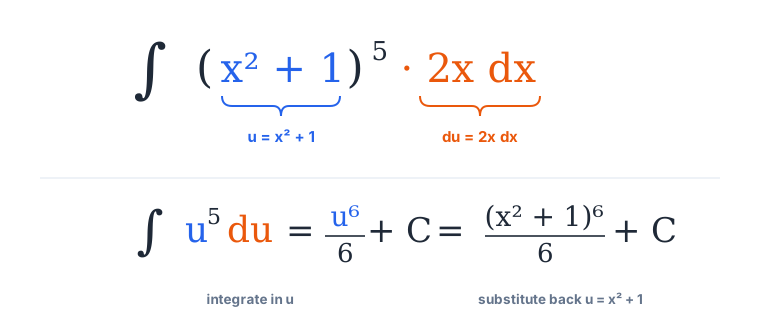
The integral of (x squared plus 1) to the fifth times 2 x d x. The inside function x squared plus 1 is marked as u in blue, and the factor 2 x d x is marked as d u in amber. Below, the integral becomes the integral of u to the fifth d u, which equals u to the sixth over 6 plus C, then (x squared plus 1) to the sixth over 6 plus C after substituting back
The inside function becomes u; its derivative times dx becomes du

How to Choose u

Look for an inside function whose derivative is also a factor of the integrand, up to a constant multiple. Good candidates:

Integrand containsTry
a power of an expression, the expression in the parentheses
a root, the expression under the root
, , the input of the function
a fraction whose numerator is (a multiple of) the derivative of the denominator the denominator
together with

If your first choice doesn’t leave a clean , try another. With practice the right is usually the “innermost” piece of the messiest part.

Steps for U-Substitution

  1. Choose , an inside function whose derivative appears as a factor.
  2. Find . If needed, solve for the piece of the integrand you’ll replace, such as .
  3. Rewrite the whole integral in terms of and . No may be left over.
  4. Integrate with respect to .
  5. Substitute back and add .
  6. Check by differentiating your answer.

Example 1: A Power of an Inside Function

Find .

Let . Then , which is exactly the rest of the integrand:

Check: by the chain rule, . ✓

Example 2: Adjusting for a Constant

Find .

Let . Then , so :

A missing constant is easy to supply this way. A missing variable is not: has no factor, and substitution can’t help.

Example 3: A Linear Inside Function

Find and .

For the first, , :

For the second, , :

That’s the answer the antiderivatives lesson reached by multiplying out. In general, a linear inside function just divides the answer by :

Example 4: A Fraction and the Natural Log

Find .

The numerator is half the derivative of the denominator. Let , so and :

The absolute value can be dropped because . The same idea gives a pattern worth remembering: .

Example 5: The Integral of tan x

Find .

Write and let , so :

Since , this is often written .

Example 6: Use the Indicated Substitution

Many textbooks say “use the indicated substitution to evaluate the integral” and give you .

Evaluate using .

Then :

Example 7: When x Is Left Over

Find .

Let , so . The factor is still there, but you can solve the substitution for it: .

This back-substitution works whenever is easy to solve for , as with any linear .

U-Substitution With Definite Integrals

For a definite integral, there are two correct methods.

Method 1: change the limits. When you change the variable, change the limits too. If , then becomes and becomes :

Then evaluate with the fundamental theorem of calculus in . You never substitute back.

Method 2: substitute back first. Find the antiderivative in as in the indefinite examples, then use the original limits.

Example 8. Evaluate .

Let , . New limits: , and .

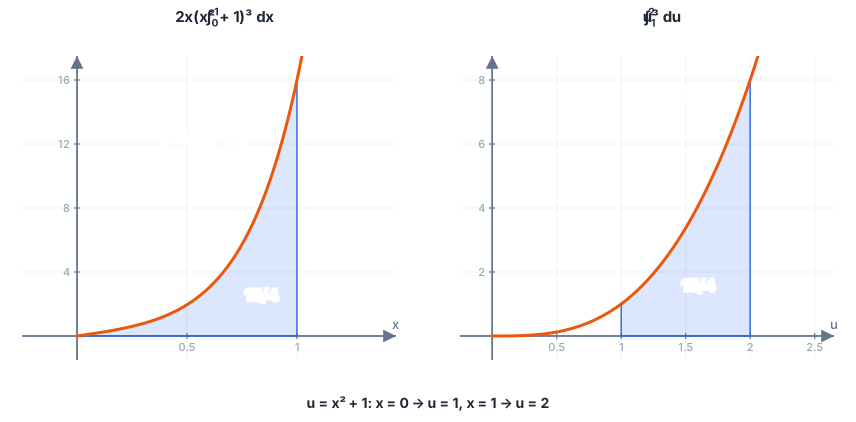
Left: the region under y equals 2 x (x squared plus 1) cubed from x equals 0 to 1. Right: the region under y equals u cubed from u equals 1 to 2. Both regions have area fifteen fourths. The substitution u equals x squared plus 1 maps x equals 0 to u equals 1 and x equals 1 to u equals 2
Changing the variable changes the region's shape, but not its area

Example 9. Evaluate .

Let , , so . New limits: and .

The most common error is mixing the two methods: substituting back to and then plugging in the new -limits, or keeping the old -limits on an integral in .

U-Substitution vs Integration by Parts

Substitution reverses the chain rule, so it fits integrands with a function and its inside derivative. It doesn’t fit a product of two unrelated functions, such as or : no choice of leaves a clean . Those need integration by parts, which reverses the product rule and comes in Calculus 2.

A rule of thumb: if one part of the integrand is the derivative of an inside piece of another part, substitute. If not, think about parts.

Common Mistakes

  • Leaving in the integral. After substituting, the integrand must be entirely in . If an remains, solve for or choose a different .
  • Forgetting . is , not .
  • Dropping the constant factor. If , then . Keep the .
  • Trying to fix a missing variable. You can divide by a constant, but not by . can’t be done by substitution.
  • Not substituting back in an indefinite integral. The answer must be in terms of .
  • Mixing limits in a definite integral. Change the limits, or substitute back, but not half of each.

For more examples, including substitutions with trig and exponential functions, see Section 5.5 of the free textbook OpenStax Calculus Volume 1.

Practice Problems

Try each one before opening the answer. The practice set has 12 more with instant checking.

Problem 1. Find .

Show answer

, : .

Answer:

Problem 2. Find .

Show answer

, : .

Answer:

Problem 3. Find .

Show answer

, , so : .

Answer:

Problem 4. Find .

Show answer

, : .

Answer:

Problem 5. Find .

Show answer

, : .

Answer:

Problem 6. Evaluate .

Show answer

, . New limits: , . .

Answer:

U-substitution finishes the Calculus 1 integration toolkit. Next, the average value of a function uses definite integrals to find the average height of a curve.

Frequently Asked Questions

What is u-substitution?+

U-substitution (integration by substitution) is a method for integrals of the form . You set , so , and the integral becomes . After integrating in , you substitute back for . It reverses the chain rule.

How do you know what to choose for u?+

Look for an inside function whose derivative also appears as a factor, up to a constant. Common choices are the expression inside a power, root, trig function or exponential, or the denominator of a fraction whose numerator is its derivative. For , choose , because is its derivative up to the factor 3.

How do you do u-substitution with definite integrals?+

Change the limits along with the variable. If , the new limits are and : . Then evaluate in without substituting back. Alternatively, find the antiderivative in first and use the original limits.

What if the derivative is off by a constant?+

That's fine. Constants can move in and out of an integral. If , then , so . Put the in front of the integral. What you can't fix this way is a missing variable factor, such as an extra .

When does u-substitution not work?+

When the rest of the integrand can't be written in terms of and . For example, has no factor to form , and this integral has no elementary antiderivative at all. Products such as need a different technique, integration by parts.

What is the difference between u-substitution and integration by parts?+

U-substitution reverses the chain rule and fits integrands of the form . Integration by parts reverses the product rule and fits products of unrelated functions, like or . Try substitution first; if no inside function has its derivative as a factor, consider integration by parts (a Calculus 2 topic).

Related lessons