Mathovia

Calculus / Calculus 1 · Derivatives

Tangent Lines and Normal Lines

The tangent line to a curve at a point is the line that matches the curve's direction there. Its slope is the derivative, so finding its equation takes three short steps, and the normal line is just one more.

Practice Problems
Written by
MPhil in Mathematics, Founder of Mathovia
Published

Mathematics verification: Mathematical formulas, calculations, worked examples and solutions are reviewed for accuracy before publication. How we check our work

Zoom in far enough on a smooth curve and it starts to look straight. The tangent line is that straight line: it passes through the point and points in exactly the same direction as the curve. Finding its equation is one of the most common calculus questions, and it’s where the derivative first turns into a concrete, drawable answer. The same line is the basis of linear approximation and Newton’s method later in the course.
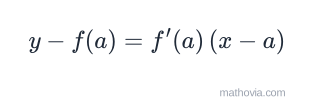
The tangent line at x equals a: y minus f of a equals f prime of a times x minus a
The tangent line at x = a: point (a, f(a)), slope f′(a)

What Is a Tangent Line?

The tangent line to at is the line through the point whose slope is the derivative .

That’s the whole definition, and it’s exactly what the limit definition of the derivative was built for. The derivative is the limit of secant slopes as the second point slides onto the first, so is the slope the curve has at that single point. The tangent line is the line with that slope.
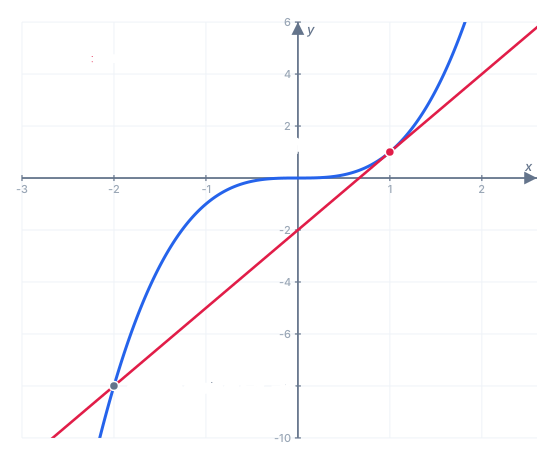
Graph of y equals x cubed with its tangent line y equals 3x minus 2 at the point 1, 1. The tangent touches the curve at 1, 1 and crosses it again at minus 2, minus 8
A tangent line can cross the curve somewhere else

You may have learned in geometry that a tangent “touches a curve at exactly one point”. That’s true for circles, but not for curves in general. The tangent to at touches there and then crosses the curve again at . What makes a line tangent is matching the slope at the point, not how many times it meets the curve.

How to Find the Equation of a Tangent Line

You need a point and a slope, then point-slope form does the rest.

  1. Find the point. Plug into the function: the point is .
  2. Find the slope. Differentiate, then plug in : the slope is .
  3. Write the line. Use point-slope form, and simplify to if you want.

The most common slip is in step 2: is a formula for the slope everywhere, and you need the number . A tangent line’s slope never contains .

Example 1: A Tangent Line to a Parabola
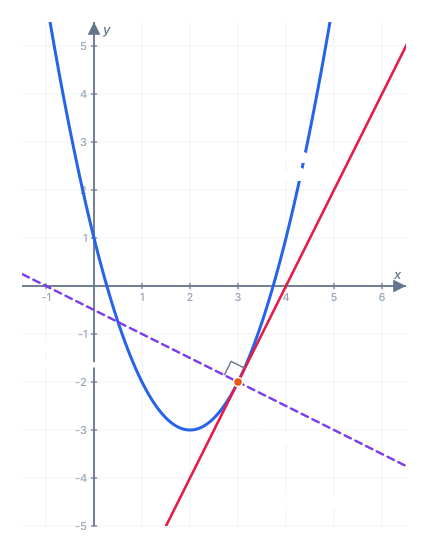
The parabola y equals x squared minus 4x plus 1 with the tangent line y equals 2x minus 8 at the point 3, minus 2, and the dashed normal line y equals minus one half x minus one half through the same point, meeting the tangent at a right angle
The tangent and normal lines at (3, −2) meet at a right angle

Find the tangent line to at .

Step 1 — the point:

Step 2 — the slope, using the power rule:

Step 3 — point-slope form:

The Normal Line

The normal line at a point is the line through that point perpendicular to the tangent line. Perpendicular slopes are negative reciprocals, so if the tangent has slope , the normal has slope :

For Example 1, the tangent slope is 2, so the normal slope is :

Two special cases: if the tangent is horizontal (), the normal is the vertical line ; if the tangent is vertical, the normal is horizontal.

Example 2: A Trig Function

Find the tangent line to at .

Step 1 — the point: , so the point is .

Step 2 — the slope: , and .

Step 3 — the line:

Leaving it in point-slope form is fine here. Expanding gives , which is no clearer.

Example 3: e^x and ln x

Two tangent lines worth knowing by heart, using the exponential and log derivatives:

FunctionPointSlopeTangent line
at
at

The graphs of and are reflections of each other in the line , and so are these two tangent lines.

Example 4: Horizontal Tangent Lines

Find every point where has a horizontal tangent line.

A horizontal line has slope 0, so solve :

Now find the points: and . The horizontal tangents are at and , with equations and . These are the peak and valley of the graph, and finding them this way is the start of the work on maximums and minimums.

Example 5: A Tangent Line With a Given Slope

Find the tangent line to that is parallel to .

Parallel lines have equal slopes, so the tangent needs slope 4. This time the slope is given and the point is unknown:

The tangent line through with slope 4 is , or .

Example 6: Tangent Lines From a Point Not on the Curve
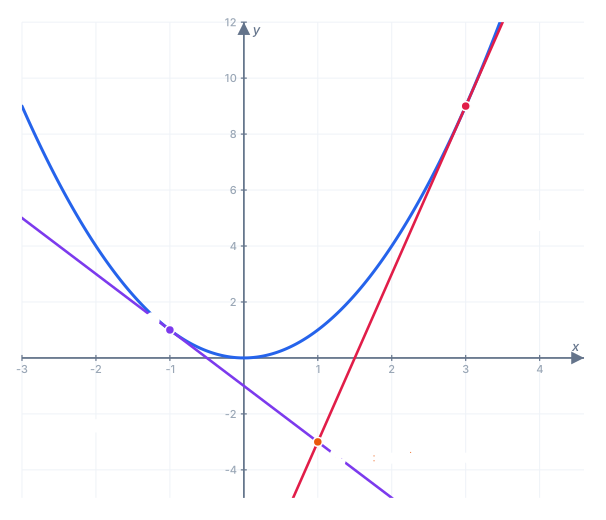
The parabola y equals x squared with two tangent lines that both pass through the point 1, minus 3 below the curve. One touches the parabola at 3, 9 and has equation y equals 6x minus 9. The other touches at minus 1, 1 and has equation y equals minus 2x minus 1
From a point outside a parabola you can draw two tangent lines

Find the tangent lines to that pass through .

The point isn’t on the curve, since , so you can’t use it as the point of tangency. Call the unknown point of tangency instead.

Step 1 — write the tangent line at : the slope is , so

Step 2 — make it pass through :

Step 3 — one tangent line for each solution:

Check: both lines give at .

Example 7: A Tangent Line to a Circle

Find the tangent and normal lines to the circle at .

Implicit differentiation gives the slope:

The tangent line is , or .

The normal slope is , so the normal line is , which simplifies to . It passes through the origin, the center of the circle. That matches the geometry fact that a radius is perpendicular to the tangent.

Vertical Tangent Lines

A curve can have a vertical tangent line, where the slope is undefined because the derivative blows up to infinity. For ,

which is undefined at and grows without bound as approaches 0. The curve gets steeper and steeper there, and its tangent line at is the vertical line . Point-slope form can’t express a vertical line, so write it as . The function isn’t differentiable at that point, even though it still has a tangent line.

Tangent Lines as Approximations

Near the point of tangency, the tangent line stays very close to the curve, so it gives easy approximate values. For at , the point is and the slope is , so the tangent line is

Then . The true value is , so the line is off by less than 0.0002. This idea, called linear approximation, gets its own lesson in the next chapter.

Common Mistakes

  • Leaving in the slope. The slope is the number , not the formula . The line isn’t a line at all.
  • Using as the y-coordinate. The point is , from the original function, not from the derivative.
  • Getting the normal slope wrong. The normal slope is the negative reciprocal . Using or alone is a common slip.
  • Using an outside point as the point of tangency. In Example 6, isn’t on the curve, so the tangency point has to be found as an unknown.
  • Assuming a tangent meets the curve only once. That holds for circles, not in general.

Practice Problems

Try each one before opening the answer. The practice set has 12 more with instant checking.

Problem 1. Find the tangent line to at .

Show answer

Step 1 — the point: , so .

Step 2 — the slope:

Step 3 — the line:

Answer:

Problem 2. Find the tangent line to at .

Show answer

Step 1 — the point: .

Step 2 — the slope:

Step 3 — the line:

Answer:

Problem 3. Find the normal line to at .

Show answer

The point is and the tangent slope is , so the normal slope is :

Answer:

Problem 4. Find the tangent line to at .

Show answer

The point is . The chain rule gives , so the slope is 2.

Answer:

Problem 5. Find the points where has a horizontal tangent line.

Show answer

Step 1 — set the derivative to zero:

Step 2 — find the y-values:

Answer: and

Problem 6. Find the tangent line to at .

Show answer

The point is and the slope is :

Answer:

That finishes the derivatives chapter. Next comes putting derivatives to work on real problems, starting with related rates, where several quantities change at once.

Frequently Asked Questions

What is a tangent line?+

A tangent line to a curve at a point is the straight line that passes through that point with the same slope as the curve there. Its slope is the derivative , so near the point it hugs the curve more closely than any other line.

What is the formula for the equation of a tangent line?+

The tangent line to at is . It is point-slope form with the point and the slope .

How do you find the equation of a tangent line?+

1. Find the point by computing . 2. Find the slope by computing . 3. Put both into point-slope form, , and simplify if you want slope-intercept form.

What is a normal line?+

The normal line at a point on a curve is the line through that point perpendicular to the tangent line. If the tangent slope is , the normal slope is . If the tangent is horizontal, the normal is vertical.

Can a tangent line cross the curve?+

Yes. A tangent line touches the curve at the point of tangency, but it can cross the curve somewhere else. The tangent to at is , which crosses the curve again at .

What does it mean when a tangent line is horizontal?+

A horizontal tangent line has slope 0, so it happens exactly where . These points are often peaks and valleys of the graph, which is why setting the derivative equal to zero is the first step in finding maximums and minimums.

What is the slope of a tangent line?+

The slope of the tangent line at is the derivative . For at , the slope is .

Related lessons