
In the last two lessons, every derivative came from the limit definition: expand, cancel, divide by
What Is the Power Rule?
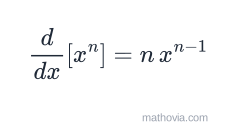
For any real number
In words: bring the exponent down in front, then subtract one from the exponent. That’s the whole rule. The notation
The rule applies to a power function, where the base is the variable
How to Use the Power Rule
- Write the term as a power of
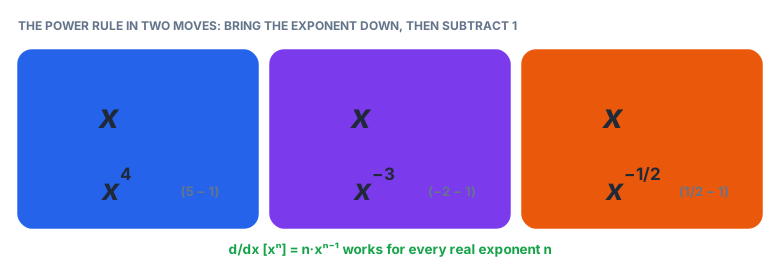
. Roots and fractions need rewriting first (more on that below). - Bring the exponent down and multiply it by any coefficient already there.
- Subtract 1 from the exponent. With negatives and fractions, this is where the arithmetic goes wrong, so take it slowly:
, not . - Tidy up, usually by turning negative and fractional exponents back into fractions and roots.
Here’s the power rule applied to a range of powers:
| Function | Derivative | Note |
|---|---|---|
| any real exponent works |
Rewriting Roots and Fractions First
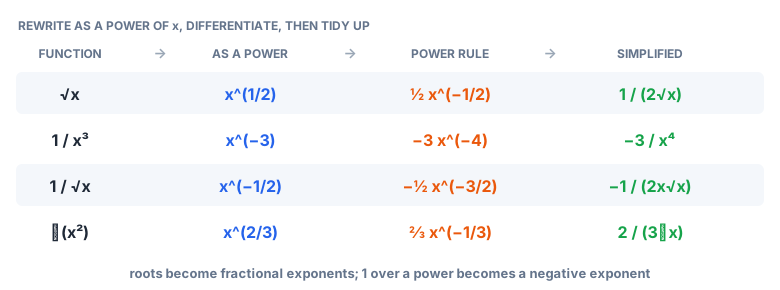
The power rule only sees
- A root is a fractional exponent:
and (see rational exponents). - One over a power is a negative exponent:
(see negative exponents).
So the derivative of
The Constant, Constant Multiple and Sum Rules
The power rule handles single powers of
| Rule | In symbols | Example |
|---|---|---|
| Constant rule | ||
| Constant multiple rule | ||
| Sum and difference rule |
Each has a simple picture. A constant’s graph is a flat line, so its slope is 0. Multiplying a function by 5 stretches its graph vertically by 5, so every slope is 5 times steeper. And when you add two functions, their rates of change add too. In practice this means you can differentiate a polynomial term by term, with constants dropping out and coefficients coming along for the ride.
What the Derivative Tells You on a Graph
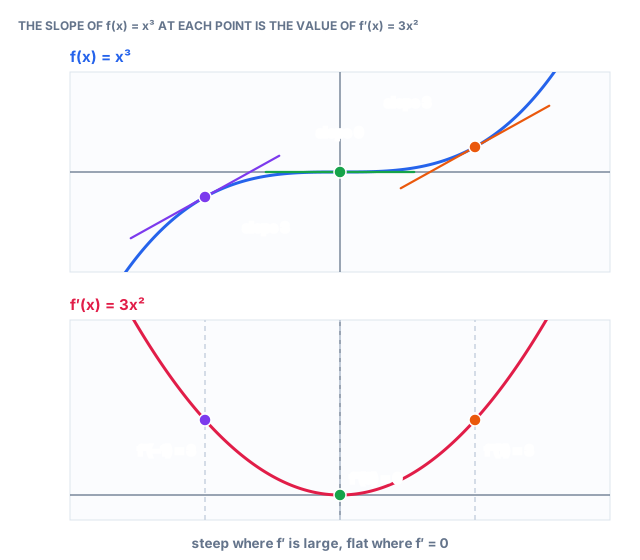
The power rule gives a whole new function, not just a number. For
Why the Power Rule Works
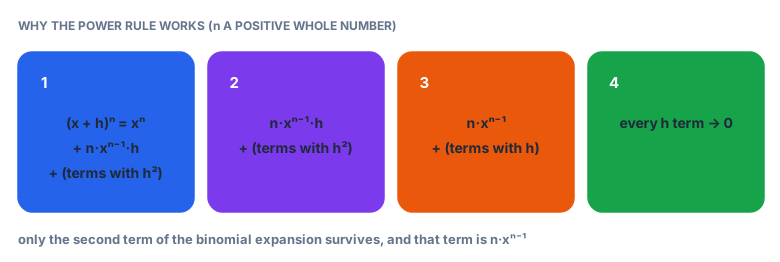
Here’s the derivation for a positive whole-number exponent
The binomial theorem expands
For negative, fractional and irrational exponents the rule is still true, but the proof needs tools from later in this chapter, logarithmic and implicit differentiation. In the meantime you’ve already checked two of those cases by hand:
Example 1: A Polynomial
Differentiate
Term by term:
Example 2: Roots and Fractions
Differentiate
Rewrite first:
Watch the sign on the second term:
Example 3: Multiply Out Before Differentiating
Differentiate
The derivative of a product is not the product of the derivatives. You’ll learn the product rule soon, but for now, expand first:
Example 4: Split a Fraction
Differentiate
When the denominator is a single term, divide it into each term of the numerator:
Example 5: The Equation of a Tangent Line
Find the tangent line to
The point is
Example 6: Where Is the Tangent Horizontal?
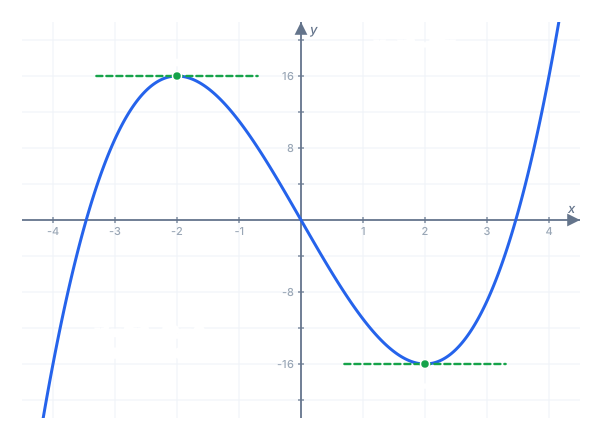
Find the points where
A horizontal line has slope 0, so solve
Example 7: Velocity From Position
A particle moves along a line with position
Velocity is the derivative of position:
Common Mistakes With the Power Rule
- Subtracting 1 the wrong way with negative exponents.
, not . One less than is . - Differentiating a root without rewriting it. Convert
to and to before using the rule. - Giving a constant a nonzero derivative.
, and in the derivative is 8, not or 0. - Using the power rule on exponentials.
and have the variable in the exponent, so the power rule doesn’t apply. - Differentiating products and quotients factor by factor.
, not . Simplify first, or use the product and quotient rules.
Practice Problems
Try each one before opening the answer. The practice set has 12 more with instant checking.
Problem 1. Differentiate
Show answer
Answer:
Problem 2. Differentiate
Show answer
Answer:
Problem 3. Differentiate
Show answer
Answer:
Problem 4. If
Show answer
Answer: 7
Problem 5. Find the tangent line to
Show answer
The point is
Answer:
The power rule handles sums of powers, but not products like