
Tangent turns an angle into a ratio: rise over run, opposite over adjacent. Inverse tan goes the other way, turning a ratio back into an angle. It’s the function behind every “what angle is this slope?” question, from the steepness of a roof or a wheelchair ramp to the direction of a vector. This calculator gives the angle in degrees and radians, recognizes exact values such as π/3, and handles the quadrant question that trips up plain arctan.
What inverse tan means
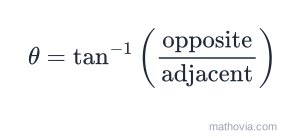
If tan θ = x, then θ = tan⁻¹(x). The little −1 means “inverse function”, not “to the power −1”, so tan⁻¹(x) is an angle, not 1/tan(x). The reciprocal of tangent has its own name, cotangent. Most calculators and programming languages call inverse tan arctan or atan.
How to calculate inverse tan (step by step)
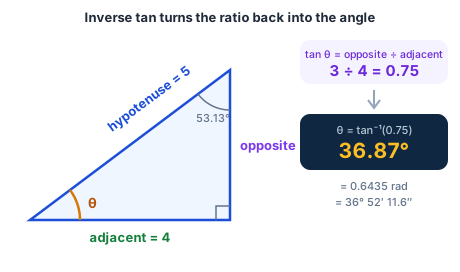
The calculator opens on tan⁻¹(0.75), the angle in a 3-4-5 right triangle.
Step One: Read the question as “which angle has this tangent?”
θ = tan⁻¹(0.75) means tan θ = 0.75
Step Two: Evaluate the arctan in radians
Inverse trig functions are computed in radians first.
tan⁻¹(0.75) = 0.643501 rad
Step Three: Convert to degrees
0.643501 × 180/π = 36.8699° (36° 52′ 11.6″)
Step Four: Check by taking the tangent
tan(36.8699°) = 0.75 ✓
That’s the smaller angle of a 3-4-5 triangle, since 3 ÷ 4 = 0.75. The right triangle calculator solves the rest of that triangle from any two values.
Exact values of inverse tan
A handful of tangent values give “nice” angles. These come up constantly in trigonometry homework, and the calculator recognizes them whether you type the decimal or the root:
| x | tan⁻¹(x) in degrees | In radians |
|---|---|---|
| 0 | 0° | 0 |
| 2 − √3 ≈ 0.2679 | 15° | π/12 |
| √2 − 1 ≈ 0.4142 | 22.5° | π/8 |
| 1/√3 = √3/3 ≈ 0.5774 | 30° | π/6 |
| 1 | 45° | π/4 |
| √3 ≈ 1.7321 | 60° | π/3 |
| √2 + 1 ≈ 2.4142 | 67.5° | 3π/8 |
| 2 + √3 ≈ 3.7321 | 75° | 5π/12 |
Negative inputs give the matching negative angle: tan⁻¹(−1) = −45° = −π/4.
Why arctan only answers between −90° and 90°
Tangent repeats every 180°: tan 45° = 1, but so does tan 225°. A function can only return one answer, so arctan is restricted to the one stretch where tangent takes every value exactly once, from −90° to 90°. As x grows, tan⁻¹(x) creeps toward 90° but never gets there. The horizontal asymptotes lesson explains this kind of flattening-out behavior.
Finding an angle from a point: atan2 and quadrants
That restriction causes real trouble when you want the direction of a point. Take (−4, 3), which sits in Quadrant II:
tan⁻¹(y/x) = tan⁻¹(3/−4) = −36.87°   ← points into Quadrant IV, wrong
correct angle = −36.87° + 180° = 143.13°
The fix depends on where the point is:
| Point is in | Angle from the positive x-axis |
|---|---|
| Quadrant I (x > 0, y > 0) | tan⁻¹(y/x) |
| Quadrant II (x < 0, y > 0) | tan⁻¹(y/x) + 180° |
| Quadrant III (x < 0, y < 0) | tan⁻¹(y/x) + 180° |
| Quadrant IV (x > 0, y < 0) | tan⁻¹(y/x) + 360° |
Programming languages bundle this logic into a function called atan2(y, x), which returns −180° to 180°. The point mode of the calculator gives both that and the 0–360° version, plus the reference angle and the point’s distance from the origin.
Inverse tan in the real world
Any slope written as rise over run turns into an angle with inverse tan:
roof pitch 6/12      →  tan⁻¹(0.5)    = 26.57°
ramp 1:12 (ADA max)  →  tan⁻¹(1/12)   = 4.76°
road grade 8%        →  tan⁻¹(0.08)   = 4.57°
That’s exactly what the roof pitch to degrees calculator does for carpenters. Surveyors, engineers and game developers use the same function to turn coordinates into bearings and directions.
In a video game, for example, pointing a character at the mouse cursor is one line of code: take the cursor’s position relative to the character as (x, y) and call atan2(y, x). The result is the rotation angle, correct in all four quadrants. Navigation works the same way. A ship 30 km east and 40 km north of port is on a bearing whose angle from due east is tan⁻¹(40/30) = 53.13°, which a navigator would then convert to a compass bearing measured from north.
Inverse tan, inverse sine or inverse cosine?
All three inverse functions find an angle in a right triangle. Which one you use depends on which two sides you know, not on the angle you want:
| You know | Use | 3-4-5 triangle example |
|---|---|---|
| opposite and adjacent | tan⁻¹(opposite ÷ adjacent) | tan⁻¹(3/4) = 36.87° |
| opposite and hypotenuse | sin⁻¹(opposite ÷ hypotenuse) | sin⁻¹(3/5) = 36.87° |
| adjacent and hypotenuse | cos⁻¹(adjacent ÷ hypotenuse) | cos⁻¹(4/5) = 36.87° |
All three give the same angle, which is a handy check. Inverse tan has one practical advantage. Its input can be any real number, while inverse sine and cosine only accept values from −1 to 1, so a measuring error can push sin⁻¹ or cos⁻¹ out of range but never tan⁻¹. That’s one reason surveyors and programmers lean on arctan.
The ranges differ too. sin⁻¹ and tan⁻¹ answer between −90° and 90°, while cos⁻¹ answers between 0° and 180°.
Slopes and their angles at a glance
A slope of 1 is 45°, but the relationship isn’t linear. Doubling the slope doesn’t double the angle:
| Slope (rise ÷ run) | Angle tan⁻¹(slope) |
|---|---|
| 0.1 | 5.71° |
| 0.25 | 14.04° |
| 0.5 | 26.57° |
| 1 | 45° |
| 2 | 63.43° |
| 3 | 71.57° |
| 10 | 84.29° |
Going from a slope of 1 to 10 only adds about 39°. The angle crawls toward 90° no matter how steep the slope gets.
For small slopes there’s a useful shortcut: tan⁻¹(x) ≈ x when x is in radians and small. tan⁻¹(0.08) = 0.0798 rad, almost exactly 0.08. Engineers use this to estimate gentle grades in their heads. Multiply the slope by 57.3 to get degrees, so an 8% grade is about 4.6°. The approximation drifts as the slope grows: at 0.5 the true answer is 0.4636 rad, about 7% less than 0.5.
Common mistakes with inverse tan
- Computing 1/tan instead of tan⁻¹. They’re different functions. Use the tan⁻¹ (often shift + tan) key.
- Leaving the calculator in the wrong mode. In radian mode tan⁻¹(1) shows 0.7854, not 45. Both are right, in different units.
- Flipping the ratio. tan θ is opposite ÷ adjacent. Adjacent ÷ opposite gives the other acute angle.
- Ignoring the quadrant. For a direction or a vector, tan⁻¹(y/x) alone is only right in Quadrants I and IV.
- Expecting an angle of 90°. tan 90° is undefined, so no finite input gives exactly 90°.