
Finding where a polynomial equals zero is one of the most useful things you can do with it. The zeros are the x-intercepts of the graph, the solutions of the equation, and the building blocks of the factored form. Quadratics have a formula, but cubics and beyond need a method: guess smart candidates, test them, divide them out. This calculator runs that method for you, keeps every answer exact when it can, and shows the work.
What the zeros of a polynomial tell you
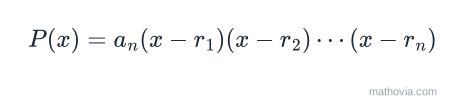
Every polynomial of degree n can be written as its leading coefficient times n factors, one for each zero r. That’s the Fundamental Theorem of Algebra, and it means a degree-n polynomial has exactly n zeros, as long as you count repeats and complex numbers. Each zero shows up as one of three kinds:
| Kind | Example | On the graph |
|---|---|---|
| Rational | 3, −2, 1/2 | x-intercept at that point |
| Irrational | 1 + √2 ≈ 2.4142 | x-intercept, but the value never ends |
| Complex | 2i, (−1 + i√3)/2 | no x-intercept, the graph misses the axis |
How to find the zeros of a polynomial (step by step)
The calculator opens on P(x) = x³ − 2x² − 5x + 6, a cubic with three whole-number zeros.
Step One: List the possible rational zeros
The Rational Root Theorem says any rational zero is a factor of the constant term divided by a factor of the leading coefficient. Here that’s factors of 6 over factors of 1.
candidates: ±1, ±2, ±3, ±6
The Rational Root Theorem lesson explains why this list has to contain every rational zero.
Step Two: Test the candidates
Substitute each one until the polynomial comes out to 0.
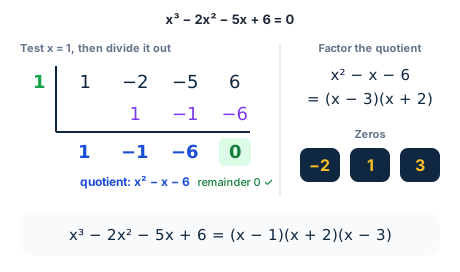
P(1) = 1 − 2 − 5 + 6 = 0 ✓ so x = 1 is a zero
Step Three: Divide out the zero with synthetic division
Dividing by (x − 1) drops the degree by one, leaving a quadratic.
1 │ 1   −2   −5    6
  │      1   −1   −6
  └──────────────────
    1   −1   −6    0      →  x² − x − 6
Synthetic division is long division with only the coefficients, which is why it’s fast.
Step Four: Solve what’s left
The quotient factors, or you can keep testing candidates:
x² − x − 6 = (x − 3)(x + 2) → x = 3 and x = −2
So the zeros are −2, 1 and 3, and the factored form is (x − 1)(x + 2)(x − 3). The graph crosses the x-axis at exactly those three points.
When the leading coefficient isn’t 1
Fractions join the candidate list. For 2x³ − 3x² − 11x + 6, the candidates are factors of 6 over factors of 2:
±1, ±2, ±3, ±6, ±1/2, ±3/2
zeros: −2, 1/2, 3
factored: (2x − 1)(x + 2)(x − 3)
The calculator writes a zero like 1/2 as the factor (2x − 1) rather than (x − 1/2), so the factored form keeps whole-number coefficients.
Irrational and complex zeros
Once no rational candidate works, a leftover quadratic is solved with the quadratic formula, which gives exact radical answers:
x² − 2x − 1 = 0        →  x = 1 ± √2          (≈ −0.4142 and 2.4142)
x³ − 1 = 0             →  x = 1 and x = (−1 ± i√3)/2
x² + 4 = 0             →  x = ±2i
Complex zeros of a polynomial with real coefficients always come in conjugate pairs. If a + bi is a zero, so is a − bi, which is why x³ − 1 has one real zero and two complex ones. The complex zeros lesson covers this pairing rule.
For a leftover of degree 3 or more with no rational zeros, such as x⁵ − x − 1, there’s no general formula (and from degree 5 on, there can’t be one). The calculator then finds the zeros numerically and shows them to six decimal places: x⁵ − x − 1 has one real zero near 1.167304 and four complex ones.
Multiplicity: crossing vs touching
A zero can repeat. In (x − 1)²(x + 2) = x³ − 3x + 2, the zero 1 appears twice, so it has multiplicity 2. The calculator spots this by dividing the same candidate out more than once.
Multiplicity shows up in the graph. At a zero with odd multiplicity the curve crosses the x-axis. At even multiplicity it touches the axis and turns back, like the bottom of a parabola. The graph marks these in different colors so you can tell them apart at a glance. For a quadratic the turning point is the vertex, which the vertex form calculator finds directly.
Checking your zeros without solving
Two quick tests catch most mistakes before you even finish.
Descartes’ Rule of Signs predicts how many positive and negative zeros to expect. Count the sign changes in P(x), then in P(−x). The number of positive zeros equals the first count or is smaller by an even number, and the same goes for negative zeros with the second count.
P(x)  = x³ − 2x² − 5x + 6      signs + − − +   2 changes → 2 or 0 positive zeros
P(−x) = −x³ − 2x² + 5x + 6     signs − − + +   1 change  → exactly 1 negative zero
actual zeros: 1 and 3 (positive), −2 (negative)  ✓
Sum and product of the zeros. For a cubic x³ + bx² + cx + d with leading coefficient 1, the zeros always add up to −b and multiply to −d. Here b = −2 and d = 6:
sum:     −2 + 1 + 3 = 2   = −(−2)  ✓
product: (−2)(1)(3) = −6  = −6     ✓
If either check fails, a zero is missing or wrong.
The graph gives a third check. A cubic with a positive leading coefficient starts low on the left and ends high on the right, so it must cross the x-axis at least once. Between the zeros, the sign of P(x) alternates at each crossing: P(0) = 6 is positive, so the curve is above the axis between −2 and 1, below it between 1 and 3, and above it again after 3. Plotting a few of those values by hand is a quick way to confirm the calculator’s picture. The Descartes’ Rule of Signs lesson explains why counting sign changes works.
Common mistakes when finding zeros
- Forgetting the negative candidates. The theorem gives ±p/q. Test −2 as well as 2.
- Stopping after one zero. Divide it out and keep going until the quotient is a quadratic or linear.
- Missing a zero at 0. If there’s no constant term, factor out x first. x⁴ + x³ = x³(x + 1) has 0 as a zero three times.
- Dropping complex zeros. “No x-intercepts” doesn’t mean “no zeros”. x² + 4 still has two.
- Skipping a placeholder in synthetic division. x³ − 1 has no x² or x term, so write 1, 0, 0, −1.
For more practice, the polynomial zeros practice problems generate new polynomials to solve, with answers.